Gyalshing districtHQ GyalshingBest Mar – May · Oct – Dec18 places5 packages10 stays
West Sikkim in short
West Sikkim, now Gyalshing district, is where the Sikkim kingdom was founded at Yuksom in 1642. Base yourself in Pelling (2,150 m) for Kangchenjunga views, Pemayangtse and the Rabdentse ruins, then go on to Yuksom, Khecheopalri Lake, Tashiding and the Goecha La trail. Plan 3–5 nights.
Best months
Mid-Oct to mid-Dec and Mar to May
Headquarters
Gyalshing, 10 km below Pelling
Nearest airport
Bagdogra (IXB) ≈ 145 km to Pelling · 5–6 h
Nearest railhead
NJP ≈ 140 km to Pelling · 5–6 h
Altitude range
About 400 m (Rangeet valley) – 8,586 m (Kangchenjunga)
Languages
Nepali, Limbu, Lepcha, Bhutia (Sikkimese), Hindi, English
Permits
None for Indians in Pelling and Yuksom; trek permits for Dzongri and Goecha La; foreigners need the RAP
West Sikkim is the part of the state where history sits closest to the surface. In 1642 three Tibetan lamas met at Yuksom and consecrated Phuntsog Namgyal as the first Chogyal on a stone throne at Norbugang. His son moved the court to Rabdentse, whose ruins lie in a forest below Pelling. Pemayangtse, the senior monastery of the Nyingma order in Sikkim, Dubdi, Sanga Choeling and Tashiding all belong to that first century of the kingdom.
Since the December 2021 reorganisation, the old West district has been split in two. The northern part is Gyalshing district, with its headquarters at Gyalshing, 10 km below Pelling. The southern part, around Soreng, Rinchenpong and Kaluk, became Soreng district. Travellers still say 'West Sikkim', and so do we, but on this site Rinchenpong, Kaluk, Hilley and Varsey sit under Soreng.
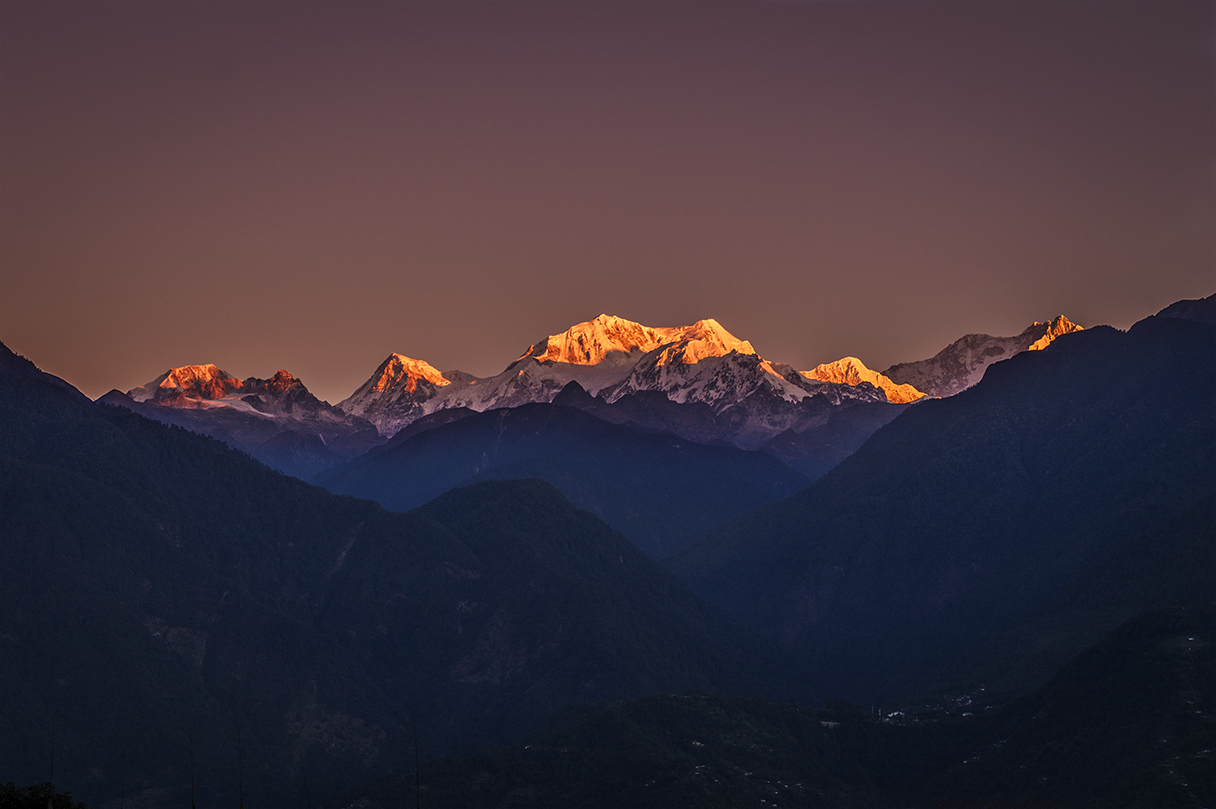
Pelling, at about 2,150 m, is the base most people use. On a clear morning between October and March it faces Kangchenjunga (8,586 m), Kabru and Pandim across the Rangeet valley. From Pelling, day trips reach Khecheopalri Lake, the Kanchenjunga Falls, Yuksom, Darap, Dentam, the Singshore Bridge and Uttarey on the Singalila Ridge by the Nepal border.
North of Yuksom lies Khangchendzonga National Park, which in 2016 became India's first UNESCO mixed World Heritage Site, listed for both its nature and its sacred meaning. The Dzongri and Goecha La trail starts in Yuksom. The district's people are mainly Limbu, Nepali, Lepcha and Bhutia, and homestays in Darap, Yuksom and Uttarey are the easiest way to meet them.
Highlights
What brings people here
Pemayangtse and the Rabdentse ruins
Walk from Pemayangtse, the senior Nyingma monastery of Sikkim at about 2,085 m, through forest to the ruins of Rabdentse, the royal capital from 1670. On the top floor of Pemayangtse sits the seven-tiered wooden model of Zangdok Palri, Guru Padmasambhava's heavenly palace, made by one lama.
Yuksom, where the kingdom began
See the stone throne at Norbugang where Phuntsog Namgyal was consecrated in 1642, the Kathok Lake whose water anointed him, and climb an hour to Dubdi, dated to 1701 and called the oldest monastery in Sikkim. Yuksom is also the gateway to Khangchendzonga National Park.
Khecheopalri, the sacred lake
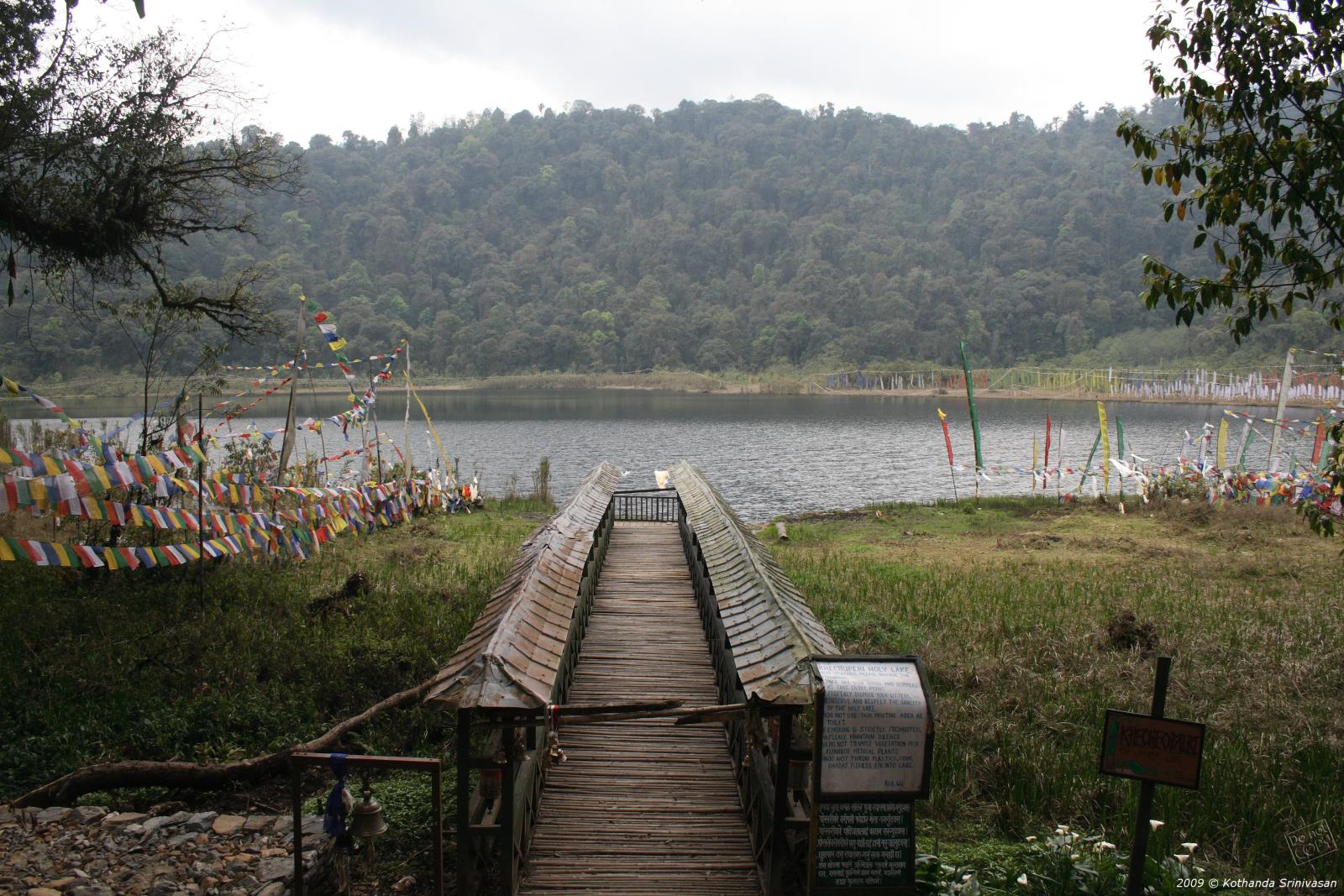
A quiet lake at about 1,700 m in a forest bowl, sacred to Buddhists, Hindus and Lepcha. Walk the wooden jetty past prayer wheels, keep silent, and notice how few leaves float on the water. Stay in a village homestay to see it at dawn.
Tashiding and the Bumchu vase
On a heart-shaped hill between the Rathong Chu and Rangeet, Tashiding's chortens and carved mani stones host Bumchu each February or March, when lamas open a sacred vase and read the year's fortune in its water level.
Goecha La trail into the park
The trek from Yuksom through Sachen, Tshoka and Dzongri to Thansing and the Goecha La viewpoints faces Kangchenjunga's south-east side. Plan 8–10 days with a registered agency and guide; most groups turn back at View Point 1 at about 4,600 m.
Singshore Bridge and Uttarey
Cross the Singshore Bridge, about 240 m long and 100 m above the gorge, often called the highest in Sikkim, then climb to Uttarey at about 2,000 m on the Singalila Ridge for forest walks and quiet homestays near the Nepal border.
A rooted story
Three lamas, one throne and the first Chogyal
By the 1640s, Tibetan Buddhism was spreading south across the Himalaya, and three lamas of the Nyingma tradition, Lhatsun Chempo, Sempa Chempo and Rigzin Chempo, came into Sikkim from the north, west and south. According to Sikkim's own histories, summarised in Wikipedia's articles on Yuksom and Phuntsog Namgyal, they met at Yuksom, whose name is usually translated as 'meeting place of the three learned monks'. Needing a lay ruler to protect the faith, they went in search of Phuntsog Namgyal, a fifth-generation descendant of Khye Bumsa, a 13th-century prince from Kham in eastern Tibet, and found him near present-day Gangtok. In 1642, at the age of 38, he was consecrated as the first Chogyal, 'religious king', on a pine-covered hill at Norbugang. He was anointed with water from a sacred urn, and the four-seat stone throne where the lamas and the king sat still stands under a large tree. A chorten nearby is said to hold earth and water from across Sikkim. Yuksom served as the capital until 1670, when the second Chogyal, Tensung Namgyal, moved to Rabdentse near Pelling. The Namgyal dynasty ruled Sikkim until it joined India in 1975.
Almost everyone reaches West Sikkim by road. From Bagdogra airport (IXB) or New Jalpaiguri (NJP) railway station, Pelling is about 135–145 km and 5–6 hours by private car via Sevoke, Melli, Jorethang, Legship and Gyalshing; indicatively ₹5,500–7,500 a car. Shared jeeps from Siliguri run to Gyalshing for about ₹500–650 a seat. From Gangtok it is about 115 km and 5–6 hours, via Singtam and Ravangla or Jorethang; shared jeeps cost about ₹350–500 to Gyalshing, and a private car ₹5,000–6,500. Pakyong Airport has had no scheduled flights since June 2024, and the Sevoke–Rangpo railway is not yet open. NH10 closes after monsoon slides; the alternative is via Darjeeling to Jorethang. Check current status before you travel.
Indian travellers need no permit for Pelling, Yuksom, Khecheopalri, Tashiding or Uttarey. The Dzongri and Goecha La trek needs a Khangchendzonga National Park permit and fees, arranged at Yuksom through a registered trekking agency with a licensed guide. Foreign nationals need the Restricted Area Permit to enter Sikkim, applied for online via the e-FRRO portal after arriving in India, and a Protected Area Permit in a group of two or more for the Dzongri–Goecha La trek. Sikkim charges a ₹50 per tourist fee at check-in. Check current status before you travel.
On a budget, shared jeeps, a budget hotel in Pelling (₹1,500–3,000 a room) and homestays in Yuksom or Uttarey (₹1,200–2,200 per person with meals) keep a 3-night West Sikkim trip near ₹6,000–9,000 per person from Gangtok, plus a shared sightseeing car. At mid level, a private car for the circuit (₹3,500–5,000 a day) and a comfort hotel (₹5,000–11,000 a room) take it to roughly ₹18,000–30,000 per person for 3–4 nights. Premium stays such as The Elgin Mount Pandim run ₹12,000–22,000 a room. A Goecha La group trek costs about ₹15,000–30,000 per person for 8–10 days. All figures indicative.
Shared jeep Gangtok–GyalshingPelling
≈ ₹350–500 a seat
Private car Gangtok–PellingPelling
≈ ₹5,000–6,500 a car
Shared jeep Pelling–YuksomYuksom
≈ ₹150–250 a seat
Private car Pelling–YuksomYuksom
≈ ₹2,500–3,500 one way
Dzongri group trek (5–6 days)Dzongri and Goecha La
≈ ₹13,000–18,000 per person
Goecha La group trek (9 walking days)Dzongri and Goecha La
≈ ₹22,000–30,000 per person plus GST
Private car Pelling–Hee BermiokHee Bermiok
≈ ₹2,000–3,000 one way
Shared jeep Jorethang–Hee BermiokHee Bermiok
≈ ₹150–250 a seat
Shared jeep Gyalshing–UttareyUttarey
≈ ₹150–250 a seat
Private car Pelling–UttareyUttarey
≈ ₹2,500–3,500 one way
Indicative 2026 prices. Fares, fees and room rates change with season: check current status before you travel.
Mostly. In December 2021 Sikkim reorganised from four districts to six. The old West Sikkim district was split into Gyalshing district (the north, with Pelling, Yuksom, Tashiding, Dentam and Uttarey) and Soreng district (the south, with Soreng, Rinchenpong, Kaluk, Hilley and Varsey). Travellers still say West Sikkim for both, and so do many drivers and hotels.
How many days do I need in West Sikkim?
Plan 3–5 nights. Two nights in Pelling cover Pemayangtse, Rabdentse, Sanga Choeling and the Skywalk plus a day to Khecheopalri and Yuksom. A night in Yuksom adds Dubdi and Tashiding without rushing. Add a night in Uttarey or Darap for village life, or 8–10 days if you plan the Goecha La trek.
What is the best time to visit Pelling and West Sikkim?
Mid-October to mid-December gives the clearest views of Kangchenjunga, and March to May brings rhododendrons and pleasant weather. January and February are cold but often clear. June to September is monsoon: slides, leeches and cloud, though hotels are cheapest. Check current status before you travel in shoulder months.
How far is Pelling from Gangtok?
About 115 km, or 5–6 hours by road, via Singtam and Ravangla or via Melli and Jorethang. A private car costs indicatively ₹5,000–6,500, and shared jeeps to Gyalshing about ₹350–500 a seat. NH10 between Gangtok and Singtam can close in the monsoon, so check current status before you travel.
Do I need a permit for Pelling or Yuksom?
Indian nationals need no permit for Pelling, Yuksom, Khecheopalri or Tashiding. The Dzongri–Goecha La trek requires a Khangchendzonga National Park permit, arranged through a registered agency at Yuksom. Foreign nationals need the Restricted Area Permit for Sikkim, applied for online, and a Protected Area Permit for the trek. Check current status before you travel.
Can I see Kangchenjunga from Pelling?
Yes, on clear days. Pelling faces Kangchenjunga (8,586 m), Kabru and Pandim across the Rangeet valley, and the helipad viewpoint in Upper Pelling and the Pemayangtse ridge give the widest views. The best odds are at sunrise from October to March. In the monsoon the range can stay hidden for weeks.
Is West Sikkim good for a family holiday?
Yes. The roads are long but the sights are gentle: monasteries, a sacred lake, waterfalls, the Skywalk and the Singshore Bridge, with short walks rather than hard hikes. Altitudes stay around 1,500–2,200 m, which suits children and seniors. Plan shorter driving days and avoid the monsoon months.
How much does a West Sikkim trip cost?
Indicatively, a budget 3-night trip from Gangtok with shared jeeps and budget rooms costs about ₹6,000–9,000 per person. A mid-range trip with a private car and good hotels runs ₹18,000–30,000 per person for 3–4 nights. Premium stays and private SUVs cost more. A Goecha La trek with an agency is about ₹15,000–30,000.
Can foreigners do the Goecha La trek?
Yes. Foreign nationals can trek to Dzongri and Goecha La with a Protected Area Permit, in a group of two or more, through a registered Sikkim trekking agency, in addition to the Restricted Area Permit for entering Sikkim, now applied for online. Rules change, so check current status before you travel and let us handle the paperwork.
Little known
Things most visitors to West Sikkim never hear
Each one is sourced, so you can check it yourself.
Rabdentse, Sikkim's second capital from 1670, lies in ruins below Pelling. Its stone throne, the Namphogang, was used for judicial pronouncements, and the Archaeological Survey of India protects the site as a monument of national importance.
Source: Wikipedia: Rabdentse
Pemayangtse Monastery is by tradition reserved for ta-tshang, 'monks of pure lineage', who must be celibate and without physical deformity. It heads the Nyingma monasteries of Sikkim.
Source: Wikipedia: Pemayangtse Monastery
The Lepcha name for Khecheopalri Lake is Sho Dzo Sho, 'Oh Lady, sit here'. Birds are said to pick fallen leaves off its surface, and the lake has been protected by state notification since 2001.
Source: Wikipedia: Khecheopalri Lake
Khangchendzonga National Park, established in 1977 and covering about 1,784 km², became India's first mixed (natural and cultural) UNESCO World Heritage Site in July 2016.
Source: UNESCO; Wikipedia: Khangchendzonga National Park
The Limbu scholar Te-ongsi Sirijunga, who revived the Limbu script in the 18th century, was killed at Hee-Martam in West Sikkim around 1741, according to his Wikipedia biography.
One person to callFrom Bagdogra or NJP until you are back
No payment to startA deposit only when you book
Get my price
Plan West Sikkim with people who live here
Who is travelling, when, and roughly what you want to spend. The Gangtok desk replies within one working day with a day-by-day plan and an itemised price.
No payment to start
Permits handled through registered partners
Every hotel, car and fee listed
Price my Sikkim trip
Tell us dates, people and budget. You get a day-by-day plan and an itemised price within one working day.