Khecheopalri is a sacred lake at about 1,700 m in a forest bowl, roughly 30 km from Pelling off the Yuksom road. Revered by Buddhists, Hindus and Lepcha, it is known as a wishing lake where, by local tradition, birds pick fallen leaves off the water. Allow 1–2 hours, or stay a night in the village.
Lepcha nameSho Dzo ShoMeans: Oh Lady, sit hereSource: Wikipedia: Khecheopalri Lake
Best months
Oct–May
Nights we suggest
0–1
From Gangtok
≈ 145 km · 6–7 h (≈ 30 km from Pelling)
Altitude
1,700 m
Known for
Sacred wishing lake, prayer wheels, leaf-free legend
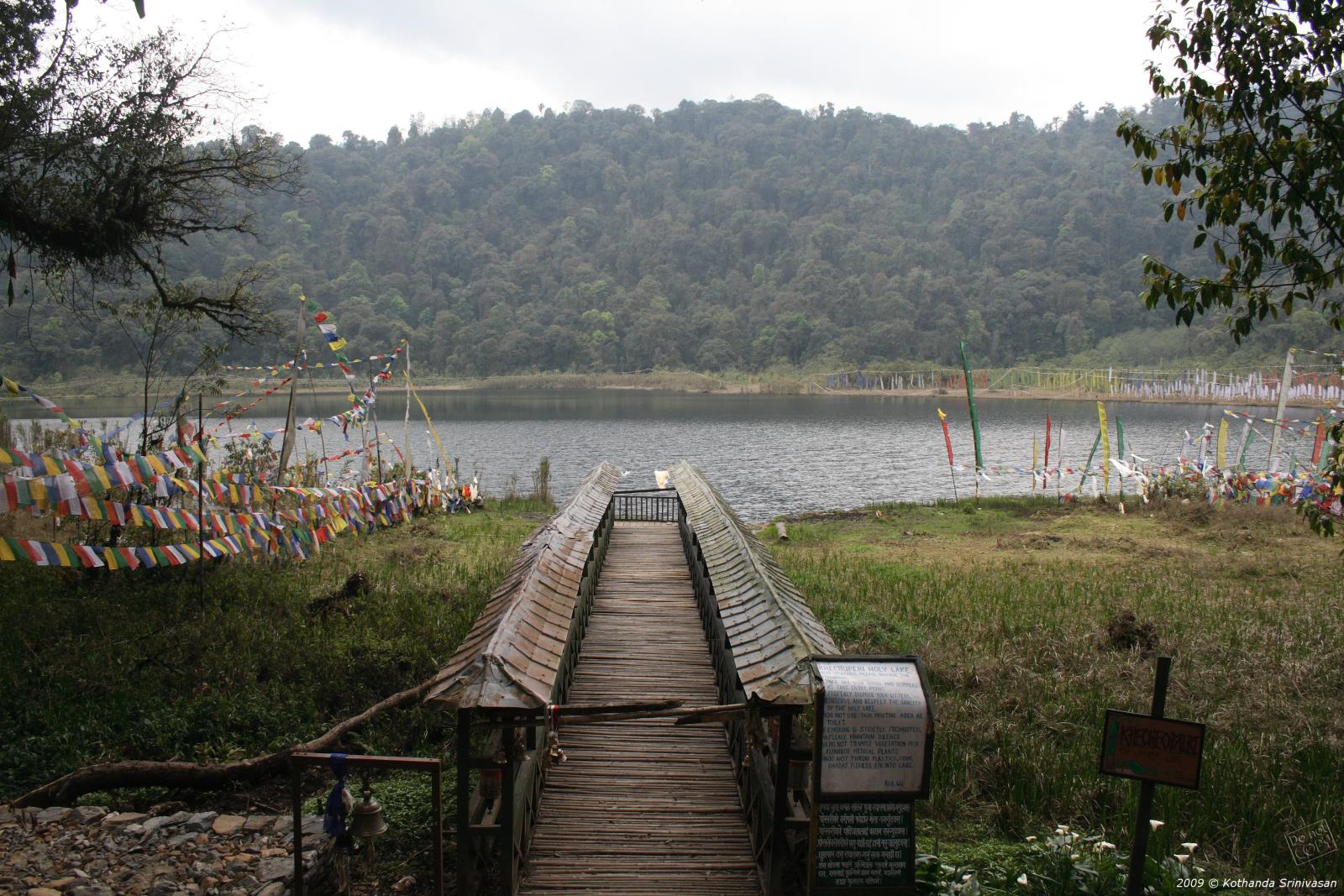
Khecheopalri Lake lies in a bowl of forested hills above Khecheopalri village, about 30 km from Pelling by a branch road off the Pelling–Yuksom route. A short paved path from the car park leads through prayer flags and a row of prayer wheels to a wooden jetty over the water. It is quiet even on busy days; signs ask visitors to keep silent.
The lake's name comes from Kha-Chot-Palri, which Wikipedia explains as the palace of the khecheo, the flying yoginis or dakinis, and it is described as the heaven of Guru Padmasambhava, who is said to have preached to sixty-four yoginis here. The Lepcha call it Sho Dzo Sho, 'Oh Lady, sit here', and Hindus also revere it. People from all these traditions come to make wishes.
The lake has been protected under a Government of Sikkim notification since 2001. Swimming, boating, fishing and feeding fish are not allowed. The best-known feature is the clean surface: by local tradition, birds pick up any leaf that falls on it. The village above has homestays and a small monastery, and old footpaths link it to Yuksom and Pelling.
Highlights
What to see and do
The wooden jetty
A wooden walkway leads over the water past prayer wheels and flags, so visitors can reach the lake without trampling the shore. Walk out slowly and quietly; the stillness is the point, and in the early morning you may have it to yourself.
Watching for leaves
By local tradition, birds pick up fallen leaves from the surface. Stand on the jetty in autumn, when leaves drop, and look at how clear the water stays. Whatever the explanation, the lake is noticeably clean for a forest pool.
Khecheopalri village and gompa
Above the lake, Khecheopalri village has a small monastery and homestays. Staying overnight lets you walk down at dawn, before day visitors arrive from Pelling, and hear the forest wake up.
Old footpaths to Yuksom
Before roads, villagers walked between Khecheopalri, Yuksom and Pelling. With a local guide you can walk part of the old trail through forest and fields, a day hike of several hours that ends in Yuksom.
Maghe Purne full moon
On the Magh full moon, usually in January or February, pilgrims gather to pray and float butter lamps on bamboo rafts. Sources differ on the date, so confirm it locally before planning a festival visit.
The story of Khecheopalri Lake
Conch shells from the sky, and a lake that keeps itself clean
Several stories gather around Khecheopalri, and Wikipedia's article records more than one. In a Lepcha tradition, a couple saw conch shells falling from the sky, the ground trembled and spring water rose to form the lake, which became the home of Tshomen Gyalmo, a protective goddess of the Dharma blessed by Tara. Buddhists know the lake as a place of Guru Padmasambhava and the goddess Tara; some say its outline, seen from the hills above, resembles a footprint, variously described as Tara's, the Buddha's or Shiva's. The detail most visitors hear is about leaves. Although the lake is ringed by forest, by local tradition hardly a leaf stays on the surface, because birds pick them up as soon as they fall. Stand on the jetty in autumn and see for yourself. Whatever you make of it, the water is kept clean by rules too: since 2001 the lake has been protected by state notification.
Source: Wikipedia: Khecheopalri Lake
Little known
Things most visitors never hear
The lake has been a protected site under Government of Sikkim Notification 701/Home/2001, dated 20 September 2001, which is why boating, swimming and fishing are banned.
Source: Wikipedia: Khecheopalri Lake
Some say the lake's outline seen from the surrounding hills resembles a footprint, described in different traditions as Tara's, the Buddha's or Shiva's.
Source: Wikipedia: Khecheopalri Lake
Padmasambhava is said to have preached to sixty-four yoginis at the lake, which gives it the name 'heaven of Padmasambhava'.
Shared jeeps to Khecheopalri run from Gyalshing or Pelling only a few times a day, mostly in the afternoon going up and the morning coming down, indicatively ₹100–200 a seat. They suit travellers staying overnight in the village.
Private car
Most visitors come on a full-day tour from Pelling that includes the lake, the Kanchenjunga Falls and Yuksom, indicatively ₹3,500–5,000 per car. The lake alone costs about ₹2,000–2,800 return. Pelling to the lake is about 30 km, 1.5 hours.
From Bagdogra / NJP
Reach Pelling first, about 135–145 km and 5–6 hours via Melli, Jorethang, Legship and Gyalshing, and visit the lake the next day. Check current status before you travel in the monsoon.
Permits in West Sikkim
Indian travellers need no permit for Pelling, Yuksom, Khecheopalri, Tashiding or Uttarey. The Dzongri and Goecha La trek needs a Khangchendzonga National Park permit and fees, arranged at Yuksom through a registered trekking agency with a licensed guide. Foreign nationals need the Restricted Area Permit to enter Sikkim, applied for online via the e-FRRO portal after arriving in India, and a Protected Area Permit in a group of two or more for the Dzongri–Goecha La trek. Sikkim charges a ₹50 per tourist fee at check-in. Check current status before you travel.
Most travellers stay in Pelling, 1.5 hours away, at hotels such as Hotel Garuda (budget), Norbu Ghang Retreat and Spa (comfort) or The Elgin Mount Pandim (premium). For a quieter night, Khecheopalri village has simple family homestays, and Daragaon Village Retreat in Darap sits on the same road. Yuksom, about an hour on, has Hotel Tashigang, Yuksum Residency and village homestays.
About 30 km, roughly 1.5 hours by car via Darap and the branch road off the Pelling–Yuksom route. A car for the lake alone costs indicatively ₹2,000–2,800 return, or ₹3,500–5,000 for a full day including the Kanchenjunga Falls and Yuksom.
Why is Khecheopalri Lake famous?
It is a sacred lake for Buddhists, Hindus and Lepcha, known as a wish-fulfilling lake. By local tradition birds pick fallen leaves off its surface, so the water stays clean. It is also linked to Guru Padmasambhava and the goddess Tara.
What is the entry fee for Khecheopalri Lake?
There is usually a small entry or parking fee, indicatively ₹20–50. Fees change, so check current status before you travel. Carry small notes, as digital payment is not always available.
Can I do boating at Khecheopalri Lake?
No. Boating, swimming, fishing and feeding fish are all prohibited. The lake has been protected under a Government of Sikkim notification since 2001. Visitors reach the water by a wooden jetty and are asked to stay quiet.
What is the best time to visit Khecheopalri Lake?
October to May, in the morning or late afternoon. Autumn and winter are clear and quiet; spring brings flowers in the forest. The monsoon from June to September brings slides on the road and leeches on the path, though the forest is green.
Is Khecheopalri Lake worth visiting?
Yes, for its calm and its place in Sikkim's sacred landscape. It is not a big scenic lake like Tsomgo; it is a small, still pool in forest, and its appeal is quiet and stories. It fits easily into a Pelling–Yuksom day.
What is the legend of Khecheopalri Lake?
Wikipedia records a Lepcha tradition in which conch shells fell from the sky, the ground shook and spring water rose to form the lake, home of a protective goddess. Buddhists link it with Padmasambhava and Tara. By local tradition, birds remove leaves from its surface.
Can I combine Khecheopalri Lake with Yuksom?
Yes. The lake is on a branch road off the Pelling–Yuksom route, and most visitors see it on the same day as the Kanchenjunga Falls, Norbugang and Kathok Lake in Yuksom. For Dubdi Monastery too, stay a night in Yuksom.
Is there accommodation at Khecheopalri?
Yes, simple family homestays in Khecheopalri village above the lake, indicatively ₹1,200–2,000 per person with meals. For more comfort, stay in Pelling, 1.5 hours away, or Yuksom, about an hour on.
Every cost shownRooms, car, permits and our fee, itemised
One person to callFrom Bagdogra or NJP until you are back
No payment to startA deposit only when you book
Get my price
Want Khecheopalri Lake in your plan?
Tell us your dates, who is travelling and roughly what you want to spend. We reply within one working day with a day-by-day route and an itemised price.
No payment to start
Permits handled through registered partners
Every hotel, car and fee listed
Price my Sikkim trip
Tell us dates, people and budget. You get a day-by-day plan and an itemised price within one working day.