Mangan districtHQ ManganBest Apr – May · Oct – Nov18 places11 packages10 stays
North Sikkim in short
North Sikkim, officially Mangan district, is Sikkim's largest and emptiest district: Lepcha villages in Dzongu, the self-governing Bhutia villages of Lachung and Lachen, Yumthang's rhododendron valley and Gurudongmar Lake near the Tibet border. Go October–November or April–May, with permits, a registered agent and at least two nights.
Best months
October–November and April–May
Headquarters
Mangan (≈ 956 m), ≈ 67 km · 2.5–3 h from Gangtok
Nearest airport
Bagdogra (IXB) ≈ 180 km to Mangan
Nearest railhead
NJP ≈ 175 km to Mangan
Altitude range
≈ 700 m – 8,586 m
Languages
Lepcha, Nepali, Sikkimese (Bhutia), Hindi, English
Permits
Protected area permit via a registered agent for Lachung and Lachen; Dzongu permit for the Lepcha reserve
North Sikkim begins about 15 km out of Gangtok, just before Kabi, and runs north to the Tibetan plateau. In between, the North Sikkim Highway follows the Teesta past Phodong, Mangan and Chungthang, where the Lachen and Lachung rivers meet. Since December 2021 the district has been called Mangan district, after its headquarters town, but travellers and drivers still say North Sikkim. It is the largest district in the state and the least crowded: the 2011 census counted about 43,700 people, roughly ten per square kilometre.
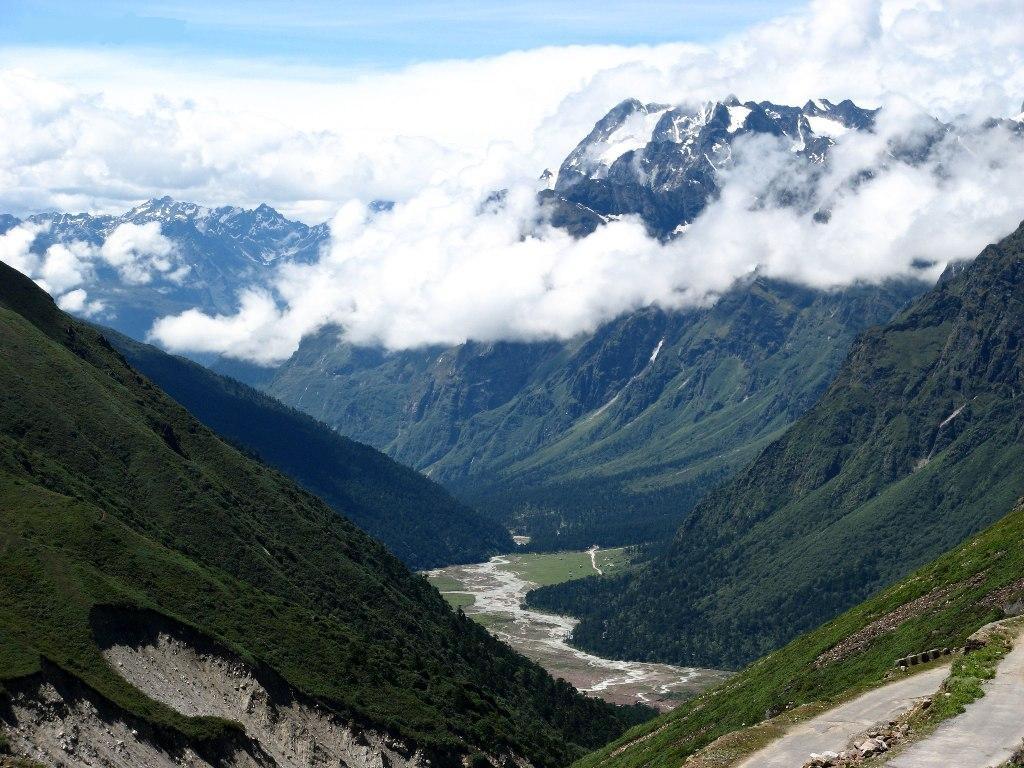
Most visitors come for two valleys. The Lachung valley leads to Yumthang, a river meadow at about 3,564 m that flowers with rhododendron and primula from April, and on to Zero Point at about 4,660 m. The Lachen valley climbs past Thangu to Gurudongmar Lake, a sacred lake near the border at roughly 5,150–5,430 m. Both villages are governed by their own traditional councils, the Dzumsa, which is unique in India.
South of Mangan, across the Teesta, lies Dzongu, a reserve set aside for the Lepcha people, Sikkim's earliest known inhabitants. Here you stay with Lepcha families in homestays, walk among cardamom fields and, every three years, can join pilgrims walking to Tholung Monastery for the airing of its relics. Closer to Gangtok, Kabi Lungchok marks a 13th-century blood-brotherhood pact between the Lepcha and Bhutia, and Phodong and Labrang monasteries hold some of Sikkim's oldest murals.
North Sikkim is also fragile. In October 2023 a glacial lake outburst from South Lhonak Lake destroyed the Teesta III dam at Chungthang, and slides closed Lachen for long stretches in 2024–26. Roads are rebuilt, but every trip still depends on weather, permits and a registered vehicle. We plan around that honestly, and we tell you when not to go.
Highlights
What brings people here
Yumthang Valley and Zero Point
A river meadow at about 3,564 m, reached through the Shingba rhododendron forests 24 km above Lachung. From late April it flowers pink, red and white; in winter it lies under snow. Zero Point (Yumesamdong), 23 km further at about 4,660 m, is where the civilian road ends.
Gurudongmar Lake
A glacier-fed lake near the Tibet border, sacred to Buddhists, who link it with Guru Padmasambhava. The Sikkim government gives its altitude as 5,430 m. It freezes from about November to May, and is reached only on a pre-dawn drive from Lachen, Indians only.
Dzongu Lepcha homestays
Stay with Lepcha families inside the reserve across the Teesta from Mangan. Walk among large cardamom fields, eat nettle soup and millet, and hear how Dzongu's young people opposed big dams in 2007–08 and then built a homestay economy.
Lachung, a Dzumsa village
Joseph Hooker called Lachung the most picturesque village of Sikkim in his Himalayan Journals. Its wooden houses, apple orchards and 1880 Nyingma monastery sit at about 2,700 m, and the village is still governed by its traditional Dzumsa council.
Phodong and Labrang monasteries
Two monasteries 2 km apart on a ridge 38 km from Gangtok: Phodong, a Karma Kagyu seat with old murals and a December masked dance, and Labrang, a Nyingma monastery completed in the 1840s that keeps much of its original structure.
Kabi Lungchok
A grove of standing stones 17 km from Gangtok where, in Sikkimese tradition, the Lepcha chief Thekong Tek and the Bhutia prince Khye Bumsa swore blood brotherhood in the 13th century before Kangchenjunga as witness. Life-size statues of both now stand at the site.
A rooted story
Two villages that govern themselves: the Dzumsa
Lachung and Lachen are the only villages in Sikkim that do not elect an ordinary gram panchayat. Instead, they are run by the Dzumsa (pronounced zom-sa), a traditional council of the Bhutia families of each village. Every household has a voice. The council chooses a headman, the Pipon, usually for a one-year term, who in turn appoints assistants known as Gyapon or Gyenbo. Together they settle disputes, organise work on shared land and pastures, fix fines, and decide matters that touch the whole community, including, in recent decades, how tourism works in the village. Wikipedia's article on the Dzumsa dates the present form of the system to the first half of the 19th century, when these high trading villages on the routes to Tibet needed a way to organise grazing, trade and seasonal moves. Rather than replace it, the state of Sikkim folded it into law. The Sikkim Panchayat (Amendment) Act of 1995 treated the Dzumsas of Lachen and Lachung as gram panchayats, and the 2001 amendment confirmed that they continue under their own traditional and customary law, with panchayat powers added on top. When you see a notice about plastic bottles at a Lachung hotel or a fixed rate for a service, it may well be a Dzumsa decision. Respect it: in these two villages, the council is the local government.
Source: Wikipedia, Dzumsa; Sikkim Panchayat (Amendment) Acts 1995 and 2001; Mangan district administration (mangan.nic.in)
Places
Where to go in North Sikkim
Every place shows its altitude and best months, so you can plan the climb and the season together.
There is no airport or railway in Mangan district. Fly to Bagdogra (IXB) or take a train to New Jalpaiguri (NJP), then drive 4.5–5 hours to Gangtok on NH10, which closes after monsoon landslides; the alternative is via Kalimpong or Algarah. Spend a night in Gangtok: it helps with altitude and lets your agent file permits. From Gangtok, the North Sikkim Highway runs north via Kabi (17 km), Phodong (38 km) and Mangan (67 km) to Chungthang (about 95 km), where it splits for Lachung and Lachen, each about 120 km and 5–6 hours from Gangtok. Tourist vehicles must cross the Toong check post by 4:00 pm. Pakyong Airport has had no scheduled flights since June 2024. Check current status before you travel.
Indian travellers need a protected area permit for Lachung, Yumthang, Zero Point, Lachen, Thangu and Gurudongmar, issued only through Sikkim Tourism-registered agents and tied to a registered tourist vehicle; operators require a minimum two-night stay. Dzongu needs its own permit, usually obtained in Mangan. Children under five are not permitted in North Sikkim protected areas. Foreign nationals need the online Sikkim restricted area permit and may visit Lachung, Yumthang and Zero Point on a group permit, but not Gurudongmar; for Lachen and Thangu, ask us. Check current status before you travel.
On a budget, a 2-night/3-day shared North Sikkim package from Gangtok costs about ₹6,500–9,000 per person with a jeep seat, permit, simple hotel or homestay and meals; add ₹3,000–4,000 per vehicle for Zero Point. Dzongu homestays cost about ₹1,500–2,500 per person a night with meals. At mid level, a private SUV for 2N/3D runs about ₹16,000–24,000 per vehicle, plus value or comfort hotels at ₹3,000–8,000 a room. At the top, Yarlam Resort in Lachung costs roughly ₹9,000–15,000 a room. Carry cash: ATMs exist in Mangan, Lachung and Lachen but often fail. All figures are indicative 2026 rates.
Shared 2N/3D North Sikkim package from GangtokLachung
≈ ₹6,500–9,000 per person
Private SUV, 2N/3D, car onlyLachung
≈ ₹16,000–22,000 per vehicle
Shared 2N/3D Lachen–Lachung package from GangtokLachen
≈ ₹7,000–9,500 per person
Private SUV, 2N/3D Lachen–Lachung, car onlyLachen
≈ ₹18,000–24,000 per vehicle
Homestay with all mealsDzongu
≈ ₹1,500–2,500 per person a night
Shared jeep Gangtok–ManganDzongu
≈ ₹250–350 a seat
Chopta Valley add-on, if allowedChopta Valley
≈ ₹1,500–2,500 per vehicle
Shared 2N/3D Lachen–Lachung packageChopta Valley
≈ ₹7,000–9,500 per person
Shared 2N/3D North Sikkim packageChungthang
≈ ₹6,500–9,000 per person
Private SUV, 2N/3D, car onlyChungthang
≈ ₹16,000–22,000 per vehicle
Indicative 2026 prices. Fares, fees and room rates change with season: check current status before you travel.
As we understand it, Lachung, Yumthang and Zero Point reopened on 8 September 2025. Lachen and Gurudongmar reopened on 9 March 2026, closed in April after a landslide, and permits resumed around 11–12 September 2026 after road repairs on 29 August. Weather can close roads at short notice, so check current status before you travel.
How many days do I need for North Sikkim?
At least two nights, which is also the operators' minimum: one night in Lachen for Gurudongmar and one in Lachung for Yumthang. Three nights is better, allowing a slower pace or a Dzongu homestay. Add at least one night in Gangtok before, for acclimatisation and permit paperwork, and one after as a buffer.
How do I get a North Sikkim permit?
Indian travellers need a protected area permit, issued only through a Sikkim Tourism-registered agent and linked to a registered tourist vehicle. Give your agent ID and two passport photos a day or two ahead. Dzongu has a separate permit, usually issued in Mangan. Foreign nationals face more limits. Check current status before you travel.
Can foreigners visit North Sikkim?
Partly. With the online Sikkim restricted area permit and a protected area permit through a registered agent, in a group of two or more, foreigners can usually visit Lachung, Yumthang and Zero Point. Gurudongmar Lake is closed to foreigners. Rules for Lachen and Thangu are unclear at present, so ask us. Check current status before you travel.
Can I take a child under five to North Sikkim?
No. Children under five are not permitted in North Sikkim protected areas, which include Lachung, Yumthang, Zero Point, Lachen and Gurudongmar. With small children, consider Gangtok, Phodong, Kabi Lungchok and Mangan, which lie outside the protected areas, or the hills of West and South Sikkim instead.
What does a North Sikkim trip cost in 2026?
Indicatively, a 2-night/3-day shared package from Gangtok costs about ₹6,500–9,000 per person with jeep seat, permit, simple stays and meals. A private SUV for the same trip is about ₹16,000–24,000 per vehicle, plus hotels. Zero Point adds about ₹3,000–4,000 per vehicle. Comfort and premium hotels raise costs considerably.
Is altitude sickness a risk in North Sikkim?
Yes. Lachung and Lachen are about 2,700–2,750 m, Yumthang about 3,564 m, Zero Point about 4,660 m and Gurudongmar around 5,150–5,430 m. Climb gradually, sleep low, drink plenty of water and avoid alcohol. Headache, nausea and breathlessness are warning signs: descend if they worsen. Consult a doctor first if you have heart or lung conditions.
What is the best month to visit North Sikkim?
October and November give the clearest skies, the best mountain views and dry roads, though they are cold at Gurudongmar. April and May bring the rhododendron bloom at Yumthang and milder days. Avoid June to August, when landslides close roads often. December to March is for snow lovers, with frequent closures.
Can I stay in Dzongu instead of Lachung?
Yes, and many travellers combine both. Dzongu is a Lepcha reserve with family homestays, much lower and warmer than Lachung, and needs its own permit. It does not replace the high valleys of Yumthang and Gurudongmar, but it offers a slower, more personal side of North Sikkim. Two nights is ideal.
Little known
Things most visitors to North Sikkim never hear
Each one is sourced, so you can check it yourself.
Lepcha, not Nepali, is the most common first language in Mangan district: 31.7 percent of residents named it in the 2011 census, ahead of Nepali at 23.2 percent and Sikkimese (Bhutia) at 14.4 percent.
Source: Census of India 2011, via Wikipedia, Mangan district
Tumlong, just below Phodong on the North Sikkim Highway, was the capital of the Kingdom of Sikkim from 1793 after raids on Rabdentse, until the Chogyal's capital moved to Gangtok in the late 19th century.
Source: Wikipedia, Tumlong
The Shingba Rhododendron Sanctuary on the road to Yumthang was established in 1984 and covers about 43 square kilometres, protecting dozens of rhododendron species between roughly 3,000 and 4,000 m.
Source: Wikipedia, Mangan district and Shingba Rhododendron Sanctuary
Dzongu has been a reserved area for the Lepcha people since a royal proclamation of the Chogyal era, generally dated to 1956, under which people from other communities may not settle or buy land there.
Source: Live History India; Sikkim Project
The October 2023 flood that destroyed the 1,200 MW Teesta III dam at Chungthang started at South Lhonak Lake, a glacial lake that grew from about 17 hectares in 1977 to more than 160 hectares by 2023.
One person to callFrom Bagdogra or NJP until you are back
No payment to startA deposit only when you book
Get my price
Plan North Sikkim with people who live here
Who is travelling, when, and roughly what you want to spend. The Gangtok desk replies within one working day with a day-by-day plan and an itemised price.
No payment to start
Permits handled through registered partners
Every hotel, car and fee listed
Price my Sikkim trip
Tell us dates, people and budget. You get a day-by-day plan and an itemised price within one working day.