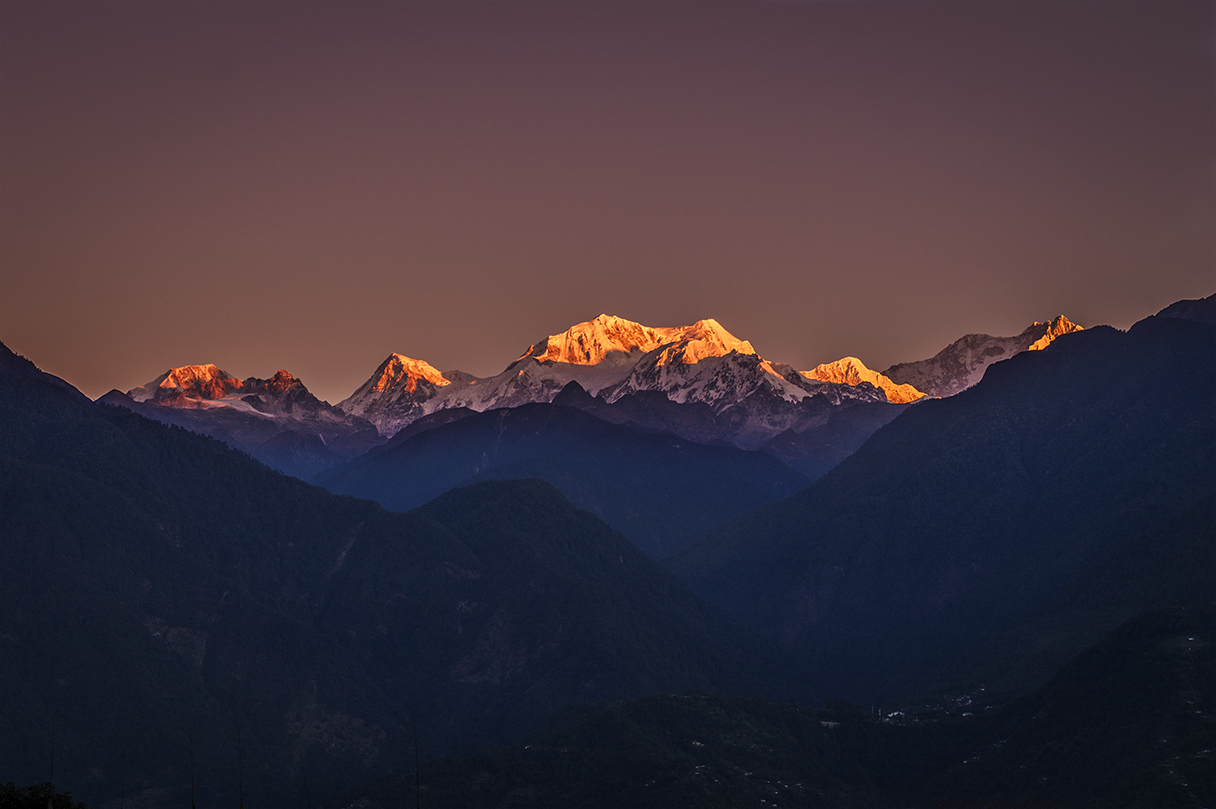
Tashiding Monastery stands at about 1,465 m on a heart-shaped hill between the Rathong Chu and Rangeet rivers, 19 km from Yuksom. Founded in 1641 and enlarged in 1717, it is one of the most sacred sites in Sikkim, famous for its chortens, carved mani stones and the Bumchu sacred-vase festival in February or March.
Best months
Oct–May; Feb–Mar for Bumchu
Nights we suggest
0–1 (stay in Yuksom or Pelling)
From Gangtok
≈ 115 km · 5–6 h via Ravangla and Legship
Altitude
1,465 m
Known for
Bumchu vase, chortens, mani stones, river confluence
Tashiding crowns a conical, wooded hill rising between two rivers: the Rathong Chu, coming down from the Kangchenjunga glaciers, and the Rangeet. Wikipedia describes the hill as heart-shaped and records that the monastery was founded in 1641 by Ngadak Sempa Chempo Phunshok Rigzing, one of the three lamas of the Yuksom coronation, and extended and renovated in 1717 under the third Chogyal, Chakdor Namgyal. It belongs to the Nyingma order, with Guru Padmasambhava as its principal figure.
The road ends at Tashiding bazaar, and a path climbs the hill to the monastery. At the top, a broad terrace holds the main temple, a field of whitewashed chortens and long walls of flat stones carved with the mantra Om Mani Padme Hum, many said to be the work of the craftsman Yanchong Lodil. Among the chortens is the Thong-Wa-Rang-Dol, believed to cleanse anyone who looks at it.
Tashiding is best known for Bumchu, on the 14th and 15th days of the first Tibetan month, when lamas open a sealed sacred vase and read the coming year in the level of its water. On ordinary days the hill is quiet, with wide views down to the river confluence and across to Pelling's ridge.
Highlights
What to see and do
The chorten field
On the hilltop terrace stand dozens of whitewashed chortens of different sizes and periods. Walk among them clockwise and look for the Thong-Wa-Rang-Dol, believed to cleanse anyone who sees it. The field is especially quiet in the late afternoon.
Carved mani stones
Long walls of flat stones carved with Om Mani Padme Hum, many attributed to the craftsman Yanchong Lodil, line the paths. Some are painted. Walk to their left so they stay on your right, as tradition asks.
Bumchu sacred vase
On the 14th–15th of the first Tibetan month, in February or March, lamas open the sacred vase and read the year's fortune in its water. Pilgrims queue for the holy water through the night.
View to the confluence
From the hilltop the land falls away to the Rathong Chu and Rangeet, with Pelling's ridge to the west and forested hills all around. The site explains why the hill was chosen as sacred.
The climb from the bazaar
The path from Tashiding bazaar to the monastery takes 30–40 minutes on foot, past prayer flags and small shrines. Cars can go part of the way, but walking up is how pilgrims arrive.
The story of Tashiding
A vase of water from the time of Padmasambhava
Tashiding's fame rests on a vase. According to the monastery tradition recorded in Wikipedia's article, Guru Padmasambhava, who taught in Tibet in the reign of King Trisong Deutsen in the 8th century, consecrated a vase of holy water that was later found and placed at Tashiding. It is kept sealed. Once a year, on the night of the 14th day of the first Tibetan month, during the festival of Bumchu ('sacred vase'), the lamas open it before a crowd of pilgrims from Sikkim, Darjeeling, Nepal and Bhutan, and examine the water. If it is filled to the brim, the coming year will be prosperous; if it is empty, famine will follow. Some of the water is then shared with the pilgrims, who carry it home as a blessing, and the vase is sealed again. The ritual is a reminder that in Sikkim the sacred is tied to the land: the water's level is read as a forecast for harvests across the state.
Source: Wikipedia: Tashiding Monastery
Little known
Things most visitors never hear
The Thong-Wa-Rang-Dol chorten at Tashiding is believed to cleanse the soul of anyone who simply looks at it.
Source: Wikipedia: Tashiding Monastery
Many of Tashiding's mani stones, carved with Om Mani Padme Hum, are attributed to the craftsman Yanchong Lodil.
Source: Wikipedia: Tashiding Monastery
Tashiding was founded in 1641, a year before the coronation at Yuksom, by Ngadak Sempa Chempo, one of the three founding lamas.
Shared jeeps link Tashiding with Legship, Gyalshing and Yuksom a few times a day, mostly in the morning, indicatively ₹100–150 from Yuksom or Legship. During Bumchu extra jeeps run but fill quickly.
Private car
From Yuksom about 19 km and 1 hour; from Pelling about 40 km and 2 hours via Gyalshing and Legship; from Gangtok about 115 km and 5–6 hours via Ravangla and Legship. A car from Pelling costs indicatively ₹2,500–3,500 one way.
From Bagdogra / NJP
About 140 km and 5–6 hours via Sevoke, Melli, Jorethang and Legship, indicatively ₹5,500–7,500 by private car. NH10 can close in the monsoon; check current status before you travel.
Indian travellers need no permit for Pelling, Yuksom, Khecheopalri, Tashiding or Uttarey. The Dzongri and Goecha La trek needs a Khangchendzonga National Park permit and fees, arranged at Yuksom through a registered trekking agency with a licensed guide. Foreign nationals need the Restricted Area Permit to enter Sikkim, applied for online via the e-FRRO portal after arriving in India, and a Protected Area Permit in a group of two or more for the Dzongri–Goecha La trek. Sikkim charges a ₹50 per tourist fee at check-in. Check current status before you travel.
Tashiding has only a few simple guesthouses and homestays, which fill during Bumchu. Most travellers stay in Yuksom, an hour away, at Yuksum Residency, Hotel Tashigang or a village homestay, or in Pelling, two hours away, where hotels run from Hotel Garuda (budget) to The Elgin Mount Pandim (premium).
It is one of the most sacred monasteries in Sikkim, founded in 1641 by one of the three lamas of the Yuksom coronation. It is known for the Bumchu sacred-vase festival, a hilltop field of chortens, carved mani stones and its setting between two rivers.
How far is Tashiding from Yuksom?
About 19 km, 45 minutes to 1 hour by car. Shared jeeps run a few times a day for about ₹100–150. From Pelling it is about 40 km and 2 hours via Gyalshing and Legship.
When is the Bumchu festival at Tashiding?
On the 14th and 15th days of the first Tibetan month, about two weeks after Losar, usually in February or early March. Dates move each year with the lunar calendar. Check current status before you travel.
Is there an entry fee at Tashiding Monastery?
There is normally no fixed entry fee. Donations to the monastery are welcome. Check current status before you travel, as some sites have introduced small fees. Carry small notes for offerings and tea in the bazaar.
How long do I need at Tashiding?
About 1.5–2 hours, including the 30–40 minute climb from the bazaar and time among the chortens. On Bumchu night, plan to stay late or overnight. Most visitors combine it with Yuksom the same day.
Who founded Tashiding Monastery?
Wikipedia records that it was founded in 1641 by Ngadak Sempa Chempo Phunshok Rigzing, one of the three lamas who consecrated the first Chogyal at Yuksom, and extended in 1717 under Chogyal Chakdor Namgyal. It belongs to the Nyingma order.
Can I stay at Tashiding?
There are a few simple guesthouses and homestays in Tashiding, indicatively ₹1,000–2,000 a room, which fill during Bumchu. Most travellers stay in Yuksom or Pelling and visit Tashiding as a stop. Book early for festival dates.
How do I get from Tashiding to Gangtok?
Drive via Legship and Ravangla, about 115 km and 5–6 hours. A private car costs indicatively ₹5,000–6,500. Shared jeeps go from Legship or Gyalshing to Gangtok in the morning. NH10 near Singtam can close in the monsoon.
Is Tashiding worth visiting?
Yes, especially for anyone interested in Buddhism, sacred landscapes or festivals. It feels different from Pelling's monasteries: a whole hill of chortens and mani stones above two rivers. It is an easy addition to a night in Yuksom.
Every cost shownRooms, car, permits and our fee, itemised
One person to callFrom Bagdogra or NJP until you are back
No payment to startA deposit only when you book
Get my price
Want Tashiding in your plan?
Tell us your dates, who is travelling and roughly what you want to spend. We reply within one working day with a day-by-day route and an itemised price.
No payment to start
Permits handled through registered partners
Every hotel, car and fee listed
Price my Sikkim trip
Tell us dates, people and budget. You get a day-by-day plan and an itemised price within one working day.