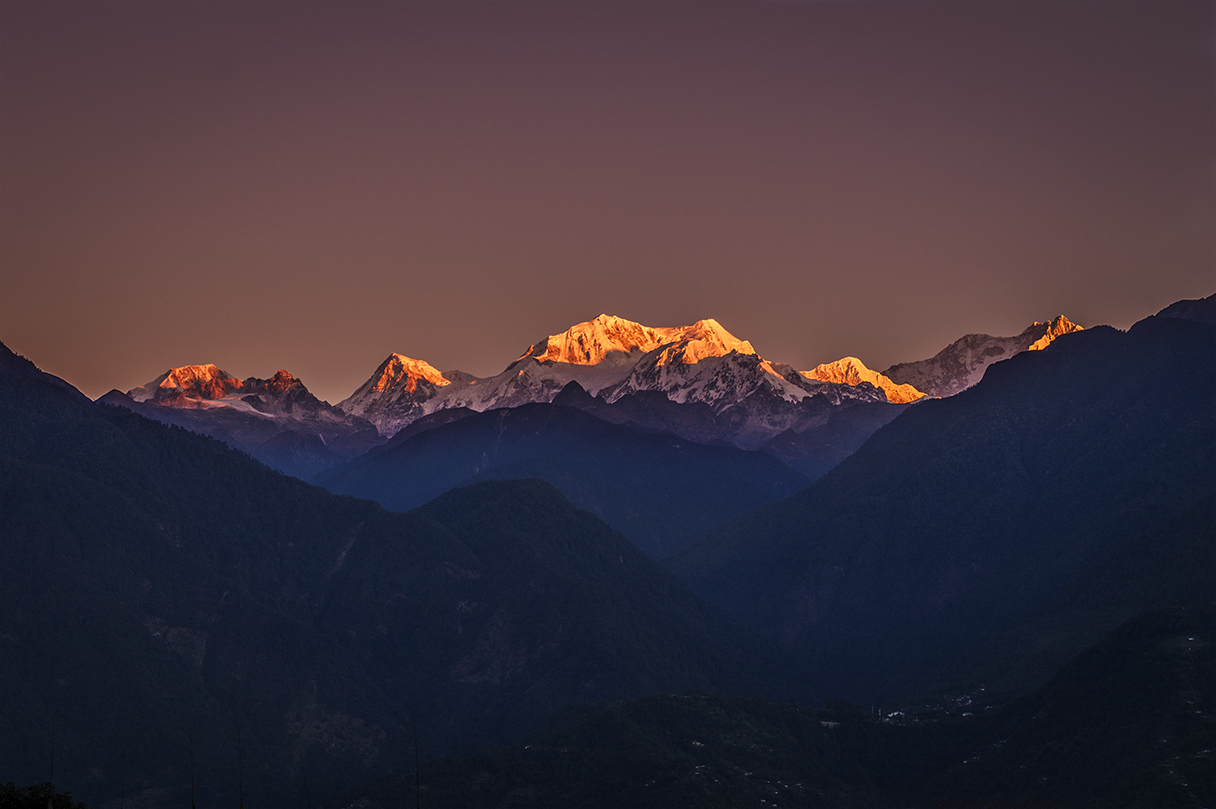
Yuksom is a village at about 1,780 m, 40 km from Pelling, where three lamas consecrated Sikkim's first Chogyal in 1642. It was the capital until 1670. Today it holds the Norbugang throne, Kathok Lake and Dubdi Monastery, and is the trailhead for Dzongri and Goecha La. Stay 1–2 nights.
Lepcha nameYuksomMeans: Meeting place of the three learned monksSource: Wikipedia: Yuksom (translation; the Lepcha attribution is as commonly given locally)
Best months
Oct–Dec and Mar–May
Nights we suggest
1–2
From Gangtok
≈ 150 km · 6.5–7.5 h (≈ 40 km from Pelling)
Altitude
1,780 m
Known for
First capital, Norbugang throne, Dubdi, Goecha La trailhead
Permit
Not needed for the village; trek permits for the park
Yuksom sits on a broad shelf above the Rathong Chu valley, ringed by forest and terraced fields, at the end of the road from Pelling. Its name is usually translated as 'meeting place of the three learned monks', after the three Tibetan lamas who met here in the 1640s. It is a small place: one bazaar street, a few hotels and homestays, a lake, a coronation site and the start of the trail into Khangchendzonga National Park.
In 1642 the lamas consecrated Phuntsog Namgyal as the first Chogyal of Sikkim on a stone throne at Norbugang, a pine-covered hill just above the village, anointing him with water from a sacred urn. Kathok Lake, beside the road, is associated with that water. Yuksom remained the capital until 1670, when the second Chogyal moved to Rabdentse. Dubdi Monastery, dated to 1701 and often called the oldest in Sikkim, stands an hour's walk above.
Most travellers arrive on a day trip from Pelling, see Norbugang and Kathok Lake and leave. We suggest a night or two. It gives you Dubdi in the morning, slow walks through the village, and an easy onward drive to Tashiding. Trekkers spend a night here before and after the Dzongri and Goecha La trek, sorting permits and porters.
Highlights
What to see and do
Norbugang coronation throne
A four-seat stone throne under a large tree on a small hill above the bazaar, where Phuntsog Namgyal was consecrated in 1642. Beside it are the Norbugang Chorten, a small temple and a large prayer wheel. Allow 30–45 minutes.
Kathok Lake
A small, still lake by the road below Norbugang, associated with the holy water used to anoint the first Chogyal. Prayer flags ring the water and locals walk around it in the evening. It is a two-minute stop or a quiet half hour.
Dubdi Monastery walk
An hour's climb of about 3 km through forest leads to Dubdi, dated to 1701 and often called the oldest monastery in Sikkim. Go early, and ask in the village whether the caretaker monk is there to open the hall.
Gateway to the park
The trail into Khangchendzonga National Park starts at the top of the village. Even if you are not trekking, a two-hour walk up the trail towards Sachen shows the forest and the Prek Chu gorge.
On to Tashiding
Tashiding, one of the most sacred monasteries in Sikkim, is about 19 km away, an hour by road. Staying in Yuksom lets you see both without rushing and continue to Legship or Gangtok.
The story of Yuksom
The coronation on Norbugang hill
The story of Yuksom is the story of Sikkim's founding. Sikkim's histories, summarised by Wikipedia, tell of three lamas of the Nyingma school, Lhatsun Chempo, Sempa Chempo and Rigzin Chempo, who came from Tibet by the north, west and south and met at Yuksom. Seeking a lay ruler to protect Buddhism in the land, they went in search of Phuntsog Namgyal, a fifth-generation descendant of the eastern Tibetan prince Khye Bumsa, and found him near present-day Gangtok. In 1642, when he was 38, they consecrated him Chogyal, 'religious king', at Norbugang, on a pedestal of stones on a pine-covered hill. The stone throne survives under a large tree, with four seats in steps: the highest for Lhatsun Chempo, one for the king and two for the other lamas. Beside it stands the Norbugang Chorten, said to contain earth and water brought from across Sikkim. Phuntsog Namgyal and the lamas then spread Buddhism among the Lepcha people, and his descendants ruled Sikkim until 1975.
Yuksom was Sikkim's capital from 1642 to 1670, before the second Chogyal, Tensung Namgyal, moved the court to Rabdentse near Pelling.
Source: Wikipedia: Yuksom
In front of the Norbugang throne a stone under a metal cover bears what devotees believe is the footprint of Lhatsun Chempo, the senior of the three lamas.
Source: Lonely Planet: Norbugang Park
Yuksom village covered 812 hectares and had 1,951 residents at the 2011 census, small for a place with such weight in Sikkim's history.
Shared jeeps run from Gyalshing and Pelling to Yuksom a few times a day, mostly in the morning, indicatively ₹150–250 a seat. Jeeps also link Yuksom with Tashiding and Legship. The last return jeep usually leaves early afternoon.
Private car
From Pelling, about 40 km and 2 hours via Darap, Rimbi and the Kanchenjunga Falls, indicatively ₹2,500–3,500 one way. From Gangtok, about 150 km and 6.5–7.5 hours via Legship and Tashiding or via Pelling.
From Bagdogra / NJP
About 170 km and 6.5–7.5 hours via Melli, Jorethang, Legship and Tashiding, indicatively ₹6,500–8,500 by private car. Most travellers break the journey in Pelling. Check NH10 status before you travel.
Indian travellers need no permit for Pelling, Yuksom, Khecheopalri, Tashiding or Uttarey. The Dzongri and Goecha La trek needs a Khangchendzonga National Park permit and fees, arranged at Yuksom through a registered trekking agency with a licensed guide. Foreign nationals need the Restricted Area Permit to enter Sikkim, applied for online via the e-FRRO portal after arriving in India, and a Protected Area Permit in a group of two or more for the Dzongri–Goecha La trek. Sikkim charges a ₹50 per tourist fee at check-in. Check current status before you travel.
Yuksom has a small choice of value hotels and many homestays. Yuksum Residency, with a terrace and garden, is one of the more comfortable hotels; Hotel Tashigang is a long-running practical base used by trekkers and families. Family homestays around the village, some linked to the Khangchendzonga Conservation Committee, cost less and include meals. There are no premium hotels; for those, stay in Pelling and visit Yuksom by day.
Yuksom is where three Tibetan lamas consecrated Phuntsog Namgyal as the first Chogyal of Sikkim in 1642, at the Norbugang throne. It was the capital until 1670, when the court moved to Rabdentse. Dubdi Monastery above the village is often called the oldest in Sikkim.
What does Yuksom mean?
Yuksom is usually translated as 'meeting place of the three learned monks', referring to the three Tibetan lamas who met here before consecrating the first Chogyal in 1642. Local tellings commonly give the name as Lepcha.
How far is Yuksom from Pelling?
About 40 km, or 2 hours by car via Darap, Rimbi and the Kanchenjunga Falls. A private car costs indicatively ₹2,500–3,500 one way, and shared jeeps about ₹150–250 a seat. Many travellers add Khecheopalri Lake on the way.
How many days do I need in Yuksom?
One night lets you see Norbugang, Kathok Lake and Dubdi without rushing. Two nights add a day hike into the park or a trip to Tashiding. Trekkers spend a night before and after the 8–10 day Goecha La trek.
Is Yuksom good for families?
Yes. It is small, safe and walkable, with gentle sights such as Kathok Lake and Norbugang, farm animals and open fields. The Dubdi walk suits active children. Accommodation is simple, so families wanting luxury should base in Pelling and visit by day.
What is the best time to visit Yuksom?
October to December and March to May. October and November give clear skies and are peak trekking season; April brings rhododendrons on the trail. Winter is cold but quiet. Avoid June to September, when rain, slides and leeches make travel and walking difficult.
Is there an ATM in Yuksom?
There may be one in the bazaar, but it is not reliable and often runs out of cash. Bring enough cash from Pelling, Gyalshing or Jorethang for hotels, homestays, guides and shops. Card and UPI acceptance varies and fails in power or network cuts.
Where do I stay in Yuksom?
Yuksom has value hotels such as Yuksum Residency and Hotel Tashigang, and many family homestays around the village at ₹1,200–2,200 per person with meals. There are no premium hotels. Book early for October and April–May, when trekking groups fill rooms.
Can I visit Yuksom and Tashiding on the same day?
Yes. Tashiding is about 19 km and an hour from Yuksom. Start with Dubdi early, see Norbugang and Kathok Lake, and drive to Tashiding by early afternoon. From Tashiding you can return to Pelling via Legship or continue towards Gangtok.
Every cost shownRooms, car, permits and our fee, itemised
One person to callFrom Bagdogra or NJP until you are back
No payment to startA deposit only when you book
Get my price
Want Yuksom in your plan?
Tell us your dates, who is travelling and roughly what you want to spend. We reply within one working day with a day-by-day route and an itemised price.
No payment to start
Permits handled through registered partners
Every hotel, car and fee listed
Price my Sikkim trip
Tell us dates, people and budget. You get a day-by-day plan and an itemised price within one working day.