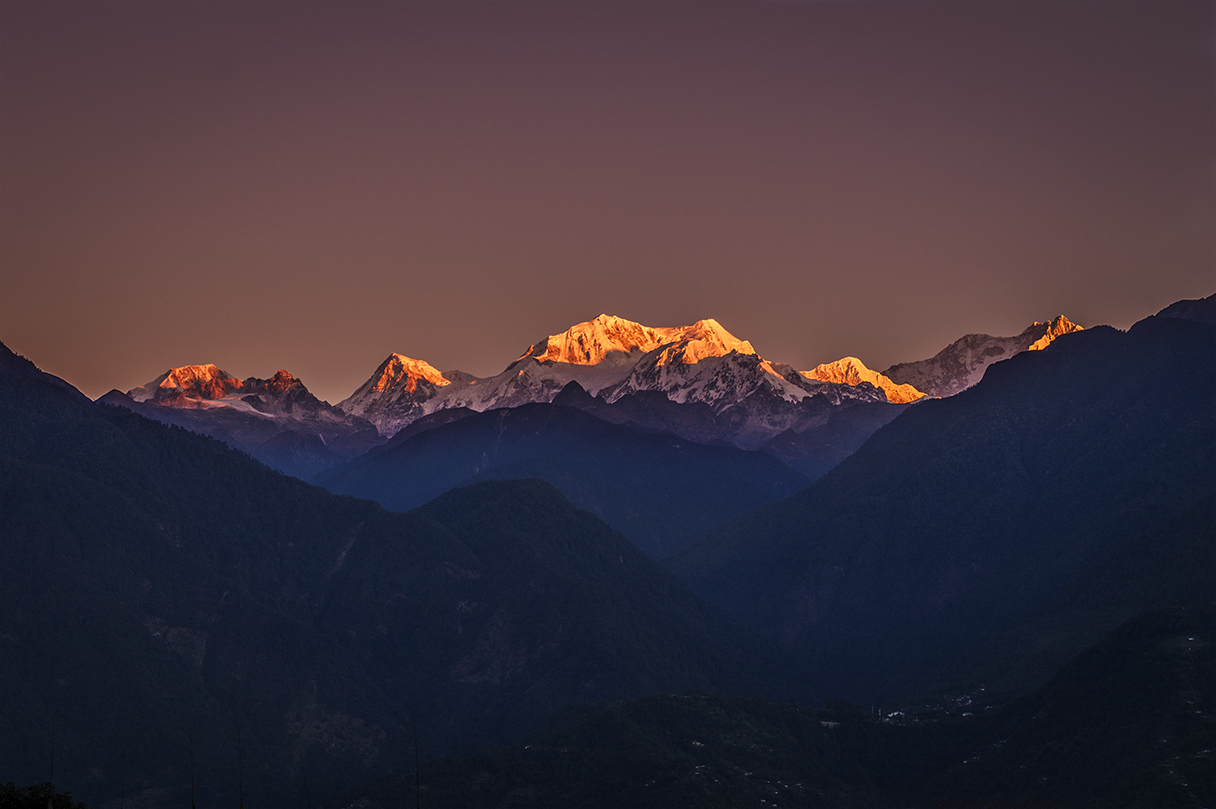
Two treks on one trail
Both treks start at Yuksom, the old capital of the Namgyal kings in Gyalshing district (West Sikkim), and follow the same path up the Prek Chu valley into Khangchendzonga National Park, a UNESCO World Heritage Site since 2016. The trail climbs through subtropical forest, then oak, magnolia and rhododendron, to the meadows of Dzongri at about 4,020 m. From there the short trek turns back, and the long trek continues to Thansing, Lamuney and the Goecha La viewpoint facing the south-east face of Kangchenjunga (8,586 m).
The Sikkim Forest Department describes the Goecha La–Dzongri route as 45 km long and gives 4,570 m for Goecha La in its 2025 press note on the trail. Wikipedia lists the actual pass at 4,940 m, which trekkers do not reach: groups normally stop at the first viewpoint below it. The higher viewpoints have been closed to protect the alpine habitat. Rules like this change, so check current status before you travel.
Day by day on the classic route
This is the standard Goecha La plan most operators, including us, follow from New Jalpaiguri (NJP). Distances are trail estimates and times are for a steady walker. The Dzongri trek uses the first five days and returns from Dzongri to Tshoka and Yuksom.
| Day | Stage | Sleep at | Altitude | Walk |
|---|---|---|---|---|
| 1 | Drive NJP to Yuksom | Yuksom | 1,780 m | ≈ 170 km · 6.5–7.5 h by road |
| 2 | Yuksom to Sachen | Sachen | 2,200 m | ≈ 8 km · 5–6 h |
| 3 | Sachen to Tshoka via Bakhim | Tshoka | 3,000 m | ≈ 7 km · 4–5 h |
| 4 | Tshoka to Dzongri via Phedang | Dzongri | 4,020 m | ≈ 9 km · 6–7 h |
| 5 | Dzongri Top sunrise, rest day | Dzongri | 4,020 m | Short climb to about 4,200 m |
| 6 | Dzongri to Thansing via Kokchurang | Thansing | 3,930 m | ≈ 10 km · 5–6 h |
| 7 | Thansing to Lamuney | Lamuney | 4,180 m | ≈ 4 km · 2–3 h |
| 8 | Goecha La viewpoint, back to Thansing | Thansing | ≈ 4,570 m max | ≈ 14–16 km · 10–12 h |
| 9 | Thansing to Tshoka via Phedang | Tshoka | 3,000 m | ≈ 15 km · 7–8 h |
| 10 | Tshoka to Yuksom | Yuksom | 1,780 m | ≈ 15 km · 6–7 h |
| 11 | Drive Yuksom to NJP | ≈ 6.5–7.5 h by road |
The Dzongri short trek
If you have a week rather than eleven days, Dzongri gives you most of the mountain for half the effort. The plan is Yuksom to Sachen, Sachen to Tshoka, Tshoka to Dzongri, then a pre-dawn climb to Dzongri Top for sunrise on Kabru, Rathong, Kangchenjunga and Pandim, and the walk down to Tshoka the same day. A last day takes you back to Yuksom. With the drives from NJP, that is six nights.
Dzongri is open meadow above the tree line, with prayer flags, stone shelters and a basic trekkers' hut, and it feels very different from the forest below. Weather on the top changes within minutes, so leave the camp by 4 am in October and be patient: cloud often lifts briefly after sunrise.
We turn this into a priced, day-by-day plan for your dates.
Permits and park rules
Indian citizens do not need an inner line permit for Sikkim, but every trekker needs a Khangchendzonga National Park entry permit and must register at Yuksom before starting. The park fee has been about ₹350 per Indian for the first seven days and ₹40 for each extra day, and about ₹560 per foreign national for seven days plus ₹80 a day after that, with separate camping, guide and porter charges. Your registered trekking agent arranges the paperwork at Yuksom with photo ID; carry two photocopies and passport photos.
Foreign nationals first need Sikkim's Restricted Area Permit, applied for online on the e-FRRO portal after arriving in India, and then a Protected Area Permit for Dzongri and Goecha La, issued only to groups of two or more through a registered agent. Solo trekking is not allowed for anyone: a registered local guide is mandatory. These are the rules as we understand them; check current status before you travel.
- No camping at Samiti Lake: it is sacred to both Bhutia and Lepcha communities, and the Forest Department forbids it.
- Carry out every wrapper, battery and bottle; the park checks bags for plastic at Yuksom.
- No wood fires: cooking is on kerosene or gas carried by your team.
- Stay on the marked trail and inside the permitted area; the pass itself is off-limits.
What it costs in 2026
Fixed group departures from Yuksom, with tents, a cook, a guide, food and park fees, cost roughly ₹22,000–30,000 per person plus 5 per cent GST for the full Goecha La trek, and roughly ₹13,000–18,000 for Dzongri. Shared transport from NJP to Yuksom and back usually costs another ₹2,000–3,500 per person. A private trek with your own guide, cook and porters is far more flexible and costs roughly ₹45,000–70,000 per person for two people, falling as the group grows.
Extra costs to plan for: offloading your rucksack onto a porter or pack animal, usually ₹400–600 per day per bag; a night in Yuksom before and after the trek; tips for the guide, cook and porters; and rental gear if you lack a warm sleeping bag or down jacket. All figures are indicative.
Choosing a trekking team
Pick a team registered with Sikkim Tourism or the Travel Agents Association of Sikkim, because only registered agents can process park permits. Ask how many trekkers share a guide (one guide for up to eight is reasonable), whether the guide holds first-aid training, what oxygen and medical kit the team carries, and what happens if you need to turn back. A good team will tell you plainly that the summit-day start depends on weather and your health, not on the schedule.
Ask also about the kitchen: how water is treated, what food comes on the trail and how waste is carried out. On our own treks the team carries all rubbish back to Yuksom, and we hire guides, cooks and porters from Yuksom and nearby villages, so the money stays in the valley the trail passes through.
Best season and grading
There are two seasons. April to mid-May brings rhododendrons in flower between Bakhim and Phedang, with warmer nights but more afternoon cloud. Late September to November brings the clearest mountain views, cold nights (well below freezing at Lamuney) and crisp mornings. December can be clear but very cold, with snow on the upper trail, and many teams stop running by mid-December. We do not run treks in the June–August monsoon, when leeches, slips and cloud take over the lower trail.
We grade Goecha La as moderate to difficult. Daily climbs of 700–1,000 m, two long days of 15 km and the summit-day start at about 3 am need real fitness: aim to jog 5 km in 35 minutes or walk 10 km with a light pack before you come. Dzongri is moderate: shorter, but it still takes you above 4,000 m in four days.
Altitude, health and what to pack
The trail gains about 2,200 m in the three days from Yuksom to Dzongri, which is why the rest day at Dzongri matters. Headache, nausea, loss of appetite and unusual breathlessness at rest are signs of acute mountain sickness. Tell your guide at once. The cure for anything worse than a mild headache is to descend, and good teams carry oxygen and a pulse oximeter.
Drink 3–4 litres of water a day, eat even when you are not hungry, avoid alcohol on the trail and do not race ahead of the group. Talk to your doctor before the trip if you have heart, lung or blood pressure conditions, and ask about acetazolamide.
Layering beats bulk. Mornings at Dzongri in October are often around -5 °C, while the afternoon walk below Tshoka can be warm and humid.
- Broken-in trekking shoes with ankle support, plus camp sandals
- Down jacket, fleece, thermal base layers, rain jacket and rain pants
- Warm hat, sun cap, gloves (inner and outer), woollen socks
- Sunglasses rated UV400, sunscreen and lip balm
- Two 1-litre bottles or a hydration bladder, and a refillable bottle for Yuksom
- Headlamp with spare batteries for the summit-day start
- Personal medicines, a small first-aid kit and photo ID copies
Rules, fees, fares and road status change often. Check current status before you travel.