Buddhist and Hindu pilgrims; Lepcha, Bhutia, Limbu and Nepali villagers · West Sikkim
Maghe Purne at Khecheopalri Lake
Magh full moon, usually Jan–Feb (dates vary; confirm each year)
Photo: Kothanda Srinivasan · CC BY 2.0, Wikimedia Commons
On the full moon of Magh, pilgrims from Sikkim, Darjeeling, Nepal and Bhutan gather at the sacred Khecheopalri Lake to pray and float butter lamps on small bamboo rafts across the water.
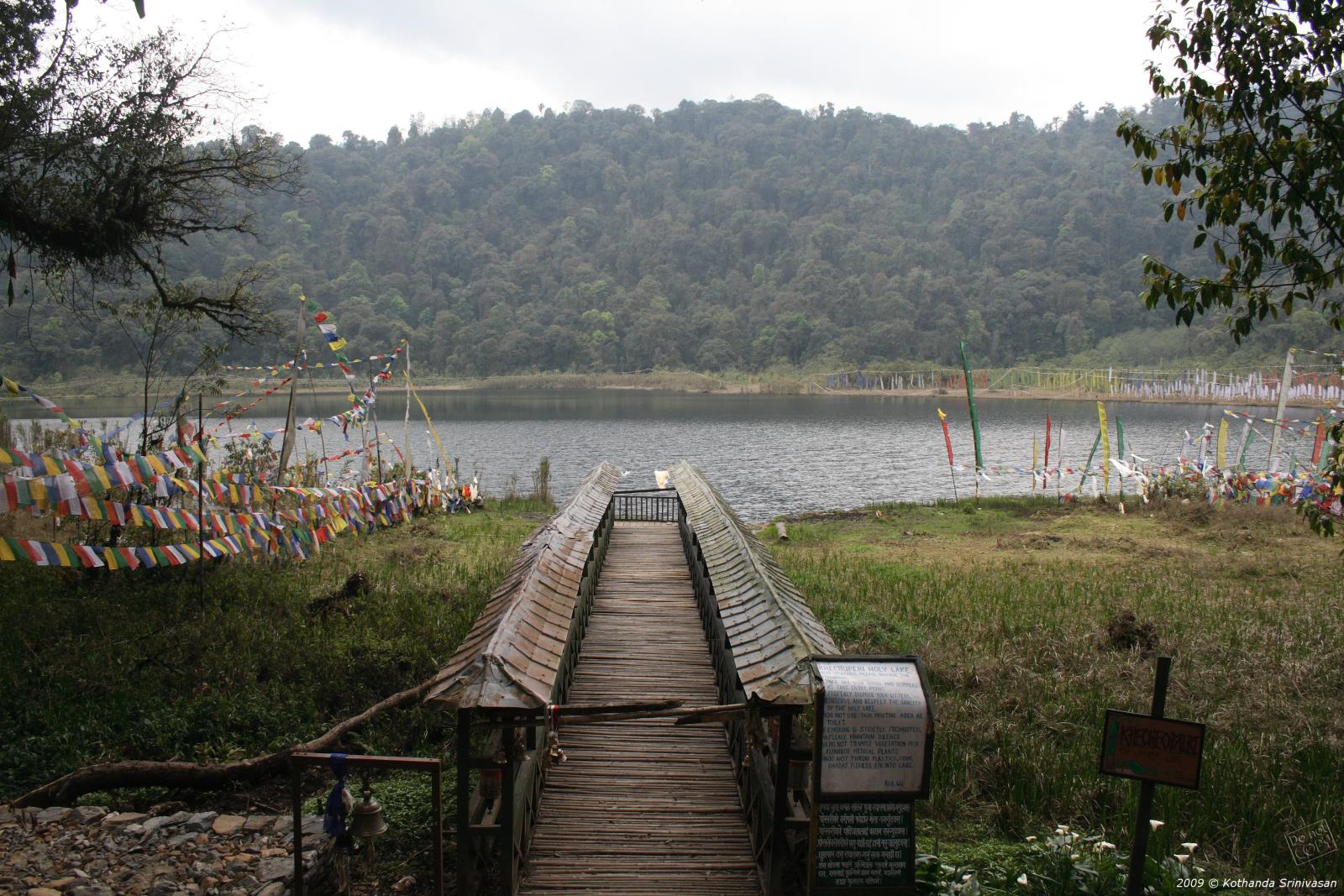
Khecheopalri Lake, at about 1,700 m near Khecheopalri village, is sacred to Buddhists and Hindus and to the Lepcha, who know it as Sho Dzo Sho, 'Oh Lady, sit here', according to Wikipedia's article on the lake. Its biggest gathering is the two-day fair of Maghe Purne, the full moon of the Nepali month of Magh. Pilgrims offer prayers, food and khadas, and float butter lamps on small bamboo rafts across the lake.
Sources disagree on timing. 'Maghe Purne' means the Magh full moon, which falls in January or February, and travel writers describe a full-moon celebration with lamps in that season; some printed guides and Wikipedia place the fair in March–April. We confirm the date with the village each year rather than guess. Another observance, Chho-Tsho, is described in some sources as taking place at the lake in October.
The lake is protected by a 2001 Government of Sikkim notification. Swimming, boating and feeding the fish are not allowed, and a wooden jetty lets visitors reach the water's edge without trampling the shore. During the fair the small car park fills quickly, and walkers come up the old paths from the villages below.
If you go
Tips for the day
- Stay a night in a Khecheopalri village homestay or in Pelling so you reach the lake before the crowds.
- Keep to the jetty, do not throw coins or food in the water, and walk clockwise around the prayer wheels.
- Sources disagree on the date, so check current status before you travel.
Questions travellers ask
Questions about Maghe Purne at Khecheopalri Lake
When is the Khecheopalri Lake festival?
The main gathering is Maghe Purne, the full moon of the Nepali month of Magh, which normally falls in January or February. Some guidebooks and Wikipedia place the fair in March–April, so sources conflict. We confirm the date locally every year before planning a festival visit. Check current status before you travel.
Why is Khecheopalri Lake sacred?
Buddhists link it with Guru Padmasambhava and the goddess Tara, and Hindus also revere it; it is often called a wish-fulfilling lake. Lepcha tradition, as recorded in Wikipedia's article, tells of conch shells falling from the sky and a spring rising to form the lake, which became home to a protective goddess.
Are there rules at Khecheopalri Lake?
Yes. The lake is protected by a 2001 state notification. Swimming, boating, fishing and feeding fish are not permitted, and visitors reach the water by a wooden jetty. Remove shoes where signs ask, keep voices low and do not leave litter. A small entry or parking fee may apply.
How far is Khecheopalri Lake from Pelling?
About 30 km, roughly 1.5 hours by car on a branch road off the Pelling–Yuksom route. A reserved car from Pelling for the lake alone costs indicatively ₹2,000–2,800, and most travellers combine it with the waterfalls and Yuksom on a full day for ₹3,500–5,000 per car.
Go for it
Where it happens and how to get there
lake
Khecheopa…1,700M
Khecheopalri Lake
The sacred lake where birds are said to clear the fallen leaves
Price your own route
Tell us dates, people and budget. We send a day-by-day plan with every cost shown. StartNot sure where to start?
We match districts to your month, your budget and the people travelling with you. StartAsk the Gangtok desk
An itemised quote within one working day. No payment to start. StartGet my price
Tell us your dates and your budget
Who is travelling, when, and roughly what you want to spend. The Gangtok desk replies within one working day with a day-by-day plan and an itemised price.
- No payment to start
- Permits handled through registered partners
- Every hotel, car and fee listed