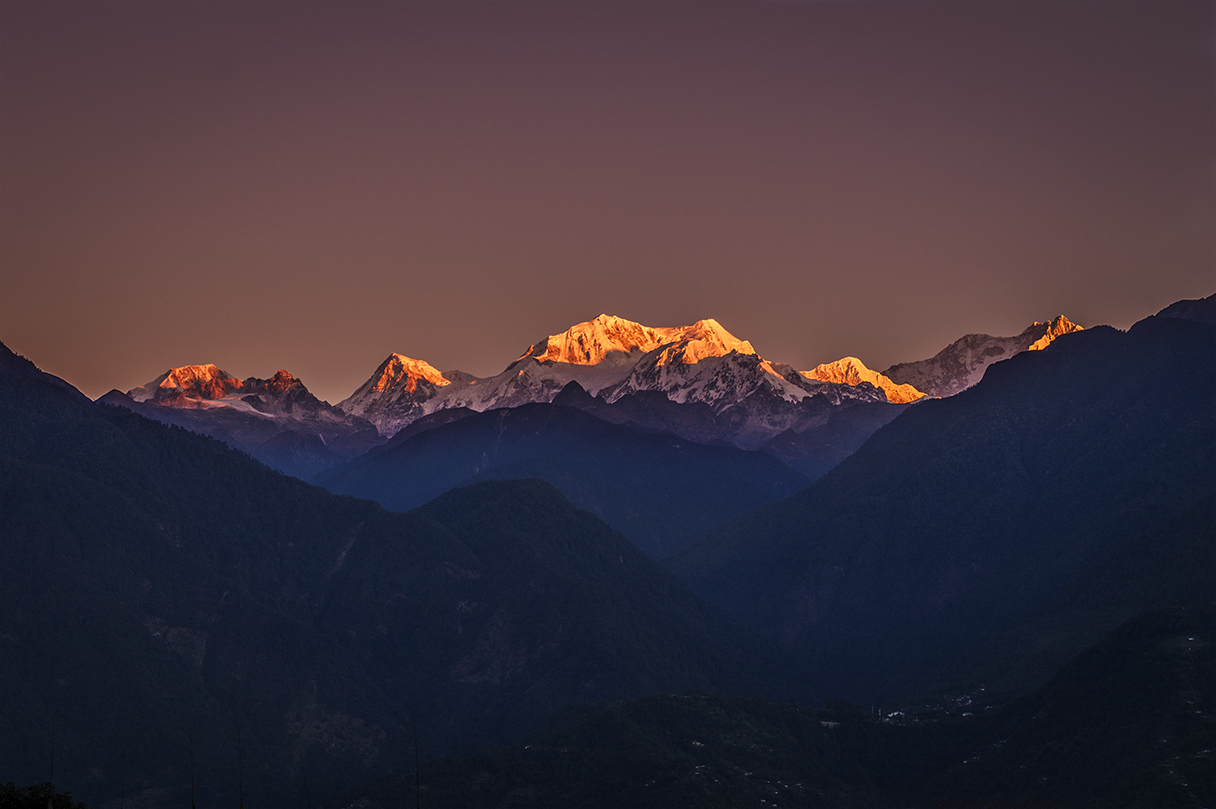
Uttarey is a homestay village at about 2,000 m on the northern slopes of the Singalila Ridge, about 35 km and 1.5–2 hours west of Pelling, past Dentam and the Singshore Bridge. It has a Kagyu monastery, forest walks to Mainbus waterfall and trails towards Chewabhanjang on the Nepal border. Stay 1–3 nights.
Not needed for Indians in the village; foreigners need the Sikkim RAP
About Uttarey
What to know before you go
Uttarey is the last village of any size on the road west from Pelling, close to the Nepal border in Gyalshing district (West Sikkim). The district administration gives its height as about 6,600 ft, roughly 2,000 m, which makes it a little cooler than Pelling and much cooler than the Dentam valley below. Houses and fields climb a slope ringed by forest of oak, magnolia and rhododendron, and the long Singalila Ridge rises behind.
The village has become a homestay stop over the last two decades. Families with Limbu, Bhutia and Nepali roots host guests in simple rooms and cook with produce from their fields. The district names its sights plainly: the Kagyu gompa, a monastery in the forest with wall paintings, Mainbus waterfall, and Chewabhanjang, a pass about 10 km away that it calls the gateway to Nepal. Beyond that, the attraction is the place itself: cool air, birdsong and very little traffic.
Most travellers reach Uttarey on a day trip from Pelling, crossing the Singshore Bridge on the way. That leaves an hour for lunch and a short walk. We suggest at least one night: dawn on the ridge, a forest walk to the waterfall, an evening by the kitchen fire. Trekkers also use Uttarey as the start of the Singalila routes that follow the border ridge north towards the Khangchendzonga area.
Highlights
What to see and do
Singshore Bridge on the way
The road from Dentam crosses the Singshore Bridge, about 240 m long and more than 100 m above a forested gorge, before climbing to Uttarey. Stop, walk across and back, and look down into the gorge. It is the classic photograph of this road.
The Kagyu gompa in the forest
The village monastery of the Kagyu school stands among trees above the houses. The district administration mentions its wall paintings and the view to the Dentam peak and river below. Visit quietly, walk clockwise, remove shoes inside and ask before taking photographs.
Mainbus waterfall walk
A forest and field walk of about 4–5 hours there and back leads to Mainbus waterfall, which the district lists among Uttarey's sights. Go with a local guide or your host's directions, carry a packed lunch, and expect mud and leeches after rain.
Ridge walks towards Chewabhanjang
Trails climb from the village through oak and rhododendron towards the Singalila Ridge and the Chewabhanjang pass, about 10 km away on the Nepal border. A half-day walk up to around 2,300 m gives wide valley views in clear weather and thick blossom in April.
Homestay evenings
Uttarey is quiet after dark. Dinner is home-cooked rice, dal, seasonal greens, pickles and often chicken or pork, served early, with conversation by the kitchen fire. Ask your hosts about their festivals and the old paths to Nepal.
Cold, clear winter mornings
From December to February nights drop near freezing and the ridge can get light snow, but mornings are often clear. Rooms are not heated, so ask for extra blankets and pack thermals. It is the quietest time of year in the village.
The story of Uttarey
The trail to Chewabhanjang and the Singalila Ridge
Uttarey sits at the foot of the Singalila Ridge, the long north–south spur that runs from the Kangchenjunga massif down to the hills near Darjeeling and forms much of the border between Sikkim and Nepal. About 10 km above the village is Chewabhanjang (also spelled Chiwa Bhanjyang), a pass on the ridge that the Gyalshing district administration describes as the gateway to Nepal. Paths over passes like this were used for generations by people on both sides for trade, grazing and family visits; ask your hosts what they remember, as told locally. The district also lists the Singalila trek, which leaves Uttarey for Chewabhanjang and continues north along the ridge through Dhor, Sikkim Megu and Dafey Bhir to Gomathang, in the high country south of Dzongri, best from mid-May to October. It is one of the least walked routes in Sikkim. Today the pass is a border point, not an official crossing for foreign travellers, so treat the trail as a forest walk and check current status before you travel.
The Gyalshing district administration describes the Singshore Bridge, on the road to Uttarey, as said to be the second highest bridge in Asia, a claim also repeated on Wikipedia.
Source: Gyalshing district administration: Utteray
Uttarey is the end point of a rhododendron trek route listed by the district: Hilley, Barsey, Jorbutey, Kalijar, Chewabhanjang and down to Uttarey, best from March to May.
Source: Gyalshing district administration: Adventures
From the Kagyu monastery in the forest above Uttarey, the district administration notes, you can see the Dentam peak and the river in the valley below.
Source: Gyalshing district administration: Utteray
Shared jeeps run between Gyalshing and Uttarey via Dentam a few times a day, mostly in the morning, indicatively ₹150–250 a seat and about 2.5 hours. Return jeeps leave Uttarey early in the day; your host can tell you when and where to wait.
Private car
From Pelling, about 35 km and 1.5–2 hours via Dentam and the Singshore Bridge, indicatively ₹2,500–3,500 one way or ₹3,000–4,000 for a day return. From Gangtok, about 150 km and 7–8 hours via Legship and Gyalshing.
From Bagdogra / NJP
About 165–175 km and 7–8 hours via Melli, Jorethang, Legship, Gyalshing and Dentam, indicatively ₹7,000–9,000 by private car. Most travellers break the journey in Pelling. NH10 closes after heavy rain; the alternative is via Darjeeling. Check current status before you travel.
Indian travellers need no permit for Pelling, Yuksom, Khecheopalri, Tashiding or Uttarey. The Dzongri and Goecha La trek needs a Khangchendzonga National Park permit and fees, arranged at Yuksom through a registered trekking agency with a licensed guide. Foreign nationals need the Restricted Area Permit to enter Sikkim, applied for online via the e-FRRO portal after arriving in India, and a Protected Area Permit in a group of two or more for the Dzongri–Goecha La trek. Sikkim charges a ₹50 per tourist fee at check-in. Check current status before you travel.
Uttarey is a homestay village, and that is the way to stay here. Families around the village host guests in simple rooms, some with shared bathrooms, at indicatively ₹1,200–2,200 per person with meals; we list them together as Uttarey village homestays and book a family that suits your group. There are a few small lodges but no hotels of Pelling's standard. If you want a comfort or premium room, stay in Pelling, at The Elgin Mount Pandim or Norbu Ghang Retreat and Spa, and visit Uttarey by day.
Uttarey is a village in Gyalshing district (West Sikkim) at about 2,000 m, close to the Nepal border on the northern slopes of the Singalila Ridge. By road it is about 35 km and 1.5–2 hours west of Pelling, via Dentam and the Singshore Bridge, and about 150 km from Gangtok.
Is Uttarey worth visiting?
Yes, if you want a quiet village night with forest walks, home cooking and cool air rather than sights. It has a Kagyu monastery, Mainbus waterfall, the ridge trails towards Chewabhanjang and the Singshore Bridge on the approach. Travellers who need hotels, shops and nightlife will prefer Pelling.
How far is Uttarey from Pelling?
About 35 km, or 1.5–2 hours by car, via Dentam and the Singshore Bridge. A private car costs indicatively ₹2,500–3,500 one way, or ₹3,000–4,000 for a day return. Shared jeeps run from Gyalshing in the morning. The road is narrow, so avoid driving it after dark.
What is the altitude of Uttarey?
The district administration gives about 6,600 ft, roughly 2,000 m. That is a little lower than Upper Pelling but Uttarey feels colder, with more forest and cloud. There is no real altitude risk at this height, but nights drop near freezing in winter, and rooms are not heated.
Can I see Kangchenjunga from Uttarey?
On clear mornings, mostly from October to March, you can see the Kangchenjunga range from viewpoints above the village, at a lower angle across forested ridges. The view is less dramatic than from Pelling, and summer cloud often hides it. A short walk up the ridge trail improves the view.
Where do I stay in Uttarey?
In a family homestay. Uttarey has several, at indicatively ₹1,200–2,200 per person with meals; some rooms share a bathroom. We book them as Uttarey village homestays, matching a family to your group. There are no hotels of Pelling's standard, so comfort and premium travellers usually visit by day.
When is the best time to visit Uttarey?
October to December for clear views and dry trails, and March to May for rhododendrons. January and February are cold, sometimes with snow on the ridge. June to September is wet, with leeches on the trails and slides on the road, so we avoid it. Check current status before you travel.
Do I need a permit for Uttarey?
Indian citizens do not need a permit to visit the village. Foreign nationals need Sikkim's Restricted Area Permit, applied for online on the e-FRRO portal. Treks along the Singalila Ridge and near the border need further permits and a registered agency. Check current status before you travel.
Is there mobile network and an ATM in Uttarey?
Mobile coverage is patchy: calls usually work in parts of the village, but data can be weak or absent, especially in bad weather. There is no ATM you can rely on. Carry enough cash from Pelling or Gyalshing for your homestay, guide, car and small purchases.
Every cost shownRooms, car, permits and our fee, itemised
One person to callFrom Bagdogra or NJP until you are back
No payment to startA deposit only when you book
Get my price
Want Uttarey in your plan?
Tell us your dates, who is travelling and roughly what you want to spend. We reply within one working day with a day-by-day route and an itemised price.
No payment to start
Permits handled through registered partners
Every hotel, car and fee listed
Price my Sikkim trip
Tell us dates, people and budget. You get a day-by-day plan and an itemised price within one working day.