A village where a kingdom began
Yuksom today is a village of about 2,000 people at 1,780 m in Gyalshing district (West Sikkim), best known as the start of the Goecha La trek. Wikipedia, drawing on the Sikkim government and older histories, records it as the first capital of the Kingdom of Sikkim and the place where the Namgyal dynasty began in 1642. That dynasty ruled, through twelve Chogyals, until 1975, when Sikkim became the 22nd state of India.
The name is usually explained as the meeting place of the three learned monks. Older sources also call the area Norbugang, and the hills around it Ney-Pemathang. You can walk every site connected with the founding in one unhurried day, and they mean far more once you know the story behind them.
Yuksom's importance did not start with the kings. In Sikkimese Buddhist tradition it is one of four sacred places of Demazong, the valley of rice blessed by Guru Padmasambhava, and Wikipedia notes that these four are read as the plexuses of a human body, with Yuksom as the third eye. Tashiding, 19 km away, is another. That older sacred geography explains why the lamas chose this basin above the Rathong Chu for the coronation rather than a larger settlement, and why pilgrims still come here as well as trekkers.
Before 1642: a pact of blood brotherhood
The story starts centuries before Yuksom. Sikkimese migration narratives, summarised in Wikipedia's article on Khye Bumsa, tell of a prince of the Minyak house from Kham in eastern Tibet who settled in the Chumbi Valley. Childless, Khye Bumsa crossed into Sikkim to seek the blessing of Thekong Tek, a Lepcha holy man and chief. Three sons followed, and the two men sealed an alliance at Kabi, north of present-day Gangtok, with stones raised as witnesses and Kangchenjunga invoked.
The site, Kabi Lungchok, still has its standing stones and statues of the two blood brothers. The treaty is remembered as the first bond between the Bhutia (Lho), Lepcha (Mon) and Limbu (Tsong) peoples, the Lho-Mon-Tsong-sum, which later Sikkimese rulers held up as the foundation of the kingdom. Phuntsog Namgyal is described in the royal genealogy as a fifth-generation descendant of Khye Bumsa's line.
Three lamas from three directions
In Sikkimese Buddhist tradition, Guru Padmasambhava, who brought tantric Buddhism to Tibet in the 8th century, hid Sikkim as a beyul, a sacred hidden valley to be opened in a time of need. In the 1640s three lamas of the Nyingma school came to open it. The best known is Lhatsun Namkha Jigme, called Lhatsun Chenpo, who is said to have crossed the high passes from the north. Ngadak Sempa Chenpo came from the west and Kathok Rigzin Chenpo from the south.
They met at Norbugang. The prophecy, as the royal chronicle tells it, called for a fourth man from the east. Messengers went looking and found Phuntsog, then 38, near present-day Gangtok, churning milk. He offered them refreshment and shelter, and the lamas took his hospitality and his royal descent as signs that he was the one. They brought him to Yuksom.
The meeting of the lamas and the man from the east is the moment Sikkimese Buddhists remember, and you will hear versions of it from monks, guides and homestay hosts across the west. Details differ in the telling, which is normal for a story passed on for nearly four centuries.
We turn this into a priced, day-by-day plan for your dates.
The coronation at Norbugang
The crowning took place on a stone platform on a pine-covered hill above the village. Phuntsog Namgyal was given the title Chogyal, a king who rules according to the dharma, and anointed with water from a sacred urn. The stone seats known as the Throne of Norbugang still stand under the trees, with a chorten beside them. Kathok Lake, at the edge of the village, carries the name of Kathok Rigzin Chenpo, as told locally, and its water is still used in Sikkimese royal and religious ceremonies.
Wikipedia's Yuksom article records that the new king set up the first central administration, dividing the kingdom into twelve dzongs, or districts, each under a Lepcha dzongpon (governor). In the Chogyal's early decades the realm reached into the Chumbi Valley, parts of what is now Darjeeling district and parts of eastern Nepal. Later wars with Bhutan and the Gorkha kingdom of Nepal cut it back to roughly the present borders.
What the sources say, and where they differ
Most of the story above comes from Sikkim's own royal chronicle, the History of Sikkim compiled in 1908 by the ninth Chogyal, Thutob Namgyal, and Maharani Yeshay Dolma, and from works that followed it, such as H. H. Risley's Gazetteer of Sikhim (1894). They are the voice of the court, and they tell the founding as a single, destined event.
Modern historians read them more carefully. In Opening the Hidden Land: State Formation and the Construction of Sikkimese History (Brill, 2011), Saul Mullard, working from earlier Tibetan and Sikkimese documents, argues that the kingdom took shape more gradually through alliances with local Lepcha and Limbu leaders, and that the neat date of 1642 and some of the lamas' roles were fixed by later writers. Monastery founding dates also vary: Dubdi is traditionally dated to 1701, while Pemayangtse and Tashiding trace their origins to the 1640s. We tell the traditional story because it is how Sikkim remembers its beginning, and we flag these debates so you can read further.
- Wikipedia: Yuksom, Phuntsog Namgyal, Khye Bumsa, Kabi Lungchok, Tensung Namgyal, Rabdentse
- Thutob Namgyal and Yeshay Dolma, History of Sikkim (1908, typescript; later published editions)
- H. H. Risley (ed.), The Gazetteer of Sikhim (1894)
- Saul Mullard, Opening the Hidden Land (Brill, 2011)
From Yuksom to Rabdentse, Tumlong and Gangtok
Yuksom was the capital for only 28 years. In 1670 the second Chogyal, Tensung Namgyal, moved the court to Rabdentse, on a ridge near today's Pelling. According to Wikipedia's article on him, his Limbu queen named the new palace Song Khim, new house in Limbu, a name that may have given the word Sikkim. Rabdentse was later destroyed by invading Gorkha forces, and the court moved to Tumlong in the north and finally, in 1894, to Gangtok, where the palace still stands.
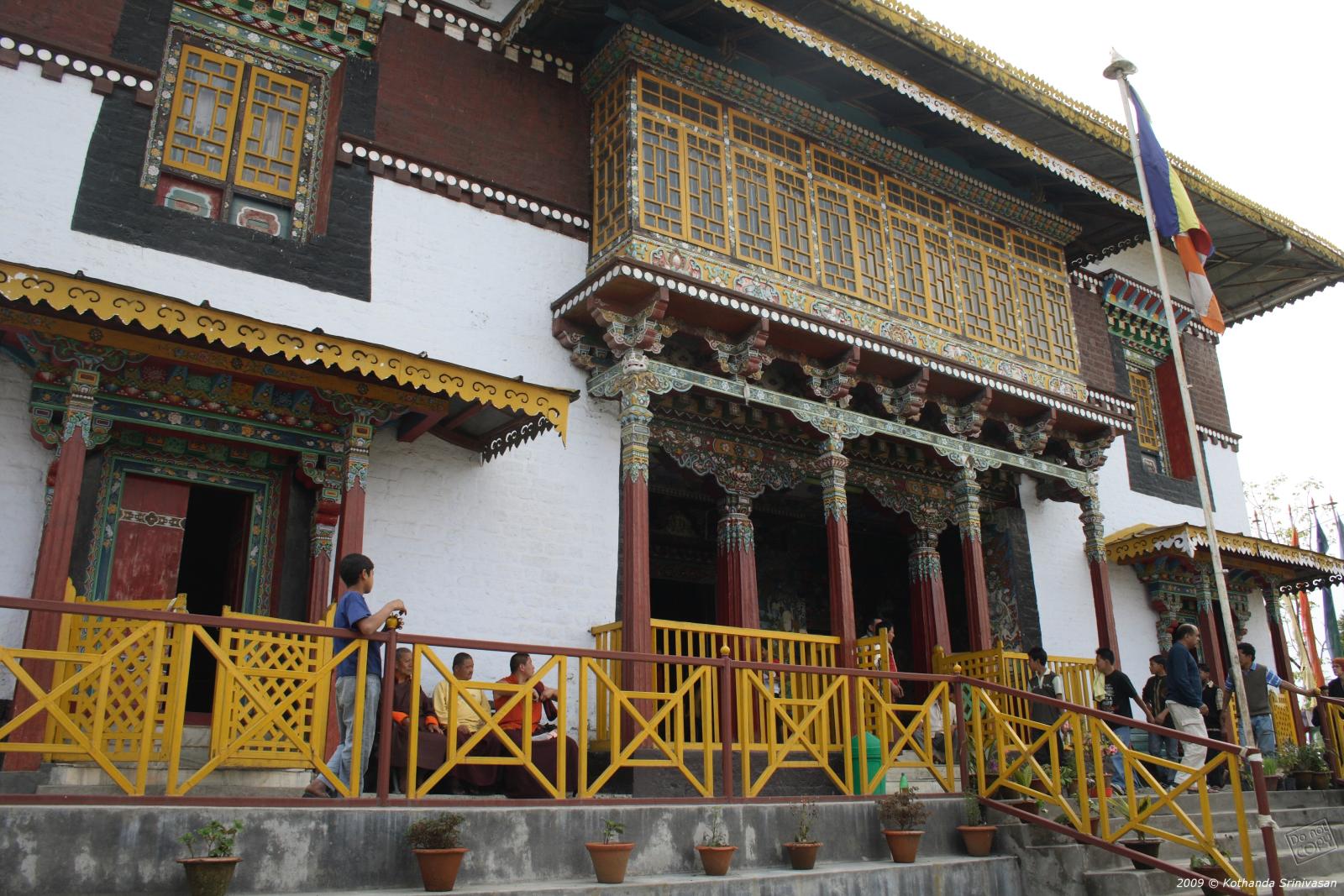
Through all these moves Yuksom kept its role in ritual. Dubdi Monastery, the retreat, was built on the hill above in the early 18th century and is linked by tradition with Lhatsun Chenpo, and the coronation site remained a place of pilgrimage. The twelfth and last ruling Chogyal, Palden Thondup Namgyal, lost his throne in 1975.
Walking the founding story today
Give the history a full day in Yuksom. Start early for Dubdi, while the path is cool, then come down for lunch and spend the afternoon at Norbugang and Kathok Lake. A local guide from the village, about ₹1,000–1,500 for the day, will point out details you would miss, from the footprint said locally to be Lhatsun Chenpo's on the throne stones to the old prayer walls. Entry to the sites is free or by small donation; check current status before you travel.
| Site | What it is | From Yuksom bazaar | Time |
|---|---|---|---|
| Norbugang Throne and Chorten | Coronation seats of 1642 under pines | ≈ 1 km walk | 45 min |
| Kathok Lake | Sacred lake used in royal rites | ≈ 500 m walk | 30 min |
| Dubdi Monastery | The retreat, traditionally 1701 | ≈ 3 km uphill · 45–60 min | 2.5–3 h return |
| Tashiding Monastery | Associated with Ngadak Sempa Chenpo | ≈ 19 km · 1 h by car | Half day |
| Rabdentse ruins | Second capital, from 1670 | ≈ 38 km · 1.5–2 h by car | Combine with Pelling |
Rules, fees, fares and road status change often. Check current status before you travel.