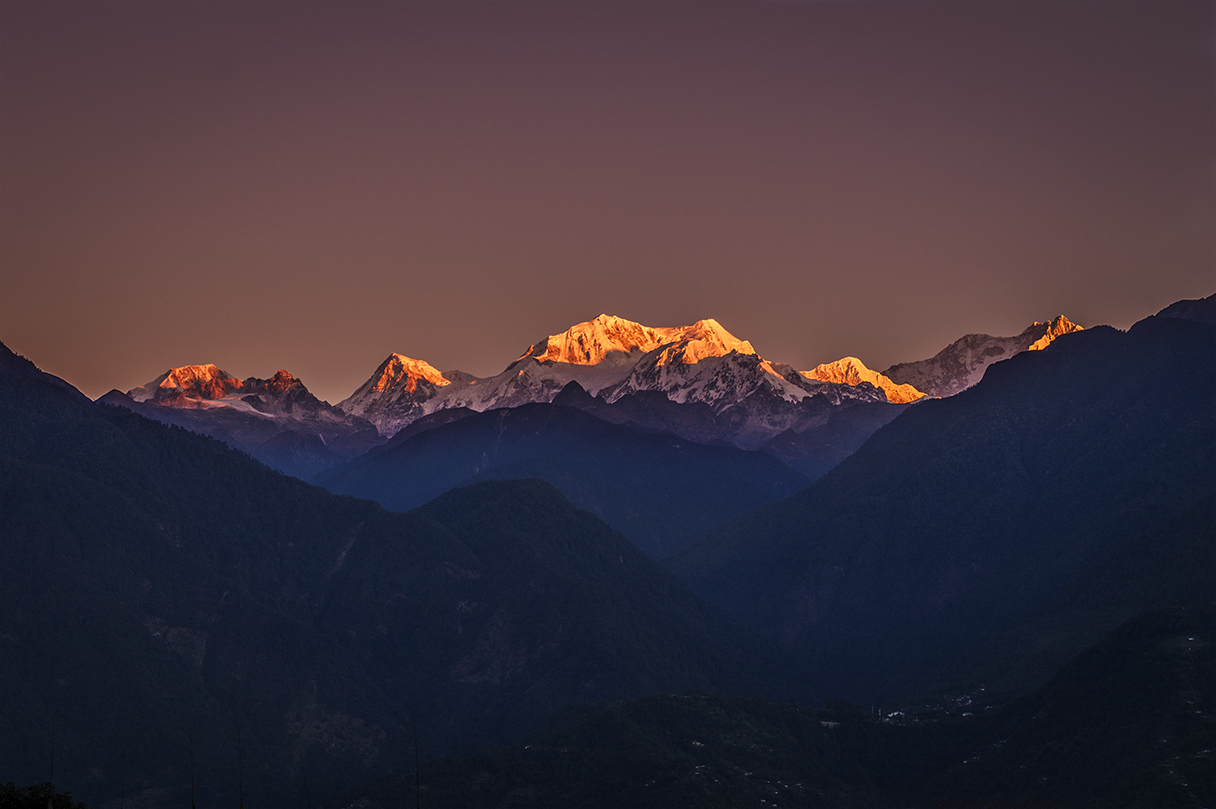
Pelling is a ridge town at about 2,150 m in Gyalshing district, 115 km from Gangtok, and the main base for West Sikkim. On clear mornings it faces Kangchenjunga, Kabru and Pandim. Pemayangtse, Rabdentse, Sanga Choeling and the Skywalk are within a few kilometres. Plan 2–3 nights.
Pelling has grown from a few houses on the ridge above Pemayangtse Monastery into West Sikkim's hotel town. It spreads in three parts along the road: Upper Pelling with the taxi stand, cafes and the helipad viewpoint; Middle Pelling; and Lower Pelling towards Pemayangtse and Gyalshing, the district headquarters 10 km below. Most hotels face north, because the view is the reason Pelling exists.
On a clear morning from October to March, Kangchenjunga (8,586 m) fills the skyline across the Rangeet valley, with Kabru to its left and Pandim to its right. The first light hits the summit pink while the valley below is still dark. From June to September cloud can hide the range for weeks, so time your visit if the view matters to you.
Around the town sit the places that tell Sikkim's early history: Pemayangtse, the senior Nyingma monastery of the state; the ruins of Rabdentse, the royal capital from 1670; and Sanga Choeling, dated to 1697, on the ridge above town, now reached past the 137-foot Chenrezig statue and glass Skywalk opened in 2018. Day trips go to Khecheopalri Lake, Yuksom, Darap, the Singshore Bridge and Uttarey.
Highlights
What to see and do
Sunrise from the helipad
Walk 10 minutes from the Upper Pelling junction to the helipad before dawn. On clear mornings from October to March you see Kangchenjunga, Kabru and Pandim catch first light, with the Rangeet valley still in shadow below. It is free and usually quiet before 6 am.
Pemayangtse Monastery
Sikkim's senior Nyingma monastery, about 2 km below Upper Pelling at 2,085 m. Climb to the top floor for the seven-tiered wooden model of Zangdok Palri, Guru Padmasambhava's celestial palace, made by one lama over five years. Small entry fee.
Rabdentse ruins walk
From a gate on the Pelling–Gyalshing road, a forest path of about 15–20 minutes leads to the ruins of the royal capital of 1670, with its three chortens and stone throne, and a view across to Kangchenjunga. Protected by the Archaeological Survey of India.
Chenrezig statue and Skywalk
The 137-foot statue of Chenrezig and the glass-floored Skywalk opened in 2018 below Sanga Choeling. Come early to avoid queues, then climb the steps on to the old monastery, dated to 1697, for a quieter view.
Day trip to Khecheopalri and Yuksom
The classic full-day loop from Pelling runs past Darap and Rimbi to Khecheopalri Lake, the Kanchenjunga Falls, and on to Yuksom's Norbugang throne and Kathok Lake. About 6–8 hours by car with stops.
The story of Pelling
A town built around a monastery's view
Pelling's name and modern growth are bound up with Pemayangtse. The monastery, whose name Wikipedia translates as 'perfect sublime lotus', has stood on this ridge since the early years of the Sikkim kingdom; it was enlarged under the third Chogyal, Chakdor Namgyal, and consecrated in 1710. Just below it, the second Chogyal, Tensung Namgyal, had moved his court to Rabdentse in 1670. Pelling as a hotel town is much newer: it grew over recent decades as roads improved and travellers came for the view of Kangchenjunga that the monks had always had. In 2018 the state added the Chenrezig statue and glass Skywalk below Sanga Choeling, giving the town a new landmark. Walk early from Upper Pelling down to Pemayangtse and on to Rabdentse, and you trace the kingdom's second chapter in about two hours.
Pelling's helipad, at about 2,200 m in Upper Pelling, has no regular flights but is one of the best free viewpoints in town, with a near 360-degree view of the ranges.
Source: Wikipedia: Pelling
The Chenrezig (Avalokiteshvara) statue near Sanga Choeling stands 137 feet tall, and the glass Skywalk beside it opened in November 2018.
Source: Wikipedia: Pelling
Pemayangtse, the monastery on the ridge just below Pelling, takes its name from words usually translated as 'perfect sublime lotus', and heads the Nyingma monasteries of Sikkim.
Shared jeeps run from Gangtok (≈ ₹350–500) and Siliguri (≈ ₹500–650) to Gyalshing, mostly in the morning, with a few continuing to Pelling. From Gyalshing a shared local taxi covers the last 10 km. Book seats the day before in peak season.
Private car
From Gangtok a reserved car takes 5–6 hours via Singtam and Ravangla or via Jorethang and Legship, indicatively ₹5,000–6,500. Pelling to Yuksom is 2 hours, to Uttarey 1.5–2 hours. NH10 between Gangtok and Singtam can close in the monsoon.
From Bagdogra / NJP
About 135–145 km and 5–6 hours via Sevoke, Melli, Jorethang, Legship and Gyalshing, indicatively ₹5,500–7,500 by private car. If NH10 is closed after slides, drivers come via Darjeeling to Jorethang. Check current status before you travel.
Indian travellers need no permit for Pelling, Yuksom, Khecheopalri, Tashiding or Uttarey. The Dzongri and Goecha La trek needs a Khangchendzonga National Park permit and fees, arranged at Yuksom through a registered trekking agency with a licensed guide. Foreign nationals need the Restricted Area Permit to enter Sikkim, applied for online via the e-FRRO portal after arriving in India, and a Protected Area Permit in a group of two or more for the Dzongri–Goecha La trek. Sikkim charges a ₹50 per tourist fee at check-in. Check current status before you travel.
Upper Pelling has the most hotels, cafes and the taxi stand, and suits budget and value travellers; Hotel Garuda is the long-standing budget choice near the helipad. For comfort, Norbu Ghang Retreat and Spa and Summit Newa Regency give mountain-facing rooms a short drive from the monasteries. At the premium end, The Chumbi Mountain Retreat and Spa offers resort facilities, while The Elgin Mount Pandim sits quietly below Pemayangtse. For village life, Daragaon Village Retreat in Darap is 8 km away.
About 115 km, or 5–6 hours by car via Singtam and Ravangla or via Jorethang and Legship. A private car costs indicatively ₹5,000–6,500. Shared jeeps run to Gyalshing for ₹350–500, and a local taxi covers the last 10 km. NH10 can close in the monsoon, so check current status before you travel.
How many days are enough for Pelling?
Two nights cover the local sights and one day trip to Khecheopalri and Yuksom. Three nights let you add the Singshore Bridge and Uttarey or a slower day at Pemayangtse and Rabdentse. Many travellers combine Pelling with Gangtok and North Sikkim in a 7–9 night trip.
What is the best time to visit Pelling?
Mid-October to March for clear Kangchenjunga views, with October and November best, and March to May for flowers and mild weather. Avoid June to September if views and dry roads matter; it is the monsoon, when slides and cloud are common but hotels are cheapest.
Can I see Kangchenjunga from Pelling?
Yes, on clear days, especially at sunrise from October to March. The helipad in Upper Pelling, hotel rooftops and the Pemayangtse lawns give the best views of Kangchenjunga, Kabru and Pandim. Cloud often builds by mid-morning, so look early.
Is Pelling better than Gangtok?
They are different. Gangtok is a busy capital with shopping, cafes and access to Tsomgo, Nathu La and North Sikkim. Pelling is a small, quiet ridge town with closer Kangchenjunga views and the early history of the kingdom. Most first-time visitors spend time in both.
Is Pelling good for a honeymoon?
Yes. Pelling offers mountain-view rooms, quiet evenings, sunrise viewpoints and short walks to monasteries. Choose a mountain-facing room at Norbu Ghang, The Chumbi Mountain Retreat or The Elgin Mount Pandim, and travel between October and April for the best chance of clear views.
How much does a Pelling sightseeing car cost?
Indicatively ₹2,500–3,500 per car for a half-day local tour covering Pemayangtse, Rabdentse, the Skywalk and Sanga Choeling, and ₹3,500–5,000 for a full day to Khecheopalri, the waterfalls and Yuksom. Rates are per vehicle, not per person, and rise slightly in peak season.
Do I need a permit to visit Pelling?
Indian nationals do not need a permit for Pelling. Foreign nationals need the Restricted Area Permit for Sikkim, now applied for online via the e-FRRO portal after arriving in India. Sikkim also charges a ₹50 per tourist fee at hotel check-in. Check current status before you travel.
Is Pelling cold?
It is cool year-round at 2,150 m. Winter nights from December to February drop near freezing, with days around 10–13 °C. Summer days reach about 20–21 °C. Rooms are rarely centrally heated, so carry warm layers and ask for a heater or extra blankets in winter.
Every cost shownRooms, car, permits and our fee, itemised
One person to callFrom Bagdogra or NJP until you are back
No payment to startA deposit only when you book
Get my price
Want Pelling in your plan?
Tell us your dates, who is travelling and roughly what you want to spend. We reply within one working day with a day-by-day route and an itemised price.
No payment to start
Permits handled through registered partners
Every hotel, car and fee listed
Price my Sikkim trip
Tell us dates, people and budget. You get a day-by-day plan and an itemised price within one working day.