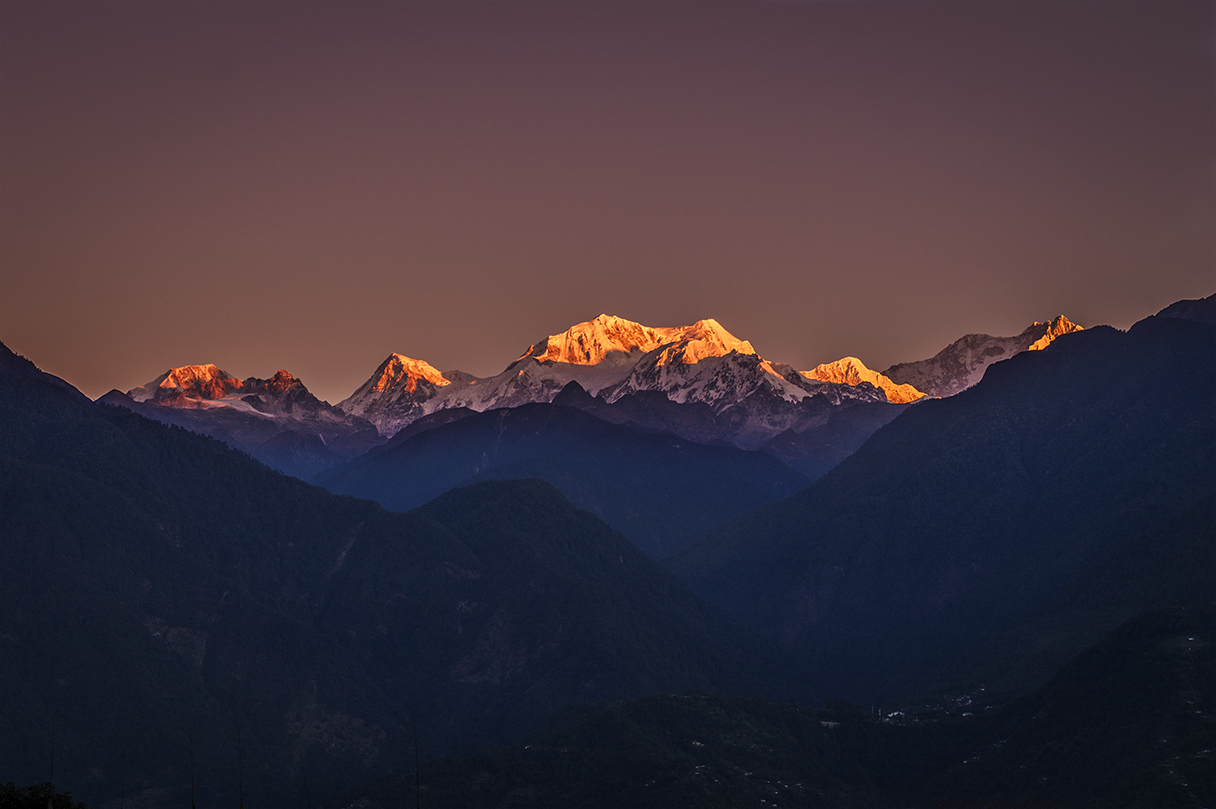
Rabdentse, about 3 km from Pelling near Pemayangtse, holds the ruins of Sikkim's second capital, founded by the second Chogyal in 1670 and later abandoned after Nepalese (Gorkha) invasions. A 15–20 minute forest path leads to palace walls, three chortens and a stone throne facing Kangchenjunga.
Rabdentse sits on a forested spur just below Pemayangtse Monastery, close to the Pelling–Gyalshing road. In 1670 the second Chogyal, Tensung Namgyal, moved his court here from Yuksom, and for over a century this hilltop was the seat of the Namgyal kings. Today it is a quiet ruin under oak, chestnut and rhododendron, protected by the Archaeological Survey of India as a monument of national importance.
The path starts at an ornamental gate on the main road and runs for 15–20 minutes through forest, past a small pond, to the ruins. What survives are the stone walls of the palace's northern and southern wings, the Taphap Chorten that marked the entrance, the Dab Lhagang prayer hall with its marble slab, three chortens where the royal family prayed, and the Namphogang, a stone throne used for judicial pronouncements.
The end of the capital came in stages. Wikipedia records that Chogyal Tsugphud Namgyal moved the capital east to Tumlong in 1793, finding Rabdentse too exposed to raids from Nepal, and gives 1814 as the end of its time as capital; the town was later destroyed by the invading Gorkha army. On a clear day the terrace at the far end faces Kangchenjunga, as the court once did.
Highlights
What to see and do
The forest path
The 15–20 minute walk from the ornamental gate on the Pelling–Gyalshing road runs through oak and rhododendron forest, past a small pond. Birds are active in the early morning, and the path is gentle enough for children and most older visitors.
Three royal chortens
At the heart of the ruins stand three chortens where the royal family offered prayers. They are among the best-preserved structures on the site and frame Kangchenjunga beautifully on clear mornings from October to March.
The Namphogang throne
A stone seat where the king's judgements were pronounced. It is easy to miss without a guide, but it is one of the few physical traces of how the kingdom was governed in the 18th century.
Palace walls and the Dab Lhagang
Low stone walls trace the palace's northern and southern wings. The Dab Lhagang, a prayer hall marked by a white marble slab, stood within the complex. ASI conservation has stabilised the remains.
View from the far terrace
At the end of the ruins a terrace looks north across the Rangeet valley to Kangchenjunga, Kabru and Pandim, with Pemayangtse on the ridge above. Sit here for 10 minutes and the reason the Chogyals chose this hill becomes clear.
The story of Rabdentse Ruins
A capital caught between Bhutan and Nepal
Rabdentse's 150 years as a royal seat were rarely peaceful. Soon after the third Chogyal, Chakdor Namgyal, came to the throne in 1700, his half-sister Pende Ongmu, who opposed his succession, invited forces from Bhutan into Sikkim, according to Wikipedia's article on the Chogyal. The young king fled to Lhasa, and Bhutanese troops occupied Sikkim until about 1708, when Tibetan mediation restored him, at the cost of land east of the Teesta. Pende Ongmu's feud did not end there: in 1716 a physician in her pay bled the king to death at the Ralang hot springs, and both she and the physician were executed. Later in the 18th century the threat came from the west, as the expanding Gorkha kingdom of Nepal raided across the Singalila Ridge. The capital moved east to Tumlong in the 1790s, and the Gorkha army reduced Rabdentse to the ruins you walk through today.
Source: Wikipedia: Rabdentse; Chakdor Namgyal
Little known
Things most visitors never hear
The Namphogang at Rabdentse is a stone throne where judgements were pronounced, a rare surviving piece of the kingdom's system of justice.
Source: Wikipedia: Rabdentse
The Archaeological Survey of India declared Rabdentse a monument of national importance and has carried out conservation of its walls and chortens.
Source: Wikipedia: Rabdentse
Wikipedia records that the capital moved to Tumlong in 1793 because Rabdentse was too vulnerable to attack from Nepal, across the Singalila Ridge to the west.
From Pemayangtse, walk a few minutes to the ornamental gate on the Pelling–Gyalshing road, then 15–20 minutes on the forest path. From Upper Pelling, allow about 45 minutes on foot to the gate.
Private car
Included in every Pelling half-day tour, indicatively ₹2,500–3,500 per car. The car drops you at the gate and waits while you walk in. A one-way taxi from Upper Pelling costs about ₹200–400.
From Bagdogra / NJP
Reach Pelling first via Melli, Jorethang, Legship and Gyalshing, about 135–145 km and 5–6 hours. The gate is on the same road, a few minutes before Pelling, so you can visit on arrival if there is daylight.
Permits in West Sikkim
Indian travellers need no permit for Pelling, Yuksom, Khecheopalri, Tashiding or Uttarey. The Dzongri and Goecha La trek needs a Khangchendzonga National Park permit and fees, arranged at Yuksom through a registered trekking agency with a licensed guide. Foreign nationals need the Restricted Area Permit to enter Sikkim, applied for online via the e-FRRO portal after arriving in India, and a Protected Area Permit in a group of two or more for the Dzongri–Goecha La trek. Sikkim charges a ₹50 per tourist fee at check-in. Check current status before you travel.
Stay in Pelling, 3 km away. The Elgin Mount Pandim, near Pemayangtse, is the closest premium hotel and an easy walk to the Rabdentse gate. Summit Newa Regency is a few minutes' drive. Upper Pelling has budget rooms at Hotel Garuda and comfort rooms at Norbu Ghang Retreat and Spa.
Rabdentse is the second capital of the Kingdom of Sikkim, founded in 1670 by the second Chogyal, Tensung Namgyal. Its ruins, including palace walls, three chortens and the Namphogang stone throne, are protected by the Archaeological Survey of India and look across to Kangchenjunga.
How far is Rabdentse from Pelling?
About 3 km by road from Upper Pelling to the gate on the Pelling–Gyalshing road, then a 15–20 minute walk on a forest path. It is a few minutes from Pemayangtse Monastery, and most visitors see both together.
Is there an entry fee for Rabdentse?
The site has been free or charged a small fee in recent years under the Archaeological Survey of India. Fees and timings change, so check current status before you travel. Keep small notes handy for entry and parking.
When was Rabdentse the capital of Sikkim?
From 1670, when the second Chogyal moved the court from Yuksom. Wikipedia records that Chogyal Tsugphud Namgyal moved the capital to Tumlong in 1793 because of raids from Nepal, and gives 1814 as the end of Rabdentse's time as capital. The Gorkha army later destroyed the town.
How much time do I need at Rabdentse?
About 1–1.5 hours including the walk in and out. Combine it with Pemayangtse for a 3-hour morning. Photographers and history readers may want longer on the terrace and at the chortens.
Is Rabdentse open in the monsoon?
Usually yes, but the forest path is slippery and leeches are common from June to September, and views are often clouded. Wear grippy shoes and leech socks, carry an umbrella and check current status before you travel.
Who destroyed Rabdentse?
According to Wikipedia, the invading Gorkha army from Nepal destroyed Rabdentse after decades of raids across the western border in the late 18th and early 19th centuries. The court had already moved east to Tumlong in the 1790s for safety.
Can elderly travellers visit Rabdentse?
Most can. The forest path is about 15–20 minutes each way, mostly gentle but uneven with roots and some steps. Take it slowly at about 2,000 m and use a walking stick if helpful. There are no facilities inside, so use toilets in Pelling first.
Is Rabdentse worth visiting?
Yes, if you are interested in Sikkim's history or want a quiet forest walk. It is the most complete surviving royal site in West Sikkim, it is close to Pelling, and on clear mornings the view of Kangchenjunga from the ruins is superb.
Every cost shownRooms, car, permits and our fee, itemised
One person to callFrom Bagdogra or NJP until you are back
No payment to startA deposit only when you book
Get my price
Want Rabdentse Ruins in your plan?
Tell us your dates, who is travelling and roughly what you want to spend. We reply within one working day with a day-by-day route and an itemised price.
No payment to start
Permits handled through registered partners
Every hotel, car and fee listed
Price my Sikkim trip
Tell us dates, people and budget. You get a day-by-day plan and an itemised price within one working day.