Soreng districtHQ SorengBest Mar – Apr · Oct – Nov10 places2 packages8 stays
Soreng in short
Soreng district, carved from West Sikkim in December 2021, is Sikkim's south-west corner: the Rinchenpong–Kaluk ridge facing Kangchenjunga, the Barsey Rhododendron Sanctuary above the Sherpa village of Okhrey, and Limbu, Lepcha and Nepali farm villages. No special permit for Indians, homestays from about ₹1,200, best October–December and March–April.
Best months
October–December and March–April
Headquarters
Soreng (≈ 1,300 m), ≈ 28 km above Jorethang
Nearest airport
Bagdogra (IXB) ≈ 125–130 km to Soreng
Nearest railhead
NJP ≈ 115 km to Soreng
Altitude range
≈ 350 m (Rangeet valley) – ≈ 4,100 m (Singalila ridge, Barsey sanctuary)
Languages
Nepali, Limbu, Lepcha, Sherpa, Tamang, Bhutia, Hindi, English
Permits
None for Indians; foreigners need Sikkim's RAP (e-FRRO); Barsey sanctuary entry ticket
Soreng district is the south-west corner of Sikkim. It was a subdivision of the West district until 13 December 2021, when the state created Soreng and Pakyong as its fifth and sixth districts, and its headquarters is the hill town of Soreng. The district borders Nepal along the Singalila ridge to the west, West Bengal to the south, Gyalshing district (West Sikkim) to the north and Namchi district across the Rangeet to the east. You enter it over the Akar bridge at Jorethang, about 70 km from Siliguri.
It is a district of farms rather than famous sights. The 2011 census counted about 64,760 people in what is now Soreng district, and fewer than two percent lived in towns. Terraces of paddy and maize climb from warm valleys at under 1,000 m, orange trees stand around houses, and large cardamom grows in the shade of alders. Above them, on the Singalila ridge, the Barsey Rhododendron Sanctuary protects 104 km² of rhododendron, oak and magnolia forest that flowers from March to May.
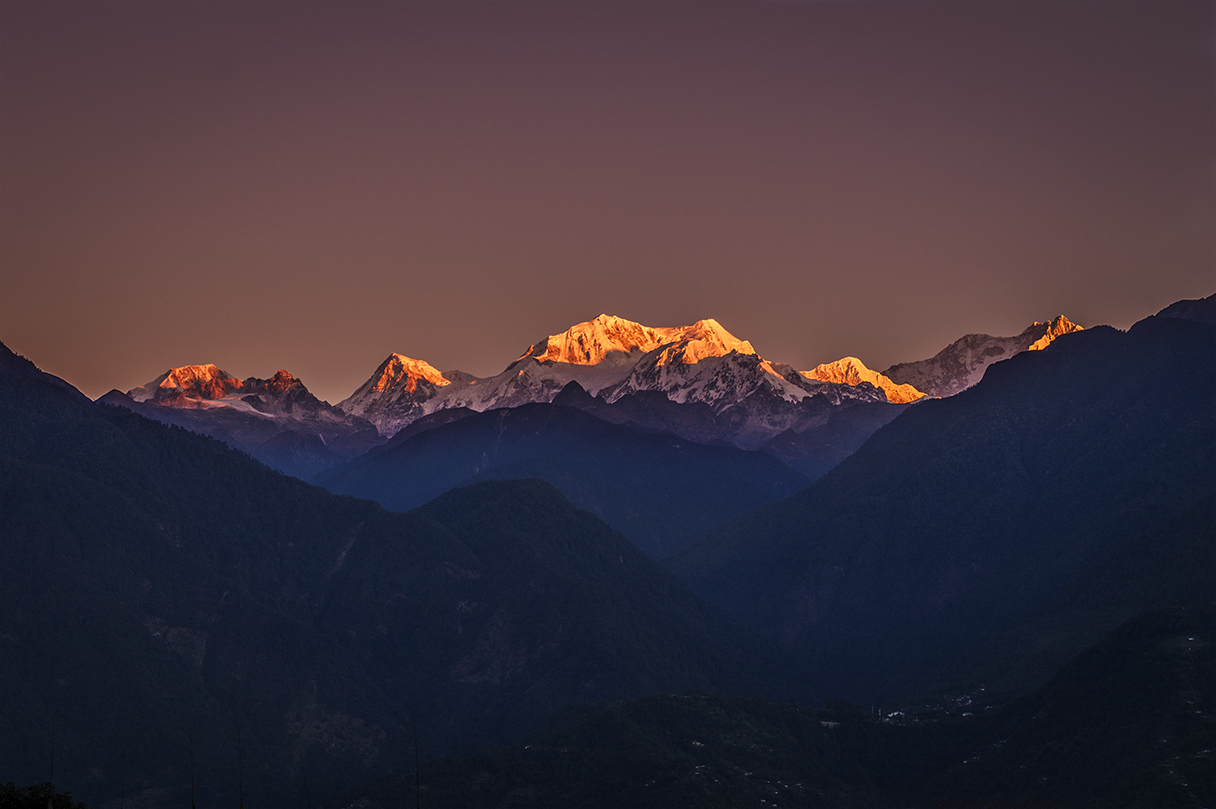
Most visitors come for two places. The twin villages of Rinchenpong and Kaluk sit on a ridge at about 1,550–1,650 m with one of the widest Kangchenjunga views in Sikkim, a monastery founded around 1730 and plenty of homestays. To the west, the Sherpa village of Okhrey and the road-end at Hilley are the base for the 4–5 km forest walk to Barsey. In between are Soreng town, the lower villages of Tharpu and Daramdin, and the bazaars of Sombaria and Mangalbarey.
Soreng is one of the most mixed corners of Sikkim. Nepali is the most common first language, but the 2011 census found Limbu spoken at home by about 14 percent of people, with Lepcha, Sherpa, Tamang, Bhutia and Rai families too. That mix gives the district its stories: a Lepcha tower of clay pots at Daramdin, a Mangar raja's fort at Tharpu, a Gurung new year at Rinchenpong. It is also cheap and quiet. Indians need no special permit, homestays cost about ₹1,200–2,200 per person with meals, and even in April you rarely share a viewpoint.
Highlights
What brings people here
Rinchenpong and Kaluk
Twin ridge villages 3 km apart at about 1,550–1,650 m, facing the whole Kangchenjunga range from October to April. Rinchenpong has the monastery founded around 1730 with its rare Ati Buddha and the Poison Lake story; Kaluk has village resorts and the widest views. Homestays from about ₹1,200 per person with meals.
Barsey Rhododendron Sanctuary
A 104 km² sanctuary on the Singalila ridge, notified in 1996. From the road-end at Hilley a 4–5 km forest trail climbs gently to the Barsey ridge at about 3,000 m. Rhododendrons bloom from March to May, usually peaking in April, and Kangchenjunga fills the view on clear mornings.
Okhrey's Sherpa homestays
A mainly Sherpa farming village at about 2,300 m, 8 km below Hilley, with a Nyingma monastery built in 1950 and dozens of family homestays. It is the most practical base for Barsey, and an evening in a Sherpa kitchen is part of the reason to come.
Limbu and Lepcha villages
Around Soreng, Daramdin and the slopes below Barsey, many families are Limbu or Lepcha. Stay in a village homestay, ask about food and festivals such as Chasok Tangnam, and hear the Lepcha story of Daramdin's clay-pot tower. Few places in Sikkim make this so easy.
Mangardzong and lower Soreng
In the warm valleys at Tharpu, the district marks the fort site of Sintu Pati Sen, a Mangar raja who, as told locally, defied the first Chogyal. Combine it with Daramdin's Stairway to Heaven site and paddy terraces for a half day almost no visitors see.
Oranges, cardamom and organic farms
Soreng is known for oranges, ginger, large cardamom, vegetables and flowers, all grown organically as across Sikkim. From November to January the slopes are full of ripe Sikkim mandarins; from August to October cardamom is harvested and dried. Farm walks cost little and need only a local guide.
A rooted story
The Mangar raja who defied the first Chogyal
In Tharpu, a farming village in the lower valleys of Soreng district, the district administration marks a historic site called Mangardzong. According to the people of the area, it says, a ruler named Sintu Pati Sen, the Mangar raja, governed this place around 1600. When Phuntsog Namgyal became the first Chogyal of Sikkim, the other rulers of the region surrendered their titles to him. Sintu Pati Sen refused, and chose to fight. The local account says he won that first war. Later, the Chogyal returned with Tibetan soldiers and attacked Mangardzong. The raja fled through the jungle and was killed in a meadow still called Raja Tar, the king's flat. Wikipedia records that Phuntsog Namgyal was consecrated in 1642, so the oral date of around 1600 should be read loosely. The Mangar, or Magar, people are one of Sikkim's Nepali-speaking communities, and Sikkim's royal chronicles say little about rulers who resisted the new kingdom. This story survives because local families kept it, and because the district has written it down. The state government has been building a memorial at the site; check its status before you go, and hear the story from a local guide.
There is no airport or railway in Soreng district. Fly to Bagdogra (IXB) or take a train to New Jalpaiguri (NJP), then drive 4–5 hours via Sevoke, along NH10 beside the Teesta to Melli, where you enter Sikkim, and up the Rangeet valley to Jorethang. NH10 closes after monsoon landslides; the alternative is via Kalimpong or Darjeeling to Jorethang. From Jorethang, cross the Akar bridge: Soreng town is about 28 km, Rinchenpong 32 km, Sombaria about 30 km and Okhrey 42 km. Shared jeeps run Siliguri–Jorethang (₹250–350) and on to most bazaars; a small car from Siliguri costs about ₹4,500–6,500. From Gangtok, allow 4.5–5.5 hours. Pakyong Airport has had no scheduled flights since June 2024. Check current status before you travel.
Indian travellers need no special permit anywhere in Soreng district. You pay Sikkim's ₹50 tourist fee, collected by your hotel or homestay and valid 30 days, and an entry ticket at the Hilley checkpost for the Barsey Rhododendron Sanctuary, about ₹50 for Indians. Foreign nationals need Sikkim's Restricted Area Permit, which since 12 January 2026 is applied for online on the e-FRRO portal after arriving in India, with approval in 24–48 hours. Foreigners pay a higher Barsey entry fee. Check current status before you travel.
Soreng is one of the cheapest parts of Sikkim. On a budget, shared jeeps cost about ₹250–350 from Siliguri to Jorethang and ₹80–180 on to the villages, and homestays charge about ₹1,200–2,200 per person a night with meals, so ₹2,000–3,000 a day each covers most trips. At mid level, a private small car costs about ₹3,000–4,000 a day and village resorts in Kaluk about ₹3,000–5,500 a room. At the top, Yangsum Heritage Farm near Rinchenpong costs roughly ₹6,000–9,500 a room with meals. Carry cash: ATMs are in Jorethang, Soreng and a few bazaars only. All figures are indicative 2026 rates.
Soreng district is the south-west corner of Sikkim. It borders Nepal to the west along the Singalila ridge, West Bengal to the south, Gyalshing district (West Sikkim) to the north and Namchi district (South Sikkim) to the east across the Rangeet. You enter it over the Akar bridge at Jorethang, about 70 km from Siliguri.
When was Soreng district created?
On 13 December 2021, according to the Soreng district administration, when Sikkim created Soreng and Pakyong as new districts. Soreng had been a subdivision of the West district, which was split into Gyalshing and Soreng. Many maps and drivers still call the area West Sikkim.
Do I need a permit to visit Soreng district?
Indian nationals need no special permit, only Sikkim's ₹50 tourist fee collected by accommodation and an entry ticket for the Barsey sanctuary. Foreign nationals need Sikkim's Restricted Area Permit, applied for online on the e-FRRO portal after arriving in India since January 2026. Check current status before you travel.
What is the best time to visit Soreng?
October to December for the clearest Kangchenjunga views and dry, cool weather, and March to April for the Barsey rhododendron bloom, which usually peaks in April. January and February are cold but clear. June to September is the monsoon, with heavy rain, leeches and landslides, and we advise against it.
How do I reach Soreng from Siliguri or NJP?
By car, 4–5 hours via Sevoke, NH10 along the Teesta to Melli, and Jorethang, about ₹4,500–6,500 for a small car. By shared jeep, go Siliguri–Jorethang (₹250–350) and change for Soreng, Rinchenpong or Sombaria. NH10 closes after monsoon slides, when drivers go via Kalimpong or Darjeeling. Check current status before you travel.
Which places should I visit in Soreng district?
For views and history, Rinchenpong and Kaluk on the ridge facing Kangchenjunga. For rhododendrons, the Barsey sanctuary from Hilley, staying in Okhrey. For village life and stories, Daramdin, Tharpu's Mangardzong site and the Sribadam monasteries near Soreng. Four to five nights covers the ridge and Barsey comfortably.
How many days do I need in Soreng?
Two nights is the minimum for the Rinchenpong–Kaluk ridge, and two more for Okhrey and the Barsey walk. Four or five nights covers both with time for a village homestay. Soreng also combines well with two nights in Pelling, about 31 km from Rinchenpong.
Is Soreng good for a budget trip?
Yes, it is one of the cheapest parts of Sikkim. Shared jeeps reach most villages, homestays cost about ₹1,200–2,200 per person with meals, and there are no permit fees for Indians beyond small tourist and sanctuary charges. A budget traveller can manage on about ₹2,000–3,000 a day.
Is Soreng the same as West Sikkim?
It used to be part of West Sikkim. Since December 2021, the old West district has been split into Gyalshing district, which keeps Pelling, Yuksom and Pemayangtse, and Soreng district, which has Rinchenpong, Kaluk, Okhrey, Hilley and Barsey. Many travel sites and drivers still use West Sikkim for both.
Little known
Things most visitors to Soreng never hear
Each one is sourced, so you can check it yourself.
Limbu is the second most common first language in Soreng district: 14.13 percent of residents named it in the 2011 census, after Nepali at 65.11 percent and ahead of Lepcha at 5.05 percent.
Source: Census of India 2011, via Wikipedia, Soreng district
Soreng and Pakyong districts were created together on 13 December 2021 by notification number 26/L&PAD/2021, splitting the old West district into Gyalshing and Soreng.
Source: soreng.nic.in (About District)
Daramdin's name comes from the Lepcha word dalom, a place of rest or flat land, according to the district administration, and the village is tied to a Lepcha story of a tower built of clay pots.
Rinchenpong Monastery, founded around 1730 and counted by the district as the third oldest in Sikkim, is also known as Sang Ngag Yangtse Monastery, and keeps a rare Ati Buddha image.
Two of the district's bazaars are named after weekdays in Nepali: Sombaria after Sombar, Monday, and Mangalbarey after Mangalbar, Tuesday. As told locally, both recall old weekly market days.
One person to callFrom Bagdogra or NJP until you are back
No payment to startA deposit only when you book
Get my price
Plan Soreng with people who live here
Who is travelling, when, and roughly what you want to spend. The Gangtok desk replies within one working day with a day-by-day plan and an itemised price.
No payment to start
Permits handled through registered partners
Every hotel, car and fee listed
Price my Sikkim trip
Tell us dates, people and budget. You get a day-by-day plan and an itemised price within one working day.