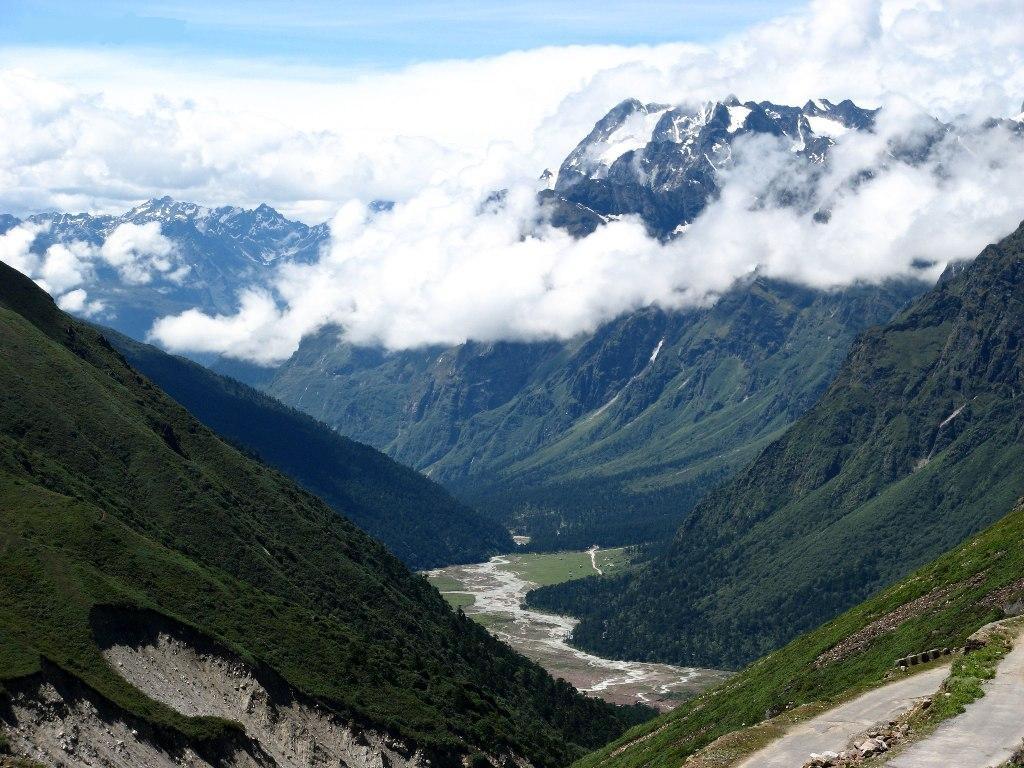
Where things stand in October 2026
North Sikkim is open again, but it is a different place to plan for than it was before 2023. Lachung, with Yumthang and Zero Point, reopened to tourists on 8 September 2025 and has been the steadier of the two valleys since. Lachen and Gurudongmar reopened on 9 March 2026, over a new single-lane Bailey bridge at Taram Chu, then closed again in April after a landslide. The road was repaired by 29 August 2026 and permits resumed around 11 and 12 September.
That is the position as we write in early October 2026. It can change in a night. We check road reports with drivers and the district administration before every departure, and we would rather move your North Sikkim days than send you up a road that is about to close. Please check current status before you travel, even if you booked months ago.
Why the roads are so fragile
On the night of 3 to 4 October 2023, South Lhonak Lake, a glacial lake high above Lachen, burst its moraine after heavy rain. The flood that followed tore down the Teesta valley, destroyed the Teesta Stage III dam at Chungthang, washed away bridges and long stretches of road, and caused loss of life downstream as far as the plains. The Wikipedia article on the 2023 Sikkim flash flood gives the wider picture.
Chungthang, where the Lachen and Lachung roads part, sat at the centre of the damage. Lachung was reconnected first. The Chungthang to Lachen road needed about 28 km of rebuilding by the Border Roads Organisation and a new bridge, and stayed closed to tourists for 887 days. Even repaired, these roads run along steep, freshly cut slopes above a river that still carries flood debris. In heavy rain, small slides are common and big ones happen.
Timeline at a glance
The key dates for planning. Every one of them is a reason to check current status before you travel.
| Date | What happened |
|---|---|
| 3–4 Oct 2023 | South Lhonak Lake outburst flood; Chungthang and the Lachen road badly damaged |
| 2024–2025 | Lachung reconnected; repeated monsoon closures across North Sikkim |
| 8 Sep 2025 | Lachung, Yumthang and Zero Point reopen to tourists |
| 9 Mar 2026 | Lachen and Gurudongmar reopen over the Taram Chu Bailey bridge |
| Apr 2026 | Landslide closes the Lachen road again |
| 29 Aug 2026 | Lachen road repaired |
| 11–12 Sep 2026 | Permits for Lachen and Gurudongmar resume |
We turn this into a priced, day-by-day plan for your dates.
The monsoon, month by month
The monsoon in North Sikkim usually runs from early June to late September, with the heaviest rain in July and August. In those months we do not sell Lachen trips with confidence, and we sell Lachung trips only with flexible dates and a clear refund rule. Permits can be suspended in the evening for the next morning, and vehicles already up north can be held for a day or two until a slide is cleared.
May and early October are shoulder months. Pre-monsoon storms in late May and late rains in early October can still close roads, but closures are usually short. October after the first week, November and March are the most reliable months for roads. December to February bring a different risk: snow and ice above Lachung and Thangu, which can close Zero Point and the Gurudongmar road even when the lower highway is fine.
- June: rising risk; early June is often workable, late June less so.
- July–August: highest risk; expect suspensions.
- September: risk falling; permits often resume mid-month.
- October–November: most reliable; book early for Puja weeks.
- December–March: snow risk at the top, roads below usually open.
Getting to Gangtok when NH10 closes
The trip north starts in Gangtok, and getting there has its own monsoon problem. NH10, the main road from Siliguri through Sevoke, Teesta Bazaar and Rangpo to Gangtok, closes after slides several times most monsoons, sometimes for days. When it does, vehicles go round via Kalimpong and Lava, or via Algarah, which adds 1.5 to 3 hours and some sharp hairpins. The Sevoke to Rangpo railway is not open yet; completion is targeted for December 2027.
If you are arriving at Bagdogra or NJP in the monsoon, do not plan to go north the next morning. Give yourself one buffer night in Gangtok, so a slow drive up does not cost you your North Sikkim permit, which is tied to dates.
Pakyong Airport near Gangtok has had no scheduled flights since June 2024, so Bagdogra (IXB) and New Jalpaiguri (NJP) remain the gateways in every season. Book flights that land before noon in the monsoon, so a detour via Kalimpong still gets you to Gangtok before dark.
What a closure looks like on the ground
Most closures are not dramatic. A slope gives way overnight after heavy rain, a stretch of road is covered with mud and boulders, and the police stop vehicles at the nearest check post while a Border Roads Organisation crew clears it with an excavator. Small slides are often cleared in two to six hours. Larger ones, or a damaged bridge, can take days or weeks.
If you are already in Lachung or Lachen when a slide blocks the road back, you stay put. The lodge keeps your room, your driver waits with you, and the district administration decides when vehicles can move, sometimes in convoys at fixed times. Extra nights are usually charged at cost, at about ₹3,000–5,000 per room with meals. This is why we keep a spare day before your flight and why travel insurance with trip-disruption cover is worth buying.
If permits are suspended before you leave Gangtok, nothing moves north that day. We then either wait a day, switch your order, or replace North Sikkim with Dzongu, Tsomgo Lake or Pelling, depending on the forecast and how long the closure is expected to last.
How to check current status
There is no single official page that tells you, at a glance, whether North Sikkim is open today. These are the sources we use, in order of usefulness.
- Your registered operator or Gangtok hotel, who hears from drivers and the permit office daily.
- Notices from the Mangan district administration and the Sikkim Tourism department, which announce suspensions and resumptions.
- Sikkim Police traffic updates and local news outlets such as EastMojo and Sikkim Express for NH10 and North Sikkim highway closures.
- Weather warnings from the India Meteorological Department for Sikkim, especially red and orange alerts.
Planning so a closure does not ruin the trip
Build the North Sikkim days in the middle of your trip, not at the end, so that if permits stop you can swap them with Gangtok or Pelling days and try again. Keep one spare day before your flight out of Bagdogra. Ask your operator in writing what happens to your money if permits stop before you leave Gangtok, and who pays if you are held up north; our own rule is a refund of the North Sikkim portion or a free switch if permits stop before departure, and extra nights up north at cost.
Have a plan B ready: Dzongu, at a lower altitude off the same highway, often stays open when Lachen does not; Tsomgo Lake and Nathu La (Indians only) to the east, and Pelling to the west, make good substitutes. Take travel insurance with trip-disruption cover. And pack patience: a two-hour wait at a slide, with tea from a roadside stall, is part of travelling in these mountains.
Rules, fees, fares and road status change often. Check current status before you travel.