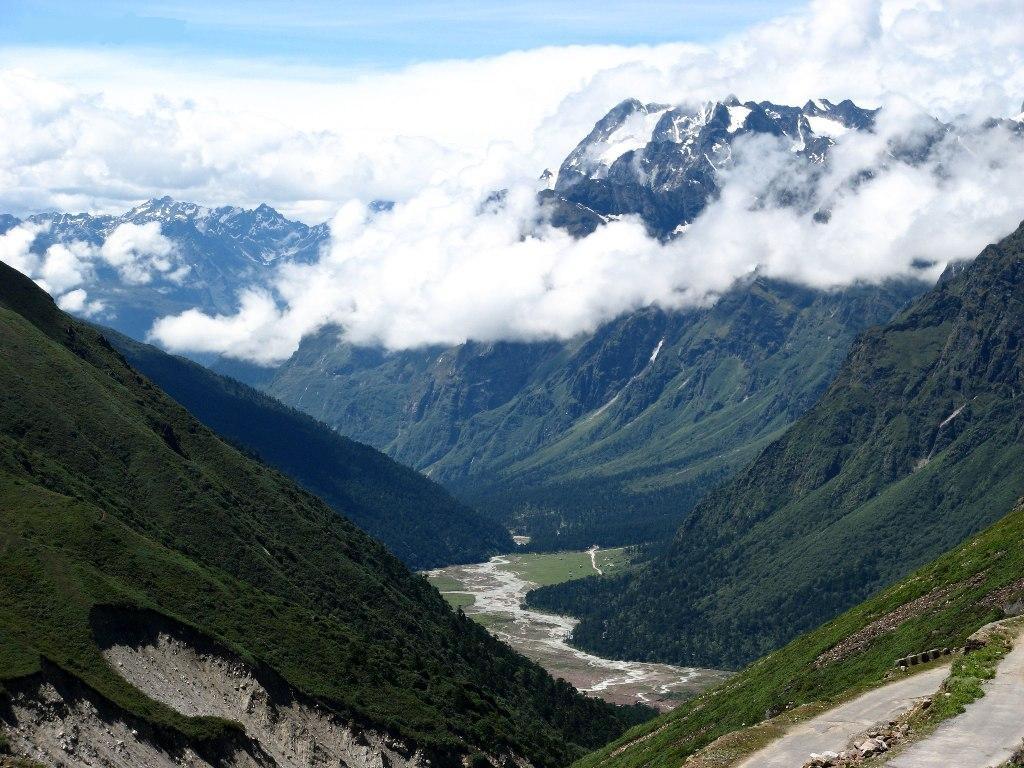
A council older than the road
Most villages in India elect a panchayat. Lachung and Lachen, the two highest villages on the North Sikkim tourist circuit, do something older. They govern themselves through the Dzumsa, a word usually explained as a meeting place or assembly of the people. Every household sends a member, decisions are taken together, and the village is led by a headman called the Pipon.
The people of the two valleys are known as Lachungpa and Lachenpa, Bhutia communities who for generations moved between winter homes in the villages and summer pastures higher up, with yaks, sheep and a little barley, potato and buckwheat. A scattered, seasonal life on a cold frontier needed a way to share pastures, settle disputes and organise work, and the Dzumsa grew to do that. Its exact age is not well documented; written accounts describe it as several centuries old, and the short Wikipedia article on the Dzumsa places its formal shape in the 19th century.
What makes it remarkable is not only that it survives, but that the modern state chose to work through it rather than replace it.
Who does what
The structure is simple. The details below come from published accounts, including a North Bengal University study and a 2024 Mongabay India article on Lachung by Shrishtee Bajpai, and practice differs slightly between the two villages.
Lachen and Lachung each have their own Dzumsa, and each sets its own rules; what applies in one valley does not automatically apply in the other.
| Role | Who | What they do |
|---|---|---|
| Dzumsa | One member from every household | The general assembly; decides village rules, fines and common work |
| Pipon | Headman, elected by the assembly | Chairs meetings, settles disputes, speaks for the village to officials |
| Gyapon (two) | Assistants to the Pipon | Help run meetings, carry messages, enforce decisions |
| Committee | Senior villagers | Advise the Pipon on customs and larger questions |
How a Pipon is chosen
Traditionally, the Pipon was chosen by the adult representatives of each family for a term of one year, and the Pipon then named two Gyapons to help. Later accounts show the rules shifting with time. According to the 2024 Mongabay India piece, in Lachung the Pipons are now selected from two different parts of the village in December, by the Tibetan calendar, and serve for two years. A Pipon there is expected to be over 45, to know the village well, and to understand its customs.
That last condition matters. The Pipon is not simply an administrator; he is meant to hold the village's memory. He knows which family grazes which pasture, which grove is sacred, how a dispute was settled twenty years ago. In a place where many rules have never been written down, that knowledge is the law.
We turn this into a priced, day-by-day plan for your dates.
A council for a herding life
Much of the Dzumsa's work has always been about land held in common. High pastures, forests for firewood and timber, and grazing routes for yaks and sheep belong to the village as a whole, not to single families. The Dzumsa decides when herds move up to summer pastures and when they come down, who may cut wood where, and what fine is due when someone breaks the rule. In a cold valley where a lost season of grazing can mean a hard winter, those decisions matter to every household.
The council also organises shared work and village rituals. Repairs to paths and bridges, preparations for festivals at the monastery and help for a family after a death have traditionally been arranged through the Dzumsa, with each household expected to contribute labour or money. Visitors sometimes see the results without knowing it: a newly cleared path, prayer flags raised along a ridge, or a lodge that is closed for a day because its owners are at a village gathering.
Recognised by Sikkim's law
When Sikkim brought in its own panchayat law after joining India in 1975, Lachen and Lachung could have been folded into the standard system. Instead, the Sikkim Panchayat Act of 1982 protected their traditional councils and recognised the annual election of the Pipons. The Sikkim Panchayat (Amendment) Act of 1995 went further: it declared that the Dzumsas existing in the two villages for many centuries shall be deemed to be Gram Panchayats.
In practice, that gives the Dzumsa two kinds of authority at once. It exercises the powers of a Gram Panchayat under state law, including development funds and schemes, and it keeps the powers it already held under customary law. Very few village bodies in India have that double standing, and it explains why rules in Lachung and Lachen can differ from those in Mangan or Gangtok.
The decisions visitors notice
You will not attend a Dzumsa meeting, but you will meet its decisions. The best known is about dams. According to the Mongabay India article, after three years of agitation the Dzumsa of Lachung decided in 2009 to ban any hydropower project on its rivers, and even proposing one in public is treated as an offence in the village. In a state where hydropower has reshaped many valleys, the Lachung Chu still runs free.
Other decisions touch tourists more directly. The local bodies in Lachung and Lachen have at times restricted packaged plastic water bottles, so carry a refillable bottle. Rules on rubbish, on where vehicles may park, and on what happens at sacred groves and springs come from the village too. Rules change from season to season, so check current status before you travel and follow what your driver or lodge tells you.
- Carry a refillable bottle; packaged water may be restricted.
- Take your rubbish back to Gangtok; bins are few.
- Ask before you photograph people, prayer flags being raised, or the inside of the monastery.
- Do not pick plants, break rhododendron branches or disturb yaks in the pastures.
- Keep noise down in the village after dark; lodges serve dinner by 8 pm and the village sleeps early.
Why it matters for the future
The October 2023 Teesta flood, triggered by the burst of South Lhonak Lake, cut Lachen off for 887 days and damaged roads to Lachung too. For two tourist seasons, the villages had almost no visitors. The Dzumsa was the body that organised local responses, spoke for the villages to the district, and decided how tourism would restart.
As tourism returns, the Dzumsa faces new questions: how many lodges a village of a few hundred households can support, how to share income between lodge owners and herders, and how to keep young people in a place where winters are long. Its answers will shape what you find when you visit. If you stay in a locally owned lodge, eat local food and pay fairly, your money goes into exactly the community that governs the valley.
Sources and further reading
For the legal position, see the Sikkim Panchayat (Amendment) Act, 1995, and the Sikkim Panchayat Act, 1982, both summarised in public law databases and in the Comptroller and Auditor General's reports on local bodies in Sikkim. For Lachung today, read Shrishtee Bajpai's 2024 Mongabay India article, republished by Vikalp Sangam as Living territory of Lachung, and the related Kalpavriksh commentary. The Wikipedia article on the Dzumsa is a short starting point. Ask your Lachung or Lachen host too, and treat what you hear as their village's own account.
Rules, fees, fares and road status change often. Check current status before you travel.