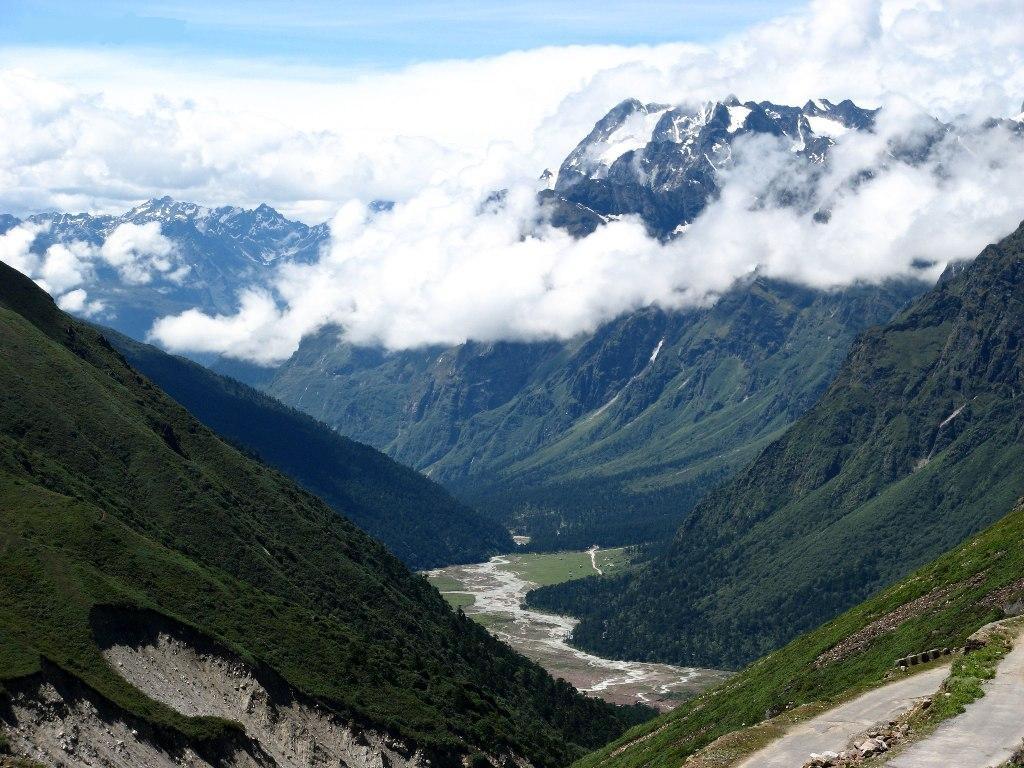
Two valleys, one road
Drive north from Gangtok for about four hours and you reach Chungthang, where two rivers meet to form the Teesta. The Lachung Chu comes down from the north-east, the Lachen Chu from the north-west. Each river has its own village at its head, roughly 2,700 m up, and each village is the base for a very different day out.
Lachung and Lachen look alike on a map and sound alike on the phone, which confuses many first-time visitors. They are about 50 km and 2.5 to 3 hours apart by road, via Chungthang. Both have wooden houses, apple trees, a 19th-century monastery and a traditional village council called the Dzumsa. Beyond that, the days you spend there are not the same at all.
Side by side
Indicative figures for 2026. Roads and permits change, so check current status before you travel.
| Lachung | Lachen | |
|---|---|---|
| Altitude of the village | ≈ 2,700 m | ≈ 2,750 m |
| From Gangtok | ≈ 118 km · 5–7 h | ≈ 125 km · 6–7 h |
| Main excursion | Yumthang 3,564 m, Zero Point ≈ 4,700 m | Thangu ≈ 3,900 m, Gurudongmar 5,183 m |
| Excursion start | 6–7 am, back by early afternoon | 4–5 am, back by noon |
| Highest point of the trip | ≈ 4,700 m (optional) | 5,183 m |
| Foreign nationals | Allowed with PAP, groups of 2+ | Gurudongmar not allowed; Lachen unclear, ask us |
| Lodges | Most choice, budget to premium | Fewer, simpler, some still reopening |
| Road status 2026 | Open since 8 Sep 2025 | Permits resumed about 11–12 Sep 2026 |
Choose Lachung if
Lachung is the gentler and more flexible of the two. The day trip goes up the Lachung Chu through the Shingba Rhododendron Sanctuary to Yumthang Valley, a wide meadow at 3,564 m with a river, a hot spring and forests of rhododendron. In late April and May the slopes are in flower; from December to March the valley is often under snow. Beyond, Zero Point (Yumesamdong) sits at about 4,700 m, where the road ends in snow and scree for most of the year.
Because the high point is optional and you can turn round at Yumthang, Lachung suits families with children over 5, seniors, honeymooners and anyone nervous about altitude. It is the only North Sikkim valley that foreign groups can reliably visit. It also has the widest range of lodges, from basic rooms around ₹2,000 to one or two resorts above ₹12,000 a night.
- Best months: April–May for flowers, October–November for clear skies, December–March for snow.
- Allow two nights, so Yumthang is a full morning rather than a rush.
- Zero Point costs ≈ ₹3,000–4,000 extra per vehicle and depends on ice on the day.
We turn this into a priced, day-by-day plan for your dates.
Choose Lachen if
Lachen exists for one dawn drive. Cars leave at about 4 to 5 am, climb past Thangu at about 3,900 m for tea, and cross a high, treeless plateau to Gurudongmar Lake, 67 km and 3 to 3.5 hours from Lachen, about 5 km south of the Tibetan border. The lake is sacred to Buddhists, who link it with Guru Padmasambhava, and to Sikhs; it freezes over from about November to mid-May. Thirty minutes there is enough, because the air holds roughly half the oxygen of sea level.
Chopta Valley, a meadow near Thangu, is usually seen on the way back. Lachen suits fit Indian adults who sleep well at altitude and accept a short night. It is also quieter, with fewer lodges and fewer vehicles. If you have heart or lung conditions, are pregnant or are travelling with small children, it is not the valley for you.
Lachen is also the better base if you want to see more of the high plateau in a slow way. On a 3-night trip, the free day can include a short walk above the village and an early night, and some travellers ask to linger in the Chopta Valley on the way back from the lake, which is open meadow at about 3,900 m with yaks and wide views of the peaks. Ask us whether Chopta is being allowed the week you travel; access depends on Army instructions.
The drive up is part of the choice
Both valleys share the first 95 km or so from Gangtok: the North Sikkim highway past Kabi Lungchok, where a Lepcha–Bhutia brotherhood treaty is remembered, the Seven Sisters Waterfall, Phodong, Mangan and the Toong check post. Vehicles must cross Toong by 4 pm, so you leave Gangtok by 9 to 10 am whichever valley you pick. Lunch is usually at Mangan or Singhik, with a view across the Teesta to Dzongu.
At Chungthang the roads part. The Lachung road is the steadier of the two in 2026, and the last 21 km climb through forest and orchards to a village spread along the river. The Lachen road runs about 28 km up a narrower gorge that was badly damaged in the October 2023 Teesta flood. It now crosses the Taram Chu on a single-lane Bailey bridge where vehicles go over one at a time, so allow extra time and expect short waits.
Coming back, Lachung to Gangtok is usually 5 to 6 hours and Lachen to Gangtok 6 to 7. After rain, either can take much longer. If you have an evening flight from Bagdogra the next day, spend the night in Gangtok rather than trying to drive straight through.
Doing both on one trip
With two nights in North Sikkim you can do both, but it is a hard trip: Gangtok to Lachen on day one, Gurudongmar at dawn on day two, then down to Lachen and across to Lachung the same afternoon, and Yumthang on day three before the drive back to Gangtok. Day two can mean 9 to 10 hours in the car.
Three nights make a far better loop: two nights in Lachen, with the second night after Gurudongmar or, better, one rest night before it, then one night in Lachung. You reach the lake better acclimatised and you see Yumthang in daylight rather than through tired eyes. This 3N/4D loop costs only ≈ ₹5,000–8,000 more per vehicle than the 2-night version, and it is the one we recommend.
Whichever you choose, remember the rules: a minimum of 2 nights in North Sikkim, vehicles past Toong by 4 pm, no children under 5, and no Gurudongmar on the same day as the drive from Gangtok.
Life in the two villages
Both villages are Lachungpa and Lachenpa Bhutia communities that historically moved yaks and sheep between summer pastures and winter homes. Both still govern local affairs through a Dzumsa, a village assembly led by an elected headman called the Pipon. The Sikkim Panchayat (Amendment) Act of 1995 treats the Dzumsas of Lachen and Lachung as Gram Panchayats, so they run local rules that visitors meet, such as limits on plastic or on how many vehicles go up to Yumthang.
Lachung Monastery sits on the slope above the village across the river; Lachen Monastery overlooks Lachen. Visit either in the late afternoon, after your excursion, and ask before taking photographs inside. In both villages, carry a refillable bottle and take your rubbish back to Gangtok.
Both villages also grow apples, potatoes and radishes on small terraced plots, and in Lachung you can often buy local apples and dried yak cheese, called chhurpi, from roadside stalls in autumn. Evenings are quiet in both: most lodges serve dinner by 8 pm and the villages go to sleep early, because the next morning starts before dawn.
Rules, fees, fares and road status change often. Check current status before you travel.