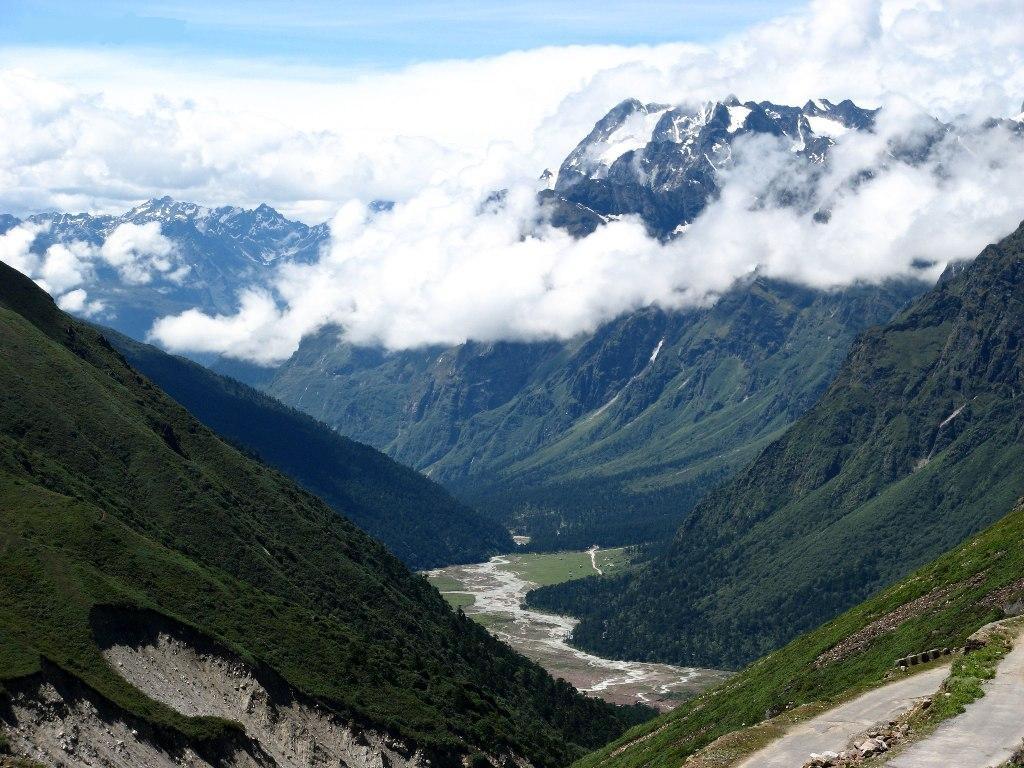
The valley and the road above it
Yumthang Valley lies 24 km and about an hour north of Lachung, at 3,564 m, where the Lachung Chu runs through a wide grassy floor between forested slopes. The road climbs through the Shingba Rhododendron Sanctuary, past a small hot spring near the river, and opens into the meadow where yaks graze and tea stalls set up in season. Zero Point, called Yumesamdong, is another 23 km and about an hour beyond, at around 4,700 m, where the motorable road ends below snowfields near the border area.
Cars leave Lachung at about 6 to 7 am, because cloud usually builds by late morning. A typical outing spends an hour in Yumthang, adds Zero Point if the road is clear, and is back in Lachung for lunch before the drive to Gangtok or Lachen. Lachung reopened to tourists on 8 September 2025; check current status before you travel.
Month by month
A guide to what you are likely to see. Snow, bloom and road conditions vary year to year by two or three weeks.
| Months | Yumthang 3,564 m | Zero Point ≈ 4,700 m | Our rating |
|---|---|---|---|
| Dec–Feb | Snow on the valley floor, −10 to 5 °C | Often closed after heavy snow | Good for snow, roads uncertain |
| March | Snow patches, bare trees, cold clear days | Usually open, deep snow | Good, best value |
| Mid-Apr–May | Rhododendrons in flower, 2 to 15 °C | Open, snow at the top | Best |
| June | Primulas and early alpine flowers, showers | Open, less snow | Good early, riskier late |
| Jul–Sep | Green, wildflowers, low cloud | Open on dry days | Avoid: slides stop permits |
| Oct–Nov | Clear skies, golden grass, first frosts | Open, fresh snow by Nov | Best |
Rhododendron season, April and May
The reason most people come to Yumthang is the rhododendrons. The Shingba Rhododendron Sanctuary, set up by the Sikkim government in 1984 along the road between Lachung and Yumthang, protects forests of rhododendron on both slopes, including Rhododendron niveum, Sikkim's state tree. Lower bushes start flowering in late March and early April; the main show, in reds, pinks, whites and yellows, usually runs from mid-April to the end of May.
The sanctuary road is beautiful in flower, but it is also where everyone stops at once. Ask your driver for an early start so you reach the best stretch before 8 am, and walk a few hundred metres off the road rather than climbing into the bushes. Please do not pick flowers or break branches; the sanctuary is protected, and the plants take years to recover.
May is also the busiest month, with Indian school holidays. Lodges in Lachung cost 20 to 40 percent more, and some fill weeks ahead. Book early, or come in the last ten days of April.
The forests are not the only flowers. As the snow line retreats in May and June, the meadows of Yumthang fill with primulas, and higher up towards Zero Point small alpine plants push through the scree. Bring a phone with a good zoom rather than walking into the meadow, and keep to the paths the yak herders use, because the ground stays soft and easily damaged after the snow melts.
We turn this into a priced, day-by-day plan for your dates.
Snow season, December to March
From December to March, Yumthang is a white valley and Zero Point is a wall of snow. This is when many Indian families come specifically to see and touch snow for the first time, and the drive up through frozen waterfalls is worth it on its own.
It is also the season of uncertainty. Heavy snowfall can close the road above Lachung for days, and Zero Point is often shut from January to early March. Ice on the road means drivers may stop short or insist on chains. Our advice: come for Yumthang, treat Zero Point as a bonus, and book two nights in Lachung so you have a second morning if the first one is closed. March often gives the best of both, with deep snow and roads mostly clear.
Pack seriously for this season: thermals, a padded jacket, waterproof gloves and boots with grip. Snow boots and long coats can be hired in Lachung for ≈ ₹100–300 an item.
Autumn and the monsoon
October and November are our favourite months for photographs. The monsoon clouds have gone, the air is sharp, the grass in Yumthang turns gold and the first snow dusts the peaks above Zero Point. Nights in Lachung drop to near freezing by late November. Durga Puja week in October is crowded and expensive; the second half of November is quieter and cheaper.
June to September is the monsoon. Yumthang is green and full of primulas, poppies and other alpine flowers, and on a clear morning it is lovely. The problem is the road from Gangtok, which slides often in heavy rain, and permits can stop at a day's notice. If you must come in the monsoon, keep the trip flexible, take travel insurance and plan a spare day before your flight.
Whichever season you choose, the light is best before 9 am, when the sun clears the eastern ridge and the valley floor is still in frost or dew. Photographers should ask the driver to leave Lachung by 6 am.
Making the most of the morning
- Leave Lachung by 6:30 am at the latest; cloud and wind build after 10 am at Zero Point.
- Decide on Zero Point in Lachung the night before. It costs ≈ ₹3,000–4,000 extra per vehicle and depends on ice.
- Take Zero Point slowly. It is about 2,000 m higher than Lachung; walk, do not run, and stay 20–30 minutes.
- Stop at the hot spring near Yumthang on the way back, not on the way up.
- Carry a refillable bottle. Lachung's Dzumsa has restricted packaged water bottles at times.
- Take all rubbish back with you; there are few bins in the valley.
What a Yumthang trip costs by season
Season changes the price more than most people expect. These are indicative 2026 figures from Gangtok for two nights in Lachung, per person on twin sharing, before GST.
- March and the second half of November: shared seat with a budget lodge ≈ ₹6,500–7,500; reserved SUV for a couple with a standard lodge ≈ ₹12,000–13,000.
- Mid-April to May and October: add 20 to 40 percent on lodges and 10 to 20 percent on vehicles; the couple's trip becomes ≈ ₹14,000–16,000.
- December to February: base rates, but budget for snow gear hire and a possible lost Zero Point day.
- Zero Point, any season: ≈ ₹3,000–4,000 extra per vehicle, decided in Lachung.
How many nights you need
Two nights in Lachung is the minimum we sell, and it is also what the current North Sikkim rules expect. The first evening you arrive tired after a 5 to 7 hour drive from Gangtok; the second morning is Yumthang and Zero Point; the third morning you drive back. In rhododendron season or snow season, a third night in Lachung gives a spare morning for weather and a slower walk through the sanctuary. Children under 5 are not permitted in North Sikkim, and vehicles must pass Toong by 4 pm on the way up.
If you have a fourth night, think about adding Lachen and Gurudongmar for Indian adults, or a night in Dzongu on the way up for a family. Both make the trip more than a single morning in a valley, and both give you a second plan if snow or a slide closes one road. Ask us for the current road reports when you book, and again two days before you leave Gangtok.
Rules, fees, fares and road status change often. Check current status before you travel.


