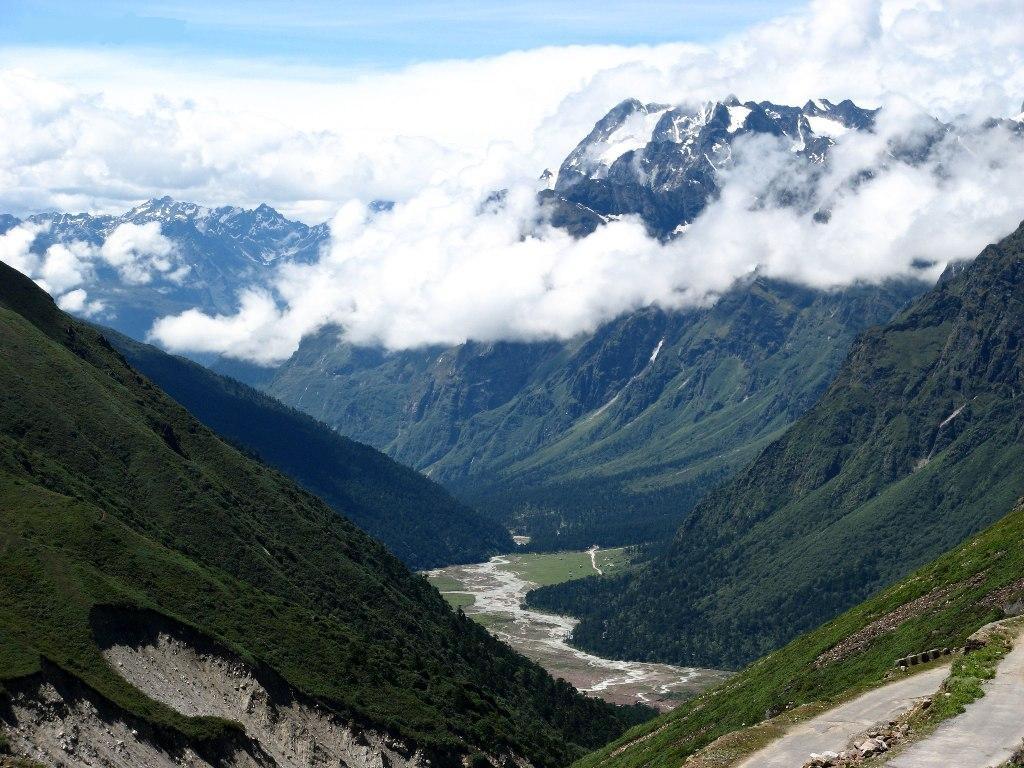
Shingba Rhododendron Sanctuary protects about 43 sq km of rhododendron, fir and birch forest between Lachung and Yumthang, at roughly 3,000–4,000 m. Established in 1984, it holds dozens of rhododendron species, including Sikkim's state tree. You drive through it on every Yumthang trip, with a protected area permit.
Best months
Late April–May for flowers; October–November for clear skies
Nights we suggest
0 (pass through from Lachung)
From Gangtok
≈ 135 km · via a night in Lachung
Altitude
≈ 3,000–4,000 m
Known for
Rhododendron forest, Sikkim's state tree, Himalayan birds
Most visitors to Yumthang pass through Shingba without knowing it. The road from Lachung climbs into a forest of rhododendron trees, silver fir and birch, draped in moss and lichen, and that forest is the sanctuary. It was set up in 1984 to protect the rhododendron woods of the upper Lachung valley and covers about 43 square kilometres, according to Wikipedia's article on Mangan district.
Rhododendrons here range from tall trees to knee-high shrubs, and the flowering season spreads over several months as the bloom climbs the slopes: from March low down to June near the tree line. Late April and May are usually the peak. In winter the forest stands deep in snow, and in the monsoon it drips with mist and moss.
Shingba is also good birding country. Wikipedia lists the wood snipe and hoary-throated barwing among its birds, and the mixed forest holds many Himalayan species. Ask your driver for one or two short stops in the forest on the way to Yumthang, ideally early in the morning when birds are active and light is soft. Do not leave the road edge alone, and never pick flowers.
Highlights
What to see and do
Tree rhododendrons over the road
On the climb from Lachung, rhododendron trees arch over the road, with red, pink and white flowers in season. The densest stretches lie between about 3,000 and 3,500 m, just below the Yumthang meadow.
A long flowering season
Because the sanctuary spans about 1,000 m of altitude, something is usually flowering from March to June. Lower trees go first; dwarf species near the tree line finish last.
Birding in mixed forest
Fir, birch and rhododendron forest supports many Himalayan birds. Wood snipe and hoary-throated barwing are recorded here. Early morning stops give the best chance of seeing birds along the road.
Moss, mist and lichen
In the damp months the forest is thick with moss and hanging lichen, beautiful in soft light. Even in October and November, morning mist often lingers in the trees.
Snow forest in winter
From December to March snow weighs down the branches. When the road is open, the drive through white forest is one of the quietest scenes in North Sikkim.
The story of Shingba Rhododendron Sanctuary
A sanctuary for Sikkim's state tree
Sikkim takes rhododendrons seriously. The state tree is Rhododendron niveum, a species with lilac to purple flower heads that grows in a narrow belt of Himalayan forest, and the Shingba sanctuary is often cited as one of its habitats. When the British botanist Joseph Dalton Hooker travelled the Lachung valley in 1849, he collected and described rhododendrons that later filled the great gardens of Britain, and his Rhododendrons of Sikkim-Himalaya, published from 1849, made the plants famous in Europe. Those same forests were declared the Shingba Rhododendron Sanctuary in 1984. Wikipedia's article counts about forty rhododendron species within it, and notes that it forms part of the Sacred Himalayan Landscape, a conservation area that links protected forests across the eastern Himalaya. The forest is still grazed in summer by herds from Lachung, and the sanctuary works alongside those traditional uses. Its most visible threat now is the volume of traffic on the Yumthang road in May. A quiet five-minute stop, with engines off, is the best way to see it.
Source: Wikipedia, Shingba Rhododendron Sanctuary and Mangan district; Hooker, Rhododendrons of Sikkim-Himalaya (1849–51)
Little known
Things most visitors never hear
The sanctuary was established in 1984 and covers about 43 square kilometres of the upper Lachung valley below Yumthang.
Source: Wikipedia, Mangan district
Wikipedia lists the wood snipe and the hoary-throated barwing among the birds of the sanctuary, which forms part of the Sacred Himalayan Landscape.
Source: Wikipedia, Shingba Rhododendron Sanctuary
Joseph Hooker's Rhododendrons of Sikkim-Himalaya, based on his 1848–49 travels, introduced many Sikkim species to British gardens.
Source: Hooker, Rhododendrons of Sikkim-Himalaya
Experiences
Hours worth planning in Shingba Rhododendron Sanctuary
You drive through the sanctuary on every Yumthang trip from Lachung. Ask your driver for one or two short stops; the forest begins a few kilometres above the village.
Private car
A private registered SUV, arranged through an agent with the permit, lets you stop longer for birds or photographs on the way up or down.
From Bagdogra / NJP
Drive to Gangtok (4.5–5 hours by NH10, or via Kalimpong when NH10 is closed), stay a night, go to Lachung the next day and through Shingba to Yumthang the morning after.
Permits in North Sikkim
Indian travellers need a protected area permit for Lachung, Yumthang, Zero Point, Lachen, Thangu and Gurudongmar, issued only through Sikkim Tourism-registered agents and tied to a registered tourist vehicle; operators require a minimum two-night stay. Dzongu needs its own permit, usually obtained in Mangan. Children under five are not permitted in North Sikkim protected areas. Foreign nationals need the online Sikkim restricted area permit and may visit Lachung, Yumthang and Zero Point on a group permit, but not Gurudongmar; for Lachen and Thangu, ask us. Check current status before you travel.
There is no accommodation inside the sanctuary. Stay in Lachung, a short drive below the forest. Lachungpa family homestays are the cheapest and most personal option; Fortuna Lachung, near the check post on the Yumthang road, is a good-value hotel closest to the sanctuary side of the village; Le Coxy Resort and Yarlam Resort suit travellers who want more comfort. Ask for an early breakfast so you reach the forest in the morning light.
Ask your driver for a stop on the way up, when light and birds are best.
Never pick flowers or break branches; it is a protected sanctuary.
Bring binoculars; many forest birds stay high in the canopy.
Stay at the road edge and watch for vehicles on blind bends.
Turn engines and music off during stops; the forest is quiet for a reason.
Month by month
When to visit Shingba Rhododendron Sanctuary
JFMAMJJASOND
BestGoodAvoid or closed
Shingba Rhododendron Sanctuary is at 3,200 m. Spend a night lower down first, climb slowly and drink water. Headache, nausea or breathlessness at rest mean go down. The altitude ladder.
In the upper Lachung valley in Mangan district (North Sikkim), between Lachung village and the Yumthang meadow. The road from Lachung to Yumthang runs through it. The sanctuary spans roughly 3,000–4,000 m and covers about 43 square kilometres.
Do I need a separate permit for Shingba sanctuary?
Not usually. The protected area permit for Lachung and Yumthang, arranged through a registered agent, covers the drive through the sanctuary. Special activities such as research or longer treks may need other permissions. Check current status before you travel.
When was Shingba sanctuary established?
In 1984, according to Wikipedia's article on Mangan district, to protect the rhododendron forests of the upper Lachung valley. It forms part of the Sacred Himalayan Landscape, a wider conservation area across the eastern Himalaya.
How many rhododendron species grow in Shingba?
Wikipedia gives about forty species for the sanctuary, while other sources give over twenty-four for the Yumthang area. The difference reflects how the area and species are counted. Either way, it is one of Sikkim's richest rhododendron forests.
What is the best month to see Shingba in flower?
Late April to mid-May is usually best, with lower trees flowering from March and high shrubs into June. The timing varies with each year's snow and temperature, so we check with local drivers in April before confirming dates.
Can I trek in Shingba sanctuary?
There are trails in the area, including routes linking Yumthang and the Lachen side, but treks need special arrangements, guides and permits and are not standard tourist activities. For most visitors, roadside stops and short walks at Yumthang are the practical way to see the forest.
Is there wildlife in Shingba sanctuary?
Yes, mainly birds and smaller mammals that are hard to see from the road. Wikipedia lists the wood snipe and hoary-throated barwing. Larger mammals avoid the busy road. Early mornings with a guide give the best chance of sightings.
How long does it take to drive through the sanctuary?
The forest section of the Lachung–Yumthang road takes roughly 30 to 45 minutes to drive without stops. With one or two short stops, allow an hour. Birding or photography trips take longer and need a private vehicle.
Can foreigners visit Shingba sanctuary?
Foreign nationals who can visit Lachung and Yumthang on a group protected area permit through a registered agent drive through the sanctuary on the way. Rules change, so check current status before you travel and ask us about the permit for your nationality.
Every cost shownRooms, car, permits and our fee, itemised
One person to callFrom Bagdogra or NJP until you are back
No payment to startA deposit only when you book
Get my price
Want Shingba Rhododendron Sanctuary in your plan?
Tell us your dates, who is travelling and roughly what you want to spend. We reply within one working day with a day-by-day route and an itemised price.
No payment to start
Permits handled through registered partners
Every hotel, car and fee listed
Price my Sikkim trip
Tell us dates, people and budget. You get a day-by-day plan and an itemised price within one working day.