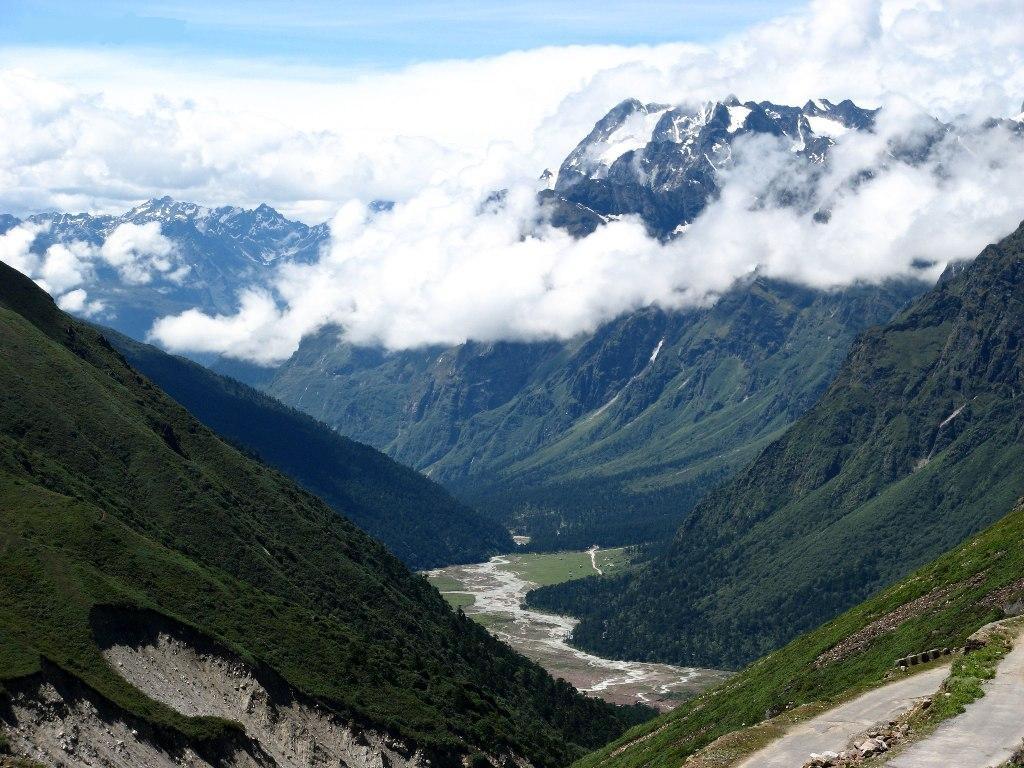
Lachung is a Bhutia village at about 2,700 m in the Lachung Chu valley, 120 km and 5–6 hours from Gangtok. It is the overnight base for Yumthang Valley and Zero Point, has an 1880 Nyingma monastery, and is governed by its own traditional council, the Dzumsa. Permit and registered agent required.
Bhutia nameLachungMeans: small pass, as against Lachen, the big passSource: Wikipedia, Lachung and Lachen, Sikkim
Best months
October–November, April–May
Nights we suggest
1–2
From Gangtok
≈ 120 km · 5–6 h
Altitude
2,700 m
Known for
Yumthang base, Dzumsa council, apple orchards, winter snow
Lachung sits in a deep valley where waterfalls drop off both walls, on the Lachung Chu a few hours above its meeting with the Lachen Chu at Chungthang. The village is spread along the road and the river: wooden and stone houses with prayer flags, apple orchards, the monastery on the eastern slope and a growing line of hotels at Fakha and Sarchok. The botanist Joseph Hooker, who travelled here in 1849, called it the most picturesque village in Sikkim in his Himalayan Journals.
Most travellers arrive late afternoon on a 2-night or 3-night North Sikkim package, sleep, and leave at 5 or 6 am for Yumthang and Zero Point. That is a pity. Lachung rewards an extra hour or two: a walk across the river to the monastery, a cup of tea with a family, a look at the fields where potatoes, barley and apples grow in a short summer. In winter snow covers the village, and in October the larch and maple turn gold.
Lachung's Bhutia families, the Lachungpas, govern themselves through the Dzumsa, a council headed by an elected Pipon. It sets village rules, including on tourism and plastic. Packaged water bottles have been restricted at times, so carry a refillable bottle. At about 2,700 m the altitude is noticeable but rarely a problem: walk slowly on arrival, drink water and skip alcohol on the first night.
Highlights
What to see and do
Lachung Monastery
A Nyingma gompa founded in 1880 on the slope across the Lachung Chu, reached by a footbridge and a short climb. Morning prayers, murals and a view back over the village roofs. The monastery holds an annual masked dance; ask us for the date in the year you travel.
Yumthang and Zero Point mornings
Lachung exists, for most visitors, as the place to sleep before Yumthang. The valley meadow lies 24 km and 1–1.5 hours up the road, and Zero Point another 23 km beyond. Leave at 5–6 am for clear skies.
Apple orchards and fields
Lachung families grow apples, potatoes, barley and vegetables in a short summer season. In spring the orchards blossom; in late summer and autumn you may see fruit being picked. Walk the lanes between houses with a local guide rather than entering fields on your own.
Waterfalls on the valley walls
In late spring and after the monsoon, dozens of waterfalls pour off the cliffs above Lachung and along the road from Chungthang, including the big falls near Bhim Nala. They are best from the road; never climb wet rocks for a photo.
Snow in winter
From December to February Lachung often lies under snow, which draws families from the plains. Roads beyond the village may close for days, so treat Yumthang as a bonus in winter, not a promise, and keep a buffer day.
The story of Lachung
The Pipon and the village council
Lachung has no ordinary panchayat. Its Bhutia households meet as the Dzumsa, a traditional council that dates, in its present form, to the first half of the 19th century according to Wikipedia's article on the institution. The council elects a headman, the Pipon, usually for one year, and he appoints assistants called Gyapon. Disputes between neighbours, use of common pasture and forest, the dates for moving herds, fines for breaking village rules and, today, many decisions about hotels, vehicles and visitors pass through the Dzumsa. The state of Sikkim recognised the arrangement in law: the Sikkim Panchayat (Amendment) Act of 1995 deemed the Dzumsas of Lachung and Lachen to be gram panchayats, and the 2001 amendment confirmed they continue under customary law. Lachung also had a living reason for strong common rules. Until 1950 it was a trading post on routes between Sikkim and Tibet, and herding, trade and short growing seasons all demanded cooperation. When a hotel owner tells you something is a Dzumsa rule, it is the village speaking.
Source: Wikipedia, Dzumsa and Lachung; Sikkim Panchayat (Amendment) Acts 1995 and 2001
Little known
Things most visitors never hear
Joseph Dalton Hooker, the British botanist who collected rhododendrons in Sikkim in 1849, called Lachung the most picturesque village of Sikkim in his Himalayan Journals.
Source: Wikipedia, Lachung
Lachung Monastery, a Nyingma gompa on the slope across the river, was established in 1880 and holds an annual masked dance.
Source: Wikipedia, Lachung Monastery
Before 1950 Lachung was a trading post on routes between Sikkim and Tibet; the Indian Army now keeps a forward base in the valley.
Buy a seat on a registered North Sikkim tour from Gangtok, usually 2N/3D with Lachen or 1–2 nights Lachung only, including permit, simple hotel and meals. Jeeps leave around 10–11 am and arrive late afternoon.
Private car
A registered private SUV from Gangtok takes 5–6 hours for about 120 km via Mangan and Chungthang. Your agent handles the permit. The vehicle must cross the Toong check post by 4:00 pm.
From Bagdogra / NJP
Drive 4.5–5 hours to Gangtok on NH10 (or via Kalimpong or Algarah when NH10 is closed by slides) and spend the night. Leave for Lachung the next morning; a same-day transfer misses the Toong cut-off.
Indian travellers need a protected area permit for Lachung, Yumthang, Zero Point, Lachen, Thangu and Gurudongmar, issued only through Sikkim Tourism-registered agents and tied to a registered tourist vehicle; operators require a minimum two-night stay. Dzongu needs its own permit, usually obtained in Mangan. Children under five are not permitted in North Sikkim protected areas. Foreign nationals need the online Sikkim restricted area permit and may visit Lachung, Yumthang and Zero Point on a group permit, but not Gurudongmar; for Lachen and Thangu, ask us. Check current status before you travel.
Hotels line the road through lower Lachung at Fakha and Sarchok and around the bazaar. On a budget, a Lachungpa family homestay with meals costs about ₹1,200–2,000 per person, or choose a simple package hotel. For value, Fortuna Lachung near the Yumthang road check post and Snow Lion Mountain Resort near the SBI ATM are dependable. Le Coxy Resort at Fakha is a comfortable family choice with heated mattresses, and Yarlam Resort in upper Lachung is the most polished hotel in the valley. Book early for May and October.
Carry a refillable bottle; packaged water bottles have been restricted in Lachung at times.
Hire boots and a coat in Lachung the evening before Yumthang, not at dawn.
Keep cash for add-ons and tips; the SBI ATM in Lachung often runs dry in peak season.
Children under five are not permitted in North Sikkim protected areas, Lachung included.
Ask before photographing people, houses and the monastery interior.
Month by month
When to visit Lachung
JFMAMJJASOND
BestGoodAvoid or closed
Lachung is at 2,700 m. Spend a night lower down first, climb slowly and drink water. Headache, nausea or breathlessness at rest mean go down. The altitude ladder.
About 120 km by the North Sikkim Highway via Kabi, Mangan and Chungthang, which takes 5 to 6 hours in good conditions. Landslide clearing can add hours, especially in the monsoon. Tourist vehicles must cross the Toong check post by 4:00 pm, so plan to leave Gangtok by 10 am.
Do I need a permit for Lachung?
Yes. Lachung lies in a protected area, and Indian travellers need a protected area permit issued through a Sikkim Tourism-registered agent, with a registered tourist vehicle. Give your agent ID and two passport photos. Foreign nationals can usually visit with a group permit. Check current status before you travel.
Is one night in Lachung enough?
One night is the minimum and covers Yumthang and Zero Point the next morning. Operators require at least two nights in North Sikkim overall, so most people combine one night in Lachen with one in Lachung. Two nights in Lachung allows a slower pace, a village walk and a buffer for bad weather.
What is the altitude of Lachung?
Lachung lies at about 2,700 m, though sources give figures from about 2,600 m to 2,900 m depending on where in the valley they measure. Most visitors feel mild breathlessness at most. Walk slowly on arrival, drink water and avoid alcohol on the first night.
What is the Dzumsa in Lachung?
The Dzumsa is Lachung's traditional village council, which acts as its local government. It elects a headman, the Pipon, usually for a year, who appoints assistants. Sikkim law has recognised it since 1995. It sets village rules, including some that affect visitors, such as restrictions on packaged water bottles.
When is the best time to visit Lachung?
October and November bring clear skies and autumn colour, and April and May bring rhododendrons at Yumthang. December to February offers snow but frequent road closures. June to August is monsoon, with landslides on the highway, and we advise against it.
Are there ATMs and mobile networks in Lachung?
The State Bank of India has a branch and ATM in Lachung, but it can run out of cash or go offline. Carry enough cash from Gangtok. Mobile signal from the main networks is usually available in the village, with little or none at Yumthang and Zero Point.
Can I take children to Lachung?
Children aged five and over can go. Children under five are not permitted in North Sikkim protected areas, which include Lachung. Pack warm clothes, snacks and water, plan short days, and watch children for headache, vomiting or unusual tiredness, which can signal altitude sickness.
What does a Lachung trip cost?
Indicatively, a shared 2N/3D North Sikkim package from Gangtok, including Lachung, costs about ₹6,500–9,000 per person with permit, simple hotel and meals. A private SUV is about ₹16,000–22,000 per vehicle for the same trip, plus hotels. The Zero Point add-on is about ₹3,000–4,000 per vehicle.
Every cost shownRooms, car, permits and our fee, itemised
One person to callFrom Bagdogra or NJP until you are back
No payment to startA deposit only when you book
Get my price
Want Lachung in your plan?
Tell us your dates, who is travelling and roughly what you want to spend. We reply within one working day with a day-by-day route and an itemised price.
No payment to start
Permits handled through registered partners
Every hotel, car and fee listed
Price my Sikkim trip
Tell us dates, people and budget. You get a day-by-day plan and an itemised price within one working day.