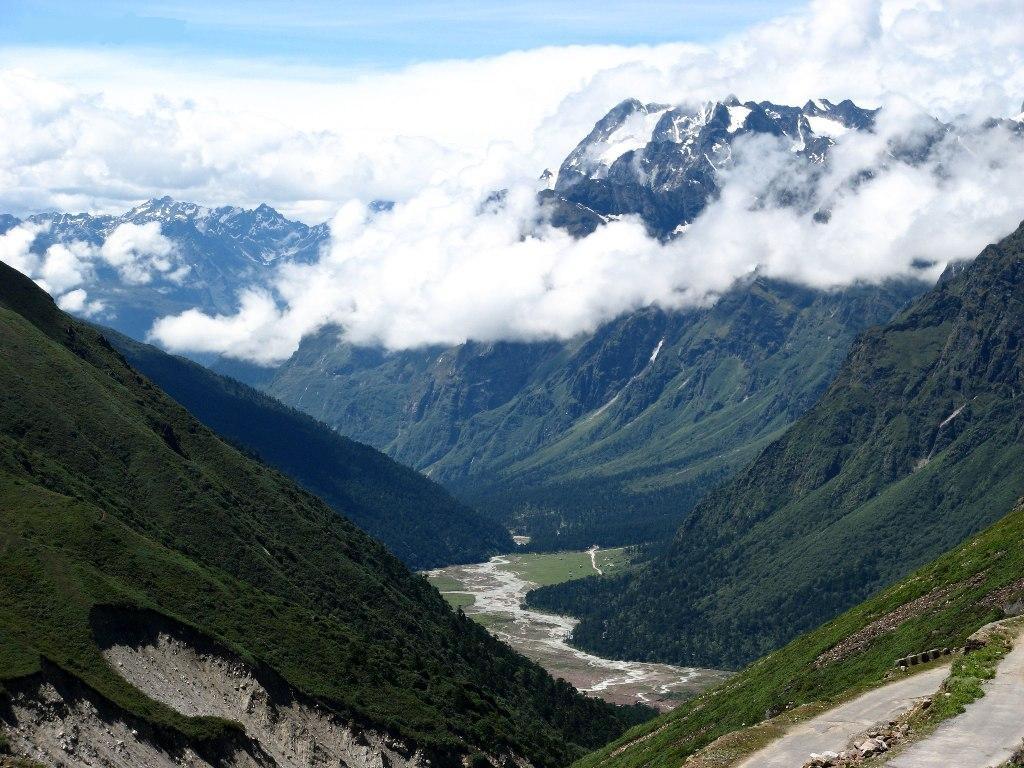
Zero Point, officially Yumesamdong, is the end of the civilian road about 23 km beyond Yumthang and roughly 45 km from Lachung, at about 4,660 m. It is a bare, snowy plateau visited as a paid add-on from Lachung, usually ₹3,000–4,000 per vehicle. Cold and altitude are serious here: stay short.
Best months
March–May, October–November
Nights we suggest
0 (visit from Lachung)
From Gangtok
≈ 165 km · via a night in Lachung
Altitude
4,660 m
Known for
Snow most of the year, road's end, high-altitude landscape
Permit
Protected area permit via a registered agent; foreigners ask us
Beyond Yumthang the road keeps climbing out of the rhododendron forest into open, stony country above the tree line. After about 23 km it reaches Yumesamdong, which every driver calls Zero Point: the place where civilian vehicles must stop. Beyond lies army territory and, further north, the Tibet border. There is nothing built here except a few seasonal stalls, and that is the point: snow on most days of the year, high peaks around you and thin, cold air.
For many Indian visitors Zero Point is the place to touch snow, even in May. The exact turning point moves with the season, depending on how far road crews and the army have cleared snow. In some weeks vehicles stop short; after heavy falls, the add-on is cancelled altogether. Your driver decides on the day based on conditions and orders, and arguing does not help.
At about 4,660 m, Zero Point is higher than anywhere most visitors have ever been. You arrive within a few hours of leaving Lachung at 2,700 m, which is a fast climb. Walk slowly, do not run or play hard in the snow, keep children warm and close, and stay no longer than 30 to 45 minutes. Anyone with a severe headache, breathlessness at rest or confusion should go down at once.
Highlights
What to see and do
Snow even in May
Zero Point usually has snow on the ground from autumn well into late spring, and often patches through summer. For many visitors it is the main reason to pay the add-on. Hire boots and coats in Lachung the evening before.
Above the tree line
The drive from Yumthang climbs from rhododendron forest into bare, stony country, a change of landscape that happens within half an hour. Watch the vegetation thin out as you climb towards 4,660 m.
The end of the road
This is as far as civilian vehicles may go on the Lachung side. Beyond lies army territory and the frontier. There is a strong sense of being at the edge of the map.
Clear autumn mornings
October and November mornings bring the clearest skies, with fresh snow on the peaks around Yumesamdong. They are also the coldest, often well below zero with wind.
Seasonal tea stalls
In the open season a few stalls sell tea, coffee, instant noodles and snacks. A hot cup at 4,660 m is part of the ritual; just remember that alcohol at this height is a bad idea.
The story of Zero Point (Yumesamdong)
Why the road stops at Zero Point
North Sikkim's high valleys run up against the border with the Tibet Autonomous Region of China, and much of the land north of Yumthang is a military area. The name Zero Point simply marks the limit of civilian movement on the Lachung side, and the exact spot depends on season and orders. Wikipedia's article on Lachung notes that before China took control of Tibet in 1950, the village was a trading post between Sikkim and Tibet. Lachung and Lachen traders, and the herders of the high pastures, once moved goods and animals over these passes. After 1950, and especially after the 1962 India–China war, the border hardened and the trade routes closed. The Indian Army now keeps a forward presence in the valley, and the road to Yumesamdong exists largely because of that. Tourism came later, and remains tightly controlled through permits issued only to registered agents. When the army closes the road for an exercise or after snow, there is no appeal. Treat Zero Point as a privilege, not a promise.
Zero Point is not a fixed spot: the place where civilian vehicles turn back moves with snow clearance and army orders, and in some weeks of winter the road is closed below it.
Source: Local drivers and operators, as told locally
At about 4,660 m, Zero Point is roughly 1,100 m higher than Yumthang and nearly 2,000 m higher than Lachung, a big climb in a single morning.
Source: Wikipedia, Yumthang Valley of Flowers; altitude data
The rivers draining Yumesamdong feed the Lachung Chu, which joins the Lachen Chu at Chungthang to form the Teesta, Sikkim's main river.
Book Zero Point as an extra with your Lachung driver, usually ₹3,000–4,000 per vehicle. You go on from Yumthang, about 23 km and 1 hour further, and return to Lachung by late morning.
Private car
In a private registered SUV the add-on is agreed with your agent in advance. The driver still needs the road to be open and the army to allow vehicles on the day.
From Bagdogra / NJP
Drive to Gangtok first (4.5–5 hours by NH10, or via Kalimpong when NH10 is closed), stay a night, go to Lachung the next day and to Zero Point the morning after.
Permits in North Sikkim
Indian travellers need a protected area permit for Lachung, Yumthang, Zero Point, Lachen, Thangu and Gurudongmar, issued only through Sikkim Tourism-registered agents and tied to a registered tourist vehicle; operators require a minimum two-night stay. Dzongu needs its own permit, usually obtained in Mangan. Children under five are not permitted in North Sikkim protected areas. Foreign nationals need the online Sikkim restricted area permit and may visit Lachung, Yumthang and Zero Point on a group permit, but not Gurudongmar; for Lachen and Thangu, ask us. Check current status before you travel.
Nobody sleeps at Zero Point: there is no accommodation and it would be dangerous at 4,660 m. Stay in Lachung, about 45 km below, and visit on an early morning drive. Families on a budget can choose a Lachungpa homestay; Snow Lion Mountain Resort and Fortuna Lachung are good value; Le Coxy Resort and Yarlam Resort suit travellers who want a warm room and a reliable packed breakfast before the 5 am departure.
Decide on Zero Point at Yumthang: if anyone already has a headache there, skip it.
Stay 30–45 minutes, walk slowly and do not run or wrestle in the snow.
Wear sunglasses; snow glare at 4,660 m can burn eyes within an hour.
Agree the add-on price with your driver before leaving Lachung.
Carry your rubbish back; the plateau has no waste collection.
Month by month
When to visit Zero Point (Yumesamdong)
JFMAMJJASOND
BestGoodAvoid or closed
Zero Point (Yumesamdong) is at 4,660 m. Spend a night lower down first, climb slowly and drink water. Headache, nausea or breathlessness at rest mean go down. The altitude ladder.
About 4,660 m (15,300 ft), according to most travel sources and consistent with elevation data for Yumesamdong. That is roughly 1,100 m above Yumthang and nearly 2,000 m above Lachung, climbed in a single morning, so altitude sickness is a real risk.
How much does Zero Point cost from Lachung?
It is a paid add-on to your Lachung package, around ₹3,000–4,000 per vehicle as an indicative 2026 figure, shared among everyone in the car. Agree the price with your driver or agent before leaving Lachung. Check current status before you travel.
Is Zero Point open now?
The Lachung, Yumthang and Zero Point circuit reopened to tourists on 8 September 2025, as we understand it. Zero Point itself depends daily on snow clearance and army permission, and it is often shut in midwinter. Check current status before you travel.
Can foreigners visit Zero Point?
Official guidance lists Zero Point with Lachung and Yumthang as open to foreigners on a group protected area permit, but some operators report foreigners being stopped at Yumthang. Rules seem to vary in practice, so ask us before you plan. Gurudongmar is definitely closed to foreigners.
How far is Zero Point from Yumthang?
About 23 km, roughly 1 hour each way on a narrow mountain road. From Lachung the total is about 45 km. The full morning round trip from Lachung to Yumthang, Zero Point and back takes 5 to 6 hours.
What is the best time to visit Zero Point?
March to May for deep snow with milder days, and October to November for the clearest skies. December to February brings the most snow but frequent closures. In July and August the road is often affected by monsoon slides.
Why is it called Zero Point?
Zero Point is the common name for the place where civilian vehicles must stop on the road beyond Yumthang; its official name is Yumesamdong. Beyond lies a military area towards the Tibet border. The exact turning point shifts with season and army orders.
Can children go to Zero Point?
Children under five are not permitted in North Sikkim protected areas. Older children can go but should be watched closely, kept warm and not allowed to run in the snow. If a child has headache, vomiting or unusual sleepiness, return to Yumthang and Lachung straight away.
What should I wear to Zero Point?
Thermal innerwear, a warm fleece and a down jacket, plus a hired long coat and snow boots, gloves, a woollen cap and sunglasses. Sunscreen and lip balm are essential, as UV and glare are strong. Carry a refillable bottle of water.
Every cost shownRooms, car, permits and our fee, itemised
One person to callFrom Bagdogra or NJP until you are back
No payment to startA deposit only when you book
Get my price
Want Zero Point (Yumesamdong) in your plan?
Tell us your dates, who is travelling and roughly what you want to spend. We reply within one working day with a day-by-day route and an itemised price.
No payment to start
Permits handled through registered partners
Every hotel, car and fee listed
Price my Sikkim trip
Tell us dates, people and budget. You get a day-by-day plan and an itemised price within one working day.