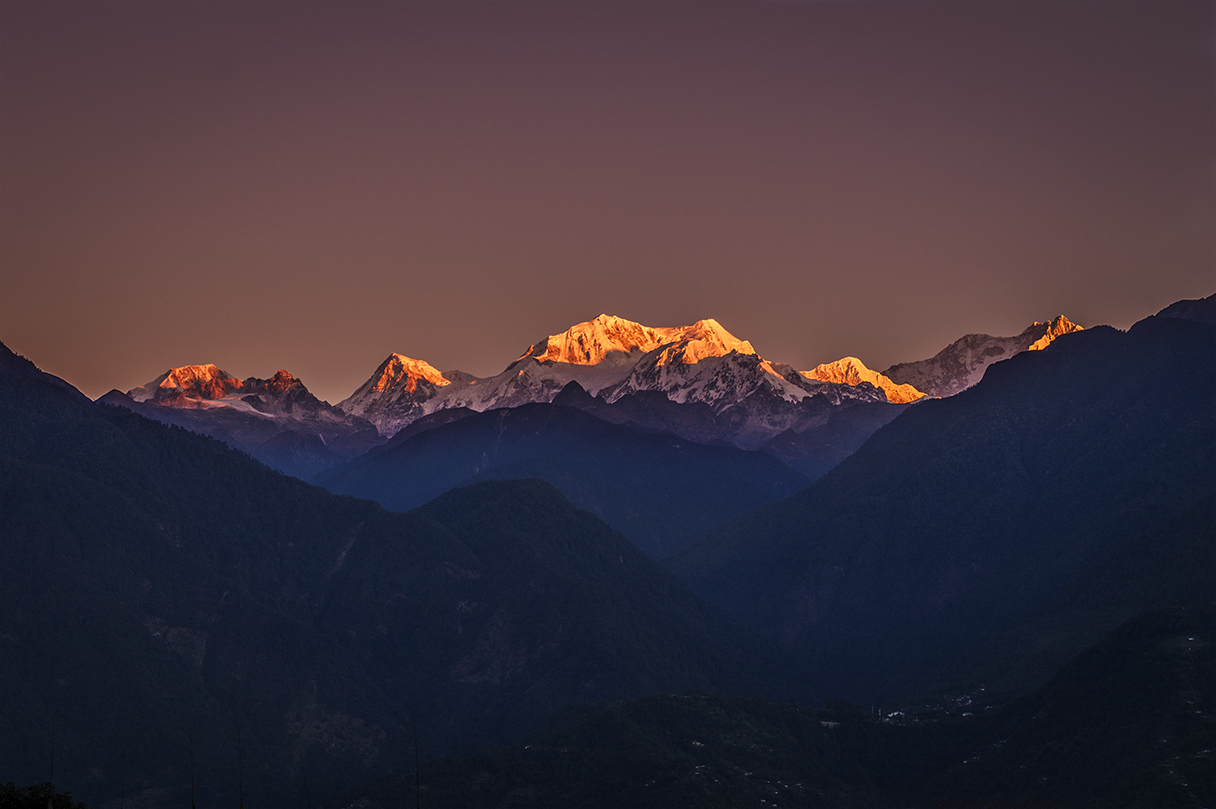
Rinchenpong is a quiet ridge village at about 1,650 m in Soreng district, 120 km from Gangtok, with one of the widest Kangchenjunga views in Sikkim. Come for the 1730 monastery and its rare Ati Buddha, the Poison Lake story, village walks and homestays from about ₹1,200 a night with meals.
Best months
October–December and February–April
Nights we suggest
2
From Gangtok
≈ 120 km · 5 h
Altitude
≈ 1,650 m (monastery ≈ 1,700 m)
Known for
Kangchenjunga views, 1730 monastery, Ati Buddha image, Poison Lake, homestays
Permit
Not needed for Indians; foreigners need Sikkim's RAP (e-FRRO)
Rinchenpong sits on a ridge above the Rangeet valley in Soreng district, which was West Sikkim until December 2021. The bazaar is a few shops, a taxi stand and a school; the houses spread along the road towards Kaluk and up the slope to the monastery. On a clear morning from October to April the whole Kangchenjunga range fills the north-west horizon, and that view, rather than any single sight, is why people come and stay two nights instead of one.
The village's history is unusually rich for its size. Rinchenpong Monastery, founded around 1730, is described by the Soreng district administration as the third oldest in Sikkim and keeps a rare Ati Buddha (Adi Buddha) image. Below the monastery path lies Bikh Pokhari, the Poison Lake, linked locally to resistance against a British force. Reesum Gumpa crowns the hill above, and the Rabindra Smriti Van park carries the name of Rabindranath Tagore.
It is a slow place. There is no shopping street, no nightlife and no hotel larger than a village resort. Days are for walking between monasteries, farms and viewpoints, eating long meals at a homestay and watching the light on the range at dawn and dusk. Pelling is about 31 km away by road, Jorethang 32 km, and Barsey's trailhead at Hilley is a half-day drive via Soreng, so Rinchenpong pairs well with both.
Highlights
What to see and do
Rinchenpong Monastery and the Ati Buddha
A short steep walk or drive above the bazaar brings you to the monastery founded around 1730, the third oldest in Sikkim according to the district administration. Inside is the rare Ati Buddha in yab-yum. Go early, ask the caretaker monk before entering and leave a small offering.
Kangchenjunga from the ridge
From the upper road and the monastery yard the range runs from Kabru to Pandim across the horizon, with Kangchenjunga at 8,586 m in the middle. Sunrise from October to April is the time; by 9 am cloud often builds. Bring a warm layer, as mornings are 3–8 °C in winter.
Bikh Pokhari, the Poison Lake
A small pond near the monastery path is the Poison Lake of local memory, tied to an account of defenders poisoning the water to stop a British force. Wikipedia records the story; locals still call the water unsafe. Look, listen to the story, and do not drink or touch it.
Reesum Gumpa on the hilltop
Above Rinchenpong, in Upper Hathidhunga, Reesum Gumpa is a small wooden-and-stone monastery that the district site lists among the oldest in Sikkim. The forest walk up takes about an hour and ends at one of the best panoramic points in the area.
Rabindra Smriti Van
A small park and viewpoint named after Rabindranath Tagore, close to the Meghi Dara area. It is a pleasant evening stroll with benches facing the range. The connection to the poet is a local tradition rather than a documented visit, which we think is worth saying plainly.
Farm and village walks
Paths link Rinchenpong with Kaluk, the farms below and the heritage farmhouse at Yangsum. You walk past maize, millet, cardamom under shade trees and household orange trees, with dogs and children for company. A local guide costs about ₹800–1,500 for a half day.
The story of Rinchenpong
The Ati Buddha of Rinchenpong Monastery
Rinchenpong Monastery was founded in about 1730 by Ngadakpa Lama, and is counted by the Soreng district administration as the third oldest monastery in Sikkim. Its Wikipedia article records that it began with around 98 lamas. What sets it apart is a rare image of the Ati Buddha, the Adi Buddha or primordial Buddha, seated in the yab-yum posture. In Vajrayana Buddhism, yab-yum (father-mother) shows a male figure in union with his female consort. It is not an image of desire: it stands for the union of compassion and wisdom, method and insight, which Vajrayana teaches must come together for enlightenment. The Ati Buddha is usually shown as a deep blue, unclothed figure, blue being the colour of the boundless sky and of the mind's original nature. Images of this kind are uncommon in Sikkim's monasteries, which makes the small hilltop gompa worth the climb. Visitors should ask the caretaker monk before entering the lhakhang, walk clockwise, and not photograph the image without permission.
Wikipedia's Rinchenpong article records a local account that Lepcha and Gorkha defenders poisoned the only lake on the approach with herbs, halting a British force. The site, Bikh Pokhari, is still pointed out on the monastery path.
Source: Wikipedia: Rinchenpong; as told locally
The Rabindra Smriti Van park is named after Rabindranath Tagore. As told locally, the poet once stayed in Rinchenpong; we have not found a written record of the visit, so treat it as village tradition.
Source: soreng.nic.in (Rabindranath Tagore Park); as told locally
Rinchenpong Monastery is thought to have started with around 98 lamas when it was founded about 1730, a large community for a hilltop gompa in western Sikkim at the time.
Shared jeeps run from Jorethang to Rinchenpong and Kaluk through the day, about 1.5 hours for roughly ₹120–180 a seat. From Siliguri, take a shared jeep to Jorethang (about 3.5–4 hours, ₹250–350) and change. Morning departures are most reliable; the last jeeps up leave mid-afternoon.
Private car
A reserved small car from Pelling takes about 1.5–2 hours over roughly 31 km via Gyalshing and Legship, for about ₹2,000–2,500 one way. From Gangtok it is about 120 km and 5 hours via Singtam, Melli and Jorethang, or via Namchi, at about ₹5,000–6,500 one way.
From Bagdogra / NJP
Bagdogra airport and NJP station are about 115–125 km away, 4.5–5 hours by car via Sevoke, Melli and Jorethang, for about ₹4,500–6,000 for a small car. The Teesta road along NH10 closes after monsoon slides; drivers then go via Kalimpong. Check current status before you travel.
Indian travellers need no special permit anywhere in Soreng district. You pay Sikkim's ₹50 tourist fee, collected by your hotel or homestay and valid 30 days, and an entry ticket at the Hilley checkpost for the Barsey Rhododendron Sanctuary, about ₹50 for Indians. Foreign nationals need Sikkim's Restricted Area Permit, which since 12 January 2026 is applied for online on the e-FRRO portal after arriving in India, with approval in 24–48 hours. Foreigners pay a higher Barsey entry fee. Check current status before you travel.
Most travellers stay in family homestays along the upper road and the monastery paths, which cost about ₹1,200–2,200 per person with meals and often face the range. For more comfort, Ghonday Village Resort and Mandarin Village Resort are a few minutes away in Kaluk, at about ₹3,000–5,500 a room. Yangsum Heritage Farm, a family farmhouse from 1833 about 2 km from the bazaar, is the characterful splurge at roughly ₹6,000–9,500 a room with meals. There are no large hotels, so book October–November and April early.
Yes, if you want quiet, a wide Kangchenjunga view and history rather than sightseeing lists. The 1730 monastery with its rare Ati Buddha, the Poison Lake story, Reesum Gumpa and farm walks fill two days well. Travellers who want shopping, nightlife or many hotels will be happier in Pelling, 31 km away.
How many days do we need in Rinchenpong?
Two nights is right for most travellers. That gives two chances at a clear sunrise, a morning for the monastery and Poison Lake, an afternoon for Reesum Gumpa or a farm walk, and time to sit and watch the range. One night is often lost to cloud.
What is the best time to visit Rinchenpong?
October to December gives the clearest views of Kangchenjunga and comfortable days of 15–20 °C. February to April is also good, with flowering trees and some haze. January is cold but often clear. June to September brings heavy rain, leeches and cloud, though prices drop.
How far is Rinchenpong from Pelling?
About 31 km by road via Gyalshing and Legship, 1.5–2 hours by car. A reserved small car costs about ₹2,000–2,500 one way. Many travellers combine the two: two nights in Pelling for its sights and two in Rinchenpong for quiet and views.
How do I reach Rinchenpong from Siliguri or NJP?
By car it is about 115–125 km and 4.5–5 hours via Sevoke, Melli and Jorethang, costing about ₹4,500–6,000 for a small car. By shared jeep, go Siliguri–Jorethang, then Jorethang–Rinchenpong. NH10 along the Teesta closes after monsoon slides; check current status before you travel.
Do we need a permit to visit Rinchenpong?
Indian nationals do not need a permit for Rinchenpong. Foreign nationals need Sikkim's Restricted Area Permit, which since January 2026 is applied for online on the e-FRRO portal after arriving in India. Sikkim also charges a ₹50 tourist fee, collected by hotels. Check current status before you travel.
Are there ATMs and shops in Rinchenpong?
There are small grocery shops and tea stalls but no ATM we would rely on. Carry enough cash for homestays, cars and meals. The nearest dependable ATMs are in Soreng, about 18 km away, and Jorethang, about 32 km. UPI works in some places when mobile data is available.
Is Rinchenpong good for a family holiday?
Yes, for families who enjoy walks and quiet. Distances are short, the altitude of about 1,650 m causes no breathing problems, and homestays cook simple food children eat. There are no amusement parks or malls. Pair it with Pelling for more sightseeing.
What is the weather like in Rinchenpong?
Summer days reach about 20–25 °C and winter nights fall to 2–5 °C. From June to September expect heavy rain most days. October to March is dry and mostly clear, with cold mornings and evenings. The ridge is breezy, so a windproof jacket helps in any season.
Every cost shownRooms, car, permits and our fee, itemised
One person to callFrom Bagdogra or NJP until you are back
No payment to startA deposit only when you book
Get my price
Want Rinchenpong in your plan?
Tell us your dates, who is travelling and roughly what you want to spend. We reply within one working day with a day-by-day route and an itemised price.
No payment to start
Permits handled through registered partners
Every hotel, car and fee listed
Price my Sikkim trip
Tell us dates, people and budget. You get a day-by-day plan and an itemised price within one working day.