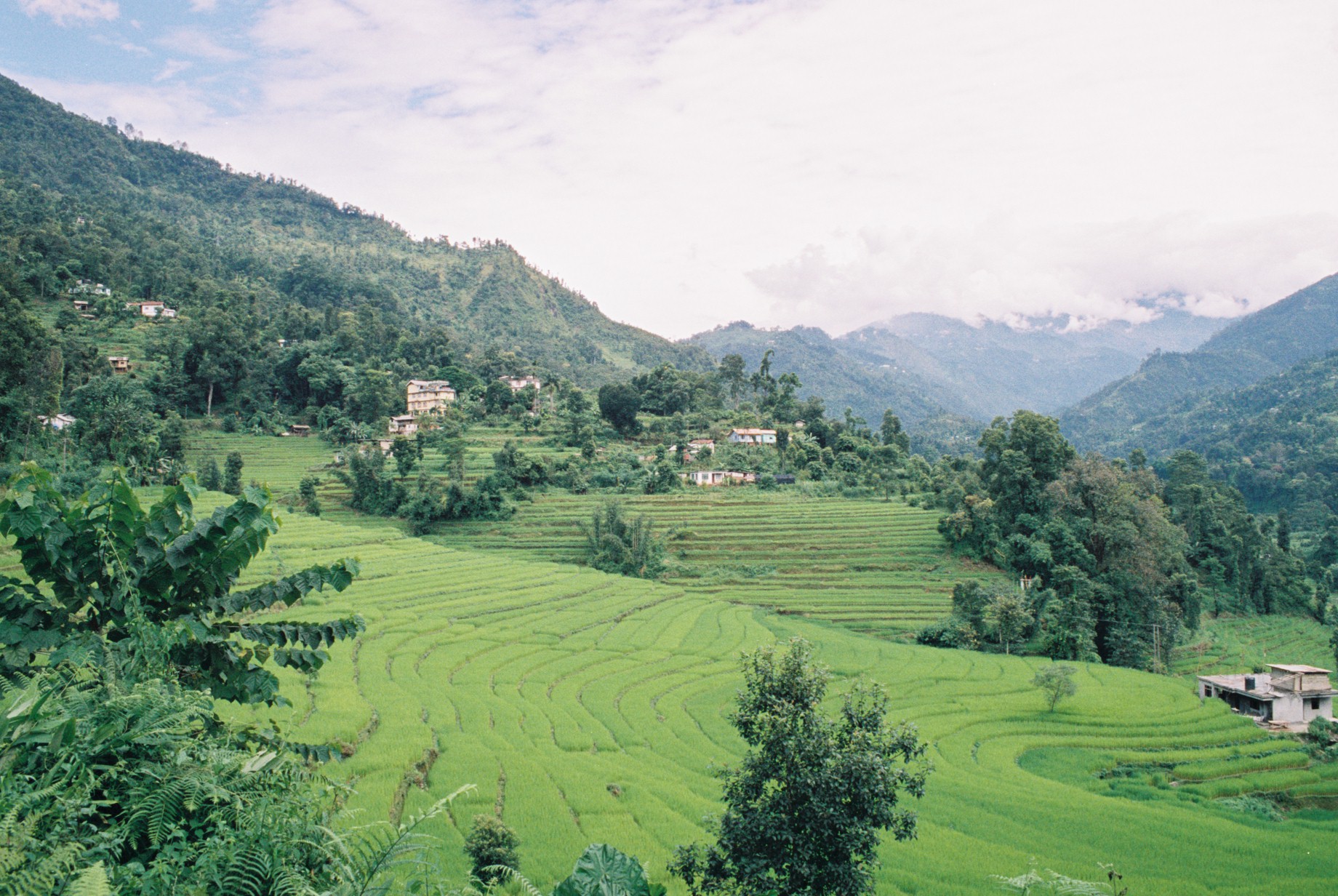
Rolep is a small farming hamlet on the Rangpo river in Rongli sub-division of Pakyong district, at about 1,200 m, with terraced fields, river sounds and a few family homestays. Wikipedia lists it among the villages around Rongli. It is a slow stop, not a sightseeing one, and it lies outside the Silk Route permit belt as far as we know; check before you go.
Best months
Oct–Apr; warm and humid in summer
Nights we suggest
1–3
From Gangtok
≈ 70 km · 3–3.5 h via Rongli (confirm with host)
Altitude
≈ 1,200 m (sources vary)
Known for
River walks, slow village stay
Permit
Not needed as far as we know; check current status before you travel
About Rolep
What to know before you go
Rolep is named among the villages around Rongli town in Wikipedia's article on Rongli, which puts it in Rongli sub-division along the Rangpo river valley. Houses and small fields sit on terraces just above the water. There is no list of sights, which is the reason people come: to walk the riverbank, watch birds, eat home food and sleep to the sound of the river.
Figures for height vary between sources; about 1,200 m is a fair guide, warm compared with Zuluk. We have not verified the exact road distance from Rongli, so ask your host for directions and drive time before you go. SNT services between Gangtok and Rongli via Rorathang are reported to include a Rolep run, but check current status before you travel.
A handful of family homestays take guests at roughly ₹1,300–2,000 per person with meals. Mobile signal is weak in the valley bottom, which most guests count as a benefit. In the monsoon, water rises fast after rain upstream, so stay out of the main channel and avoid the road after heavy rain.
Highlights
What to see and do
River walks
Short walks along the Rangpo river bank and farm lanes, best in the morning. In winter the water is low and clear. In the monsoon keep well away from the edge.
Birds along the water
Trees by the river hold common hill birds. We do not promise particular species. Early morning and dusk are best, and a local guide helps.
Terraced fields
Rice, maize and vegetables grow on terraces above the water. Ask before entering any field and for the day's work to explain.
Home cooking
Meals follow the season: terrace rice, greens, squash, pickles and sometimes fish when the family has a catch. Ask your host what is growing.
A quiet recovery night
After the high Silk Route, Rolep's warm air and low height are gentle. Many guests find it a good place to rest on the way down.
The story of Rolep
The river that runs through Rongli
Rolep lives on the Rangpo river, one of the main rivers of east Sikkim, and its story is the river's. Wikipedia's article on Rongli says the Rangpo and the Jaldhaka both originate from lakes in Rongli sub-division. The Rangpo flows past Pakyong sub-division villages and Rorathang and joins the Teesta at Rangpo town, while Rongli Khola meets it at Rongli. Wikipedia's article on Rorathang adds that the Rangpo is joined by the Pachey and Reshi at Rorathang, and that it forms part of the Sikkim and West Bengal boundary after the Reshi joins. So the water you hear at Rolep passes the markets of Rongli and Rorathang and meets the Teesta at the gateway town of Rangpo. For a village, that is a lot of geography: a small place on a river that draws the border of two states. No further legends are needed, and we do not tell any we cannot source.
Source: Wikipedia: Rongli; Wikipedia: Rorathang; Wikipedia: Rangpo River
Little known
Things most visitors never hear
Wikipedia lists Rolep among the villages around Rongli town, alongside Lingtam, Padamchen, Dalapchand, Chujachen and Zuluk.
Source: Wikipedia: Rongli
Wikipedia's Rorathang article says SNT buses connect Rolep and Rongli with Gangtok via Pakyong, Rangpo and Singtam. Check current status of services before you travel.
Source: Wikipedia: Rorathang
Wikipedia says the Rangpo river rises from lakes in Rongli sub-division and meets the Teesta at Rangpo town, so Rolep is on a river system that reaches the Sikkim border.
Shared jeeps and SNT buses run from Gangtok and Rangpo towards Rongli via Rorathang. A local run serves Rolep, but timings are few and change, so ask your host and check current status before you travel. Fares are small, usually under ₹300.
Private car
From Gangtok about 70 km and 3 to 3.5 hours via Pakyong and Rorathang, then a local road. Confirm the exact route and drive time with your host, because we have not verified it. A reserved small car costs about ₹4,000–5,500 one way.
From Bagdogra / NJP
About 115 km and 4.5 to 5 hours via Sevoke, Rangpo and Rorathang. NH10 can close after monsoon landslides; the alternative is via Kalimpong and Pedong. Pakyong Airport has no scheduled flights, so plan on Bagdogra (IXB) or NJP.
Permits in Pakyong and the Silk Route
The upper Silk Route beyond Rongli, including Lingtam, Padamchen, Zuluk, Thambi View Point, Nathang and Kupup, is a protected area open to Indian nationals only. The permit is processed at Rongli for named people, dates and a vehicle, usually through a registered agent, driver or homestay; carry original photo ID, copies and two passport photos. Foreign nationals, including OCI holders, are not allowed beyond Rongli, but Aritar, Mankhim, Rhenock, Rorathang, Rangpo and Pakyong town need only the general Sikkim entry permit. For Rolep, ask us. Check current status before you travel.
A few family homestays take guests at about ₹1,300–2,000 per person with meals; our rolep-homestays listing covers them. Rooms are simple and the setting is the draw. For more comfort, stay at Aritar or Pakyong, within a drive. For more height, move up to Lingtam or Padamchen with the Silk Route permit. Book ahead and confirm how to reach the house, since road names are rarely marked. We do not name individual families here.
Rolep is a hamlet in Rongli sub-division of Pakyong district, on the Rangpo river valley. Wikipedia lists it among villages around Rongli. We recommend confirming exact directions with your host.
What is there to do in Rolep?
Walk the river bank and farm lanes, watch birds, eat home food and rest. There are no major sights. It is a slow place.
Do we need a permit for Rolep?
As far as we know Rolep is not inside the Silk Route protected area, but rules and boundaries can change. Ask your host and check current status before you travel.
How far is Rolep from Rongli?
We have not verified the exact distance. Ask your host. Allow about an hour or more on narrow hill roads.
How much does a homestay cost?
About ₹1,300–2,000 per person a night with meals, indicative. Cash is usually needed.
Is it safe to swim in the river?
No. Currents are strong and water rises after rain upstream. Stay out of the main channel.
When is the best time to visit?
October to April for settled weather and low water. Summers are warm and humid, and the monsoon has slides and high rivers.
Is there mobile signal?
Weak in the valley bottom. Carry cash and download maps in advance.
Can foreigners visit Rolep?
Foreigners with a Sikkim Restricted Area Permit may be able to, if Rolep is outside the protected belt, but we advise confirming. Ask us and check current status before you travel.
Every cost shownRooms, car, permits and our fee, itemised
One person to callFrom Bagdogra or NJP until you are back
No payment to startA deposit only when you book
Get my price
Want Rolep in your plan?
Tell us your dates, who is travelling and roughly what you want to spend. We reply within one working day with a day-by-day route and an itemised price.
No payment to start
Permits handled through registered partners
Every hotel, car and fee listed
Price my Sikkim trip
Tell us dates, people and budget. You get a day-by-day plan and an itemised price within one working day.