Before the kings: the Lepcha and the blood oath
Long before there was a kingdom, the Lepcha, who call themselves Rong, lived in the forests and river valleys below Kanchenjunga; they are generally considered the earliest inhabitants of Sikkim. The Limbu, who call themselves Tsong, lived in the west and along today's border with Nepal. From Tibet came Bhutia settlers who brought Buddhism and a different way of farming and trading.
The story Sikkimese histories tell about how these peoples came together begins at Kabi Lungchok, about 17 km north of Gangtok on the North Sikkim highway. There, a Bhutia leader named Khye Bumsa and the Lepcha chief Thekong Tek swore an oath of blood brotherhood, marked by stones that still stand in a grove by the road. The name is usually translated as 'stone erected by our blood'. The oath is remembered as the founding friendship between Lepcha and Bhutia, and visitors can stop at the memorial on the way to Phodong and Mangan. Sources: the Wikipedia articles on Kabi Lungchok and the Kingdom of Sikkim, and the Sikkim government's own histories.
The names people gave this land tell the same layered story. The Wikipedia article on Sikkim gives the most widely accepted origin of the word 'Sikkim' as two Limbu words, su (new) and khyim (house or palace), said to refer to a palace built by an early ruler. The Bhutia name is Denzong, usually translated as 'valley of rice', and the Lepcha have their own name for the land, Nye-mae-el. The old official name of the kingdom, used until the 1800s, was Dremoshong. One small country, at least four names, each from a different community that calls it home.
1642: three lamas and a king at Yuksom
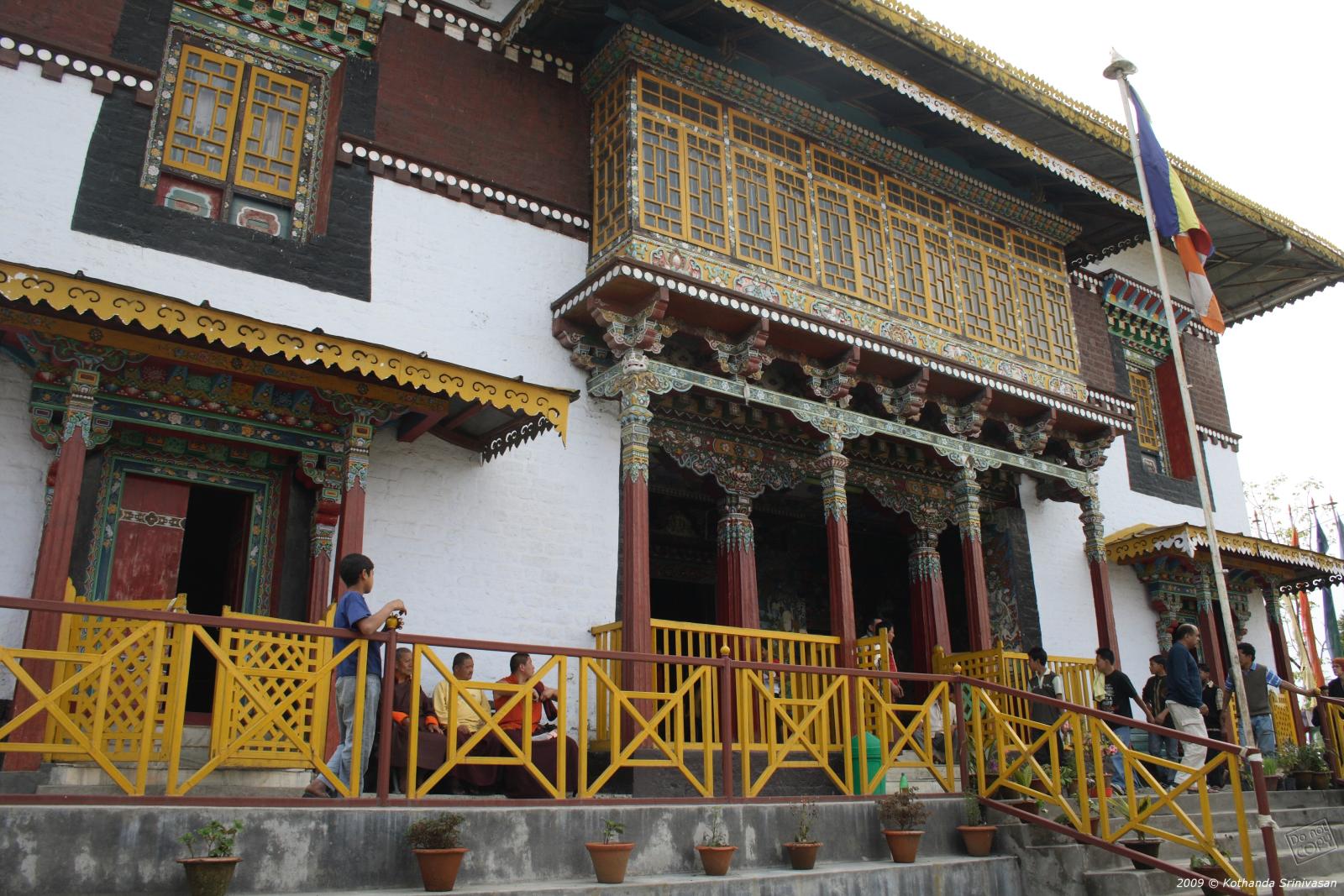
According to Sikkim's traditional histories, a descendant of Khye Bumsa, Phuntsog Namgyal, was consecrated as the first Chogyal, or 'righteous ruler', in 1642 at Yuksom in West Sikkim. Three Nyingma lamas who had come over the high passes from Tibet performed the ceremony; the best known of them is Lhatsun Namkha Jigme, remembered in Sikkim as Lhatsun Chenpo. The coronation site at Norbugang in Yuksom, with its stone throne, is one of the most important heritage sites in the state.
The new kingdom was organised around Buddhist institutions, and the Chogyals built and endowed the great Nyingma monasteries of the west, Dubdi and Pemayangtse among them. Phuntsog Namgyal's son Tensung Namgyal moved the capital to Rabdentse, near Pelling, in 1670; its ruins can still be walked through today. Source: Wikipedia, Chogyal and Kingdom of Sikkim; the 1908 History of Sikkim compiled by Thutob Namgyal and Yeshay Dolma.
| Year | Event | Where to see it today |
|---|---|---|
| 1642 | Phuntsog Namgyal consecrated first Chogyal | Norbugang, Yuksom |
| 1670 | Capital moves to Rabdentse | Rabdentse ruins, near Pelling |
| 1793 | Capital moves to Tumlong after Gorkha raids | Tumlong, North Sikkim |
| 1817 | Treaty of Titalia restores lost land | - |
| 1835 | Darjeeling granted to the East India Company | Darjeeling, West Bengal |
| 1861 | Treaty of Tumlong: British protectorate | - |
| 1894 | Thutob Namgyal moves the capital to Gangtok | Tsuklakhang, Gangtok |
| 1950 | Sikkim becomes an Indian protectorate | - |
| 1975 | Referendum; Sikkim becomes India's 22nd state on 16 May | State Day, 16 May |
Raids, treaties and the road to Gangtok
The 18th century was hard on the kingdom. Sikkim was attacked from Bhutan and then repeatedly by the Gorkha armies of Nepal, which raided Rabdentse and occupied much of the west. In 1793, under Tsugphud Namgyal, the court moved to Tumlong in the north, further from the reach of raiders. Tsugphud Namgyal ruled from 1793 to 1863, the longest reign of any Chogyal.
When Britain fought Nepal in 1814–16, Sikkim sided with the British, and the 1817 Treaty of Titalia returned land that Nepal had taken. The price of British friendship rose over time. In 1835 the Chogyal granted Darjeeling to the East India Company, and in 1861 the Treaty of Tumlong made Sikkim a British protectorate in all but name. After a British expedition in 1888 pushed Tibetan troops out of Sikkim, the British posted a Political Officer, John Claude White, in Gangtok from 1889, and in 1894 the ninth Chogyal, Thutob Namgyal, moved the capital to Gangtok. That decision is why the town on this ridge is the capital today. Source: Wikipedia, Kingdom of Sikkim and Gangtok.
We turn this into a priced, day-by-day plan for your dates.
Sir Tashi Namgyal and the last Chogyal
Tashi Namgyal, the eleventh Chogyal, ruled from 1914 to 1963, through the end of British India. In 1950 Sikkim signed a treaty with independent India that made it an Indian protectorate: India handled defence, foreign affairs and communications, and the Chogyal ruled at home. Tashi Namgyal was a painter and a patron of learning; the Namgyal Institute of Tibetology in Gangtok, whose foundation stone was laid by the 14th Dalai Lama in 1957 and which Jawaharlal Nehru inaugurated in 1958, carries his family's name.
His son Palden Thondup Namgyal became the twelfth and last Chogyal in 1963. His second wife was Hope Cooke, an American who married him in 1963 and became Gyalmo, or queen; she later wrote a memoir, Time Change (1981). Through the early 1970s political parties pressed for democratic government, and in 1973 large protests led to an agreement with India that reduced the Chogyal's powers. Source: Wikipedia, Palden Thondup Namgyal and Hope Cooke; Andrew Duff, Sikkim: Requiem for a Himalayan Kingdom (2015).
Palden Thondup Namgyal's coronation in April 1965 drew guests from around the world to Gangtok.
1975: the referendum and the 22nd state
In April 1975 the Sikkim assembly voted to abolish the monarchy, and a referendum held days later endorsed abolition and merger with India by a very large majority. Some historians and writers have described the circumstances of the referendum as questionable, and the debate continues in books such as Andrew Duff's. On 16 May 1975 Sikkim became the 22nd state of India, and the date is still marked every year as Sikkim State Day. Kazi Lhendup Dorji became the first Chief Minister. Palden Thondup Namgyal died in New York in 1982.
Sikkim kept special protections in its new status, including Article 371F of the Indian Constitution, which preserves certain old laws and seats in the assembly reserved for the Bhutia-Lepcha community. These are part of why Sikkim still feels distinct from its neighbours. Source: Wikipedia, Kingdom of Sikkim and 1975 Sikkimese monarchy referendum.
Where to meet this history in Gangtok
Gangtok is a young capital, but it holds much of the kingdom's memory if you know where to look. These places are all within a short drive of MG Marg, and most can be seen in a half day.
If you want to go deeper, plan a day with a local guide who can read the murals and inscriptions, and time it for a Chaam at Tsuklakhang. We can arrange both on our Gangtok journeys.
- Tsuklakhang, the royal chapel in the old palace compound, where coronations and royal weddings took place; open to the public mainly during Losoong and Pang Lhabsol
- The Namgyal Institute of Tibetology, for thangkas, manuscripts and old photographs of the kingdom
- The Elgin Nor-Khill, built in the 1930s as the royal guest house, now a heritage hotel
- Raj Bhawan, once the British Residency where John Claude White lived, seen from the road at Cherry Banks
- White Hall on the Ridge, named after John Claude White
- Kabi Lungchok, 17 km north, where the Lepcha-Bhutia blood oath is remembered
- Further afield: Norbugang in Yuksom and the Rabdentse ruins near Pelling, on our West Sikkim journeys
Rules, fees, fares and road status change often. Check current status before you travel.